
Course Overview
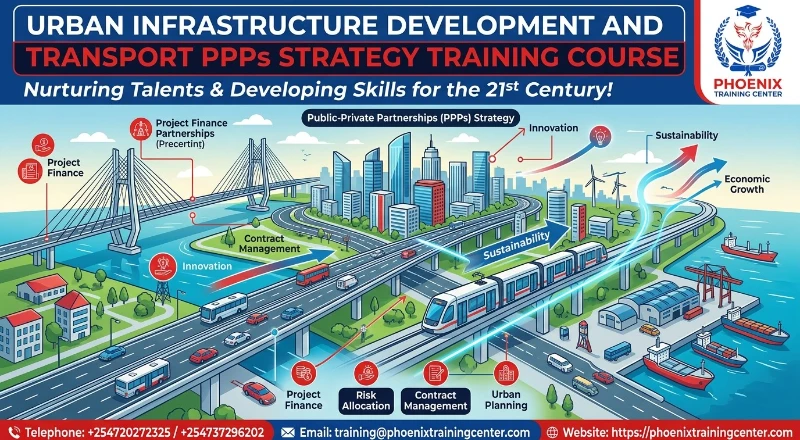
Rapid global urbanization presents complex challenges that require sustainable planning, resilient infrastructure, and innovative financing models. As premier offerings among professional urban development training courses, this specialized program equips public officials, urban planners, transport authorities, and private sector developers with actionable tools to navigate complex metropolitan growth. Participants will analyze the structural pressures created by rapid population growth, managing critical challenges such as urban density, informal expansion, infrastructure fragility, and financial constraints across modern cities. Through a multidisciplinary lens, the program bridges urban policy, spatial planning, and public-private partnerships (PPPs) to build sustainable, climate-resilient cities.
This Urban Infrastructure Development and Transport PPPs: Comprehensive Strategy Training Course covers the full life cycle of urban asset creation, public transport integration, and long-term infrastructure delivery. Key topics explore transit-oriented development (TOD), multimodal transport network integration, climate adaptation strategies, land value capture, and bankable project structuring. By combining theoretical frameworks, international best practices, and hands-on modeling, participants will learn how to design bankable transport PPPs, mitigate urban risk, and establish sustainable financing structures for resilient urban mobility systems.
Upon the successful completion of this Urban Infrastructure Development and Transport PPPs Strategy Training Course, participants will be able to:
ü Evaluate the systemic impacts of rapid urban density, informal expansion, infrastructure fragility, and social vulnerabilities on metropolitan mobility systems.
ü Design integrated urban infrastructure strategies that combine spatial planning, land use management, and transit-oriented development (TOD).
ü Structure bankable Public-Private Partnership (PPP) frameworks tailored for urban transport assets and public mobility projects.
ü Implement land value capture mechanisms and innovative municipal financing models to fund resilient urban infrastructure.
ü Formulate climate-resilient and low-carbon transport infrastructure policies to mitigate environmental risks and urban vulnerability.
Training Methodology
The course utilizes an interactive, practical adult-learning methodology designed for immediate executive application. The course is designed to be highly interactive, challenging and stimulating. It will be an instructor led training and will be delivered using a blended learning approach comprising of:
ü Expert-led interactive presentations on urban planning, transport engineering, and PPP project finance
ü Hands-on financial and risk modeling workshops focused on transport asset concessions
ü Real-world case study analysis examining global urban transit projects and metropolitan infrastructure programs
ü Group break-out sessions developing practical responses to rapid urbanization challenges
ü Practical Session simulations with structured peer reviews and trainer feedback
Our facilitators are seasoned industry professionals with years of expertise in their chosen fields. All facilitation and course materials will be offered in English.
Who Should Attend?
This Urban Infrastructure Development and Transport PPPs Strategy Training Course would be suitable for, but not limited to:
ü Urban Planners, Municipal Engineers, and City Development Directors
ü Public Sector Executives and Transport Ministry Officials
ü PPP Unit Directors, Transaction Advisors, and Infrastructure Economists
ü Transport Authority Managers and Public Transit Operators
ü Private Infrastructure Developers, Concessionaires, and Real Estate Investors
ü Financial Analysts, Project Finance Officers, and Multilateral Development Bank Specialists
Personal Benefits
ü Master cutting-edge methodologies for structuring transport PPPs and urban development strategies.
ü Enhance technical expertise in project risk allocation, financial modeling, and concession design.
ü Position yourself as a strategic leader capable of solving complex municipal infrastructure challenges.
ü Expand your professional network across international public sector leaders and private developers.
Organizational Benefits
ü Accelerate urban transport project bankability through improved risk allocation and procurement design.
ü Integrate land value capture techniques to unlock new revenue streams for municipal projects.
ü Build resilient infrastructure frameworks capable of withstanding climate shocks and urban pressures.
ü Improve cross-sector coordination between land management authorities, transport operators, and finance units.
ü Course Duration: 5 Days
ü Training Fee:
o Physical Training: USD 1,500
o Online / Virtual Training: USD 1,000
Module 1: Metropolitan Growth Dynamics and Urban Fragility
ü Structural analysis of global urban trends and rapid urbanization patterns
ü Mitigating challenges arising from urban density, informal expansion, infrastructure fragility, and spatial inequality
ü Institutional frameworks and governance structures in multi-jurisdictional metropolitan areas
ü Assessing municipal infrastructure deficits and service delivery gaps in high-density cities
ü Practical Session: Conducting an urban vulnerability and infrastructure deficit mapping exercise for a rapidly growing metro area
Module 2: Integrated Urban Land Use and Transit-Oriented Development (TOD)
ü Aligning urban spatial master plans with high-capacity transport corridors
ü Principles of Transit-Oriented Development (TOD): Density, diversity, and design around transit hubs
ü Regulatory frameworks: Zoning flexibility, floor area ratio (FAR) incentives, and air rights
ü Regenerating urban centers through integrated transport and real estate developments
ü Practical Session: Designing a TOD master plan framework incorporating mixed-use zoning and public mobility access
Module 3: Strategic Planning for Urban Transport Systems
ü Multimodal transport network planning: Bus Rapid Transit (BRT), Light Rail Transit (LRT), and Metro systems
ü Demand forecasting, traffic origin-destination modeling, and capacity optimization
ü Last-mile connectivity strategies, non-motorized transport (NMT), and active mobility integration
ü Digitalization in urban mobility: Intelligent Transportation Systems (ITS) and Mobility-as-a-Service (MaaS)
ü Practical Session: Evaluating transport modal selection criteria and building a high-capacity corridor feasibility matrix
Module 4: Foundations of Public-Private Partnerships in Transport
ü Core PPP models in urban transport: Concessions, DBFOM, Availability Contracts, and Management Agreements
ü Comparing traditional public procurement with PPP project delivery mechanisms
ü Assessing Public Sector Comparator (PSC) benchmarks and Value for Money (VfM) indicators
ü Feasibility analysis: Technical, legal, economic, and commercial viability frameworks
ü Practical Session: Building a Value for Money (VfM) model to compare traditional procurement against a transport PPP
Module 5: Project Finance and Structuring for Urban Transport PPPs
ü Project finance architecture for capital-intensive transport assets
ü Structuring the Special Purpose Vehicle (SPV): Equity, mezzanine, and senior debt capital stacks
ü Revenue mechanisms: User-pays tariffs, availability payments, shadow tolls, and viability gap funding (VGF)
ü Financial metrics for lenders: Debt Service Coverage Ratio (DSCR), Loan Life Coverage Ratio (LLCR), and Equity IRR
ü Practical Session: Building a 20-year financial cash flow waterfall model for a urban toll road or light rail concession
Module 6: Risk Allocation and Contractual Frameworks in PPPs
ü Systemic risk identification: Construction, demand/ridership, political, regulatory, and force majeure
ü Designing optimal risk allocation matrices across public authorities and private developers
ü Key legal agreements: Concession Agreements, Direct Agreements, EPC, and O&M contracts
ü Managing demand risk: Guarantees, revenue risk-sharing mechanisms, and minimum revenue guarantees (MRG)
ü Practical Session: Drafting a comprehensive risk allocation matrix for an urban Bus Rapid Transit (BRT) PPP transaction
Module 7: Land Value Capture and Municipal Infrastructure Finance
ü Mechanisms of Land Value Capture (LVC): Tax increment financing (TIF), developer exactions, and betterment levies
ü Monetizing municipal assets, air rights, and commercial concessions at transit terminals
ü Sub-national borrowing, municipal green bonds, and credit enhancement facilities
ü Blended finance strategies combining multilateral development bank funds with private capital
ü Practical Session: Structuring a Tax Increment Financing (TIF) model to fund surrounding infrastructure through value capture
Module 8: Environmental Resilience, Climate Adaptation, and Low-Carbon Mobility
ü Climate risk assessment for urban infrastructure: Flooding, extreme heat, and sea-level rise
ü Transition strategies for zero-emission public transit fleets (Electric Buses and Hydrogen Rail)
ü Decarbonizing urban mobility and qualifying for international climate finance (GCF, Carbon Credits)
ü Nature-based solutions for resilient urban drainage and transport corridor protection
ü Practical Session: Developing a climate adaptation and low-carbon transition plan for a public transit fleet
Module 9: Stakeholder Governance, Social Inclusion, and Informal Transit Integration
ü Integrating informal transport operators (minibuses, paratransit) into formal PPP transit networks
ü Universal accessibility standards, gender-responsive transport design, and social equity
ü Stakeholder engagement, public consultations, and managing community displacement
ü Social impact assessments and resettlement action plans (RAP) in urban infrastructure
ü Practical Session: Structuring an informal operator integration strategy and compensation framework for a new transit corridor
Module 10: Procurement, Financial Close, and Performance Management
ü Competitive tendering processes: Request for Qualifications (RFQ) and Request for Proposals (RFP)
ü Negotiation strategies, bid evaluation, and achieving successful financial close
ü Key Performance Indicators (KPIs), availability standards, and penalty deduction regimes in O&M
ü Contract management, handback requirements, and dispute resolution mechanisms
ü Practical Session: Simulating a PPP concession agreement negotiation and designing KPI deduction regimes for O&M performance
About Our Trainers
Our training faculty consists of senior urban planners, transport economists, and PPP transaction advisors with over 15 years of international experience across Africa, Asia, and global markets. They have led major municipal infrastructure projects, advised ministries of transport, and structured complex project finance deals for multilateral development agencies. The trainers bring real-world transactional experience, combining academic rigor with practical execution insights.
Quality Statement
Phoenix Training Center is committed to providing top-tier professional development and executive education. As part of our high-quality urban development training courses, this program is continuously updated to incorporate cutting-edge global best practices, emerging financial structures, and climate resilience frameworks. We maintain strict quality control standards across instructional design, case material selection, and workshop facilitation to ensure a high-impact learning experience.
Tailor-Made Courses
We understand that every organization has unique challenges and opportunities as well as unique training needs. Phoenix Training Center offers tailor-made courses designed to address specific requirements and challenges faced by your team or organization. Whether you need a customized curriculum, a specific duration, or on-site delivery, we can adapt our expertise to provide a training solution that perfectly aligns with your objectives. We can customize this Course to focus on your industry, specific risk profile, or internal stakeholder dynamics. Contact us to discuss how we can create a bespoke training program that maximizes value and impact for your team. For further inquiries, please contact us on Tel: +254720272325 / +254737296202 or Email training@phoenixtrainingcenter.com.
Admission Criteria
ü Participants should be reasonably proficient in English.
ü Applicants must live up to Phoenix Center for Policy, Research and Training admission criteria.
Terms and Conditions
ü Discounts: Organizations sponsoring Four Participants will have the 5th attend Free
ü What is catered for by the Course Fees: Fees cater for all requirements for the training – Learning materials, Lunches, Teas, Snacks and Certification. All participants will additionally cater for their travel and accommodation expenses, visa application, insurance, and other personal expenses.
ü Certificate Awarded: Participants are awarded Certificates of Participation at the end of the training.
ü Course Improvement: The program content shown here is for guidance purposes only. Our continuous course improvement process may lead to changes in topics and course structure.
ü Approval of Course: Our Programs are NITA Approved. Participating organizations can therefore claim reimbursement on fees paid in accordance with NITA Rules.
Booking for Training
Kindly send an email to the Training Officer on training@phoenixtrainingcenter.com and we will send you a registration form. We advise you to book early to avoid missing a seat to this training. Or call us on +254720272325 / +254737296202
Payment Options
We provide 3 payment options, choose one for your convenience, and kindly make payments a week before the training starts (at least 5 to 7 days before the Training start date) to reserve your seat:
ü Groups of 5 People and Above – Cheque Payments to: Phoenix Center for Policy, Research and Training Limited should be paid in advance, a week before the training starts.
ü Invoice: We can send a bill directly to you or your company.
ü Deposit directly into Bank Account (Account details provided upon request)
Cancellation Policy
ü Payment for all courses includes a registration fee, which is non-refundable, and equals 15% of the total sum of the course fee.
ü Participants may cancel attendance 14 days or more prior to the training commencement date.
ü No refunds will be made 14 days or less before the training commencement date. However, participants who are unable to attend may opt to attend a similar training course at a later date or send a substitute participant provided the participation criteria have been met.
Accommodation and Airport Pick-up
For physical training attendees, we can assist with recommendations for accommodation near the training venue. Airport pick-up services can also be arranged upon request to ensure a smooth arrival. Please inform us of your travel details in advance if you require these services. For reservations contact the Training Officer on Email: training@phoenixtrainingcenter.com or on Tel: +254720272325 / +254737296202.
| Course Dates | Venue | Fees | Enroll |
|---|

Phoenix Training Center
Typically replies in minutes