
Course Overview
The Universal Design for Learning (UDL) and Educational Accessibility Training Course is a transformative 5-day professional program tailored for educators, instructional designers, curriculum developers, and academic administrators. This course addresses systemic learning barriers by embedding flexible, accessible, and inclusive instructional strategies into physical and digital learning environments. Participants will learn how to leverage the UDL framework to optimize learning experiences for diverse student populations, including neurodivergent learners and individuals with disabilities.
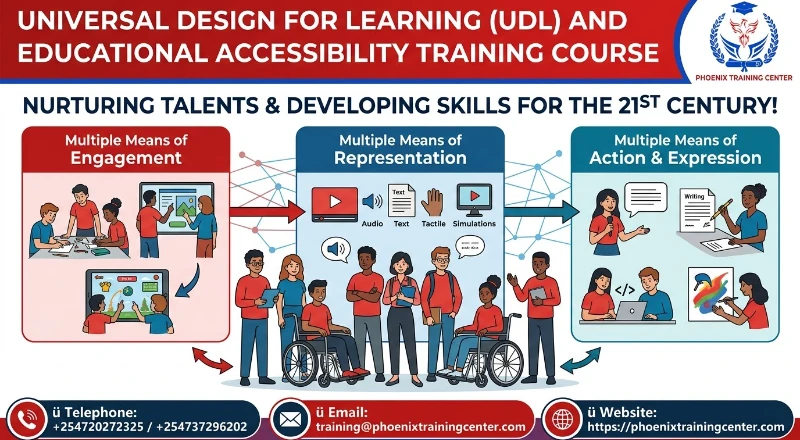
Throughout the program, participants will explore the core pillars of Universal Design for Learning: multiple means of engagement, representation, and action/expression. Key topics include digital accessibility standards (WCAG), assistive technology integration, neuroinclusive pedagogy, accessible assessment design, and inclusive policy formulation. Through interactive lesson redesign workshops, digital content audits, and collaborative instructional lab sessions, attendees will build practical expertise to dismantle learning barriers and foster educational equity across K-12, higher education, and corporate learning sectors.
Upon the successful completion of this Universal Design for Learning (UDL) and Educational Accessibility Training Course, participants will be able to:
ü Apply the UDL Guidelines to design flexible lesson plans, curricula, and learning materials that accommodate diverse learner profiles.
ü Evaluate digital and physical learning environments for compliance with Web Content Accessibility Guidelines (WCAG 2.1/2.2) and international accessibility standards.
ü Integrate assistive technologies, accessible educational resources (AER), and alternative format materials into daily instructional delivery.
ü Construct multi-modal, authentic assessment strategies that minimize construct-irrelevant barriers while accurately measuring learner mastery.
ü Formulate institutional accessibility strategies, policy roadmaps, and peer-coaching frameworks to institutionalize UDL practices.
Training Methodology
The training utilizes an immersive, active-learning approach aligned with UDL principles to demonstrate inclusive pedagogy in practice. The course is designed to be highly interactive, challenging and stimulating. It will be an instructor led training and will be delivered using a blended learning approach comprising of:
ü Interactive presentations framing neuroscientific foundations of learning and educational accessibility standards
ü Practical technology labs focusing on digital document remediation, captioning, and assistive tool testing
ü Collaborative design workshops centered on lesson plan retrofitting and curriculum audit charrettes
ü Case study analysis of institutional UDL implementation, policy frameworks, and accessibility audits
ü Peer modeling, group feedback sessions, and capstone instructional portfolio reviews
Our facilitators are seasoned industry professionals with years of expertise in their chosen fields. All facilitation and course materials will be offered in English.
Who Should Attend?
This Universal Design for Learning (UDL) and Educational Accessibility Training Course would be suitable for, but not limited to:
ü K-12 and Higher Education Faculty Members
ü Instructional Designers and E-Learning Specialists
ü Curriculum Developers and Educational Content Creators
ü School Administrators and Academic Department Heads
ü Special Education Coordinators and Student Support Officers
ü Corporate Trainers and Human Resource Learning Managers
Benefits of the Course
Personal Benefits
ü Master practical strategies for designing barrier-free, engaging curricula across physical and virtual platforms.
ü Enhance professional competency in digital document remediation, alt-text creation, and assistive technology integration.
ü Expand career advancement opportunities as an educational accessibility coordinator or UDL instructional designer.
ü Develop a proactive mindset to address neurodiversity and varied learning styles effectively.
Organizational Benefits
ü Ensure institutional compliance with global educational accessibility laws, disability acts, and digital guidelines.
ü Improve learner retention, engagement, and academic performance across diverse student demographics.
ü Reduce the need for ad-hoc accommodations by building universally accessible learning materials from inception.
ü Foster an inclusive organizational culture that prioritizes educational equity and neuroinclusive learning environments.
ü Course Duration: 5 Days
ü Training Fee:
o Physical Training: USD 1,500
o Online / Virtual Training: USD 1,000
Module 1: Foundations of Universal Design for Learning (UDL) and Educational Accessibility
ü Evolution of educational inclusion: Special education vs. integration vs. Universal Design for Learning
ü The CAST UDL Framework: Architecture, guidelines, and checkpoint navigation
ü The medical model vs. social model of disability in educational institutions
ü Legal frameworks and civil rights standards governing educational accessibility
ü Practical Session: Auditing an Existing Course Syllabus using UDL Core Principles
Module 2: Neuroscience of Learning: Engagement, Representation, and Action / Expression
ü The three brain networks in learning: Affective, Recognition, and Strategic networks
ü Neurodiversity in the classroom: Supporting executive functioning, ADHD, and autism
ü Identifying and eliminating construct-irrelevant barriers in instructional design
ü The relationship between UDL, Differentiated Instruction, and Culturally Responsive Teaching
ü Practical Session: Mapping Brain Network Functions to Specific Classroom Instructional Barriers
Module 3: Designing Multiple Means of Engagement for Diverse Learners
ü Strategies for recruiting interest and optimizing individual choice and autonomy
ü Sustaining effort and persistence through collaborative learning and mastery-oriented feedback
ü Fostering self-regulation: Developing self-assessment, coping strategies, and motivation
ü Cultivating inclusive classroom cultures and psychologically safe learning spaces
ü Practical Session: Redesigning a Learning Activity to Provide Variable Paths of Engagement
Module 4: Designing Multiple Means of Representation and Accessible Content
ü Presenting information in visual, auditory, and tactile modalities
ü Clarifying vocabulary, symbols, mathematical notation, and syntax across disciplines
ü Promoting cross-linguistic understanding and supporting English Language Learners (ELL)
ü Enhancing comprehension: Activating background knowledge and highlighting big ideas
ü Practical Session: Transforming a Static Text-Based Lesson into a Multi-Modal Learning Module
Module 5: Designing Multiple Means of Action and Expression in Learning
ü Varying the methods for response and navigation in physical and digital tasks
ü Optimizing access to tools, assistive technologies, and expressive media
ü Building fluency through graduated levels of support and scaffolding
ü Supporting executive functions: Goal-setting, planning, strategy development, and memory management
ü Practical Session: Creating Choice Boards for Student Projects with Varied Demonstration Modes
Module 6: Digital Accessibility Standards, WCAG, and E-Learning Environments
ü Overview of Web Content Accessibility Guidelines (WCAG 2.1/2.2 Level AA standards)
ü Creating accessible digital documents: Headings, alt-text, contrast ratios, and table structure
ü Accessible Learning Management Systems (LMS) setup: Canvas, Moodle, and Blackboard configurations
ü Closed captioning, audio descriptions, and transcript creation for media content
ü Practical Session: Performing a Complete Accessibility Remediation on a PDF and Slide Deck
Module 7: Assistive Technologies and Accessible Educational Resources (AER)
ü Exploring hardware and software assistive technologies: Screen readers, speech-to-text, and switches
ü Open Educational Resources (OER) and open-format accessible instructional materials
ü Built-in accessibility features in operating systems, browsers, and productivity suites
ü Selection and pedagogical integration of assistive tools into general education classrooms
ü Practical Session: Testing Instructional Materials using Screen Readers and Keyboard-Only Navigation
Module 8: Inclusive Assessment Strategies and Barrier-Free Evaluation
ü Differentiating between learning construct measurement and accessibility barriers
ü Designing flexible rubrics aligned with learning standards without prescribing the medium
ü Formative vs. summative assessment flexibility: Self-assessments and peer evaluations
ü Providing accessible testing conditions and timing accommodations by design
ü Practical Session: Redesigning a Traditional Written Exam into an Accessible Multi-Option Assessment
Module 9: Institutional Policy, UDL Advocacy, and Systemic Change Management
ü Formulating institutional UDL implementation plans and accessibility roadmaps
ü Faculty professional development strategies: Peer coaching, UDL mentorship, and PLCs
ü Procurement policies for acquiring accessible edtech software and digital learning tools
ü Measuring institutional impact: Student retention, satisfaction, and accessibility metrics
ü Practical Session: Drafting an Institutional UDL Action Plan and Stakeholder Engagement Strategy
Module 10: Capstone Instructional Design Studio and UDL Implementation Plan
ü Synthesis of UDL principles across a full unit of study or training module
ü Peer review and expert evaluation of redesigned instructional packages
ü Developing an individual continuous improvement plan for UDL implementation
ü Final defense of capstone accessible curriculum projects
ü Practical Session: Presenting a Fully Accessible and UDL-Compliant Course Package
About Our Trainers
Our trainers are accomplished instructional designers, educational psychologists, and accessibility specialists with extensive experience leading UDL implementations across school systems, universities, and corporate training divisions. Holding advanced doctoral and master's degrees in Education, Instructional Design, and Special Education, they have consulted for international educational bodies, published peer-reviewed research on neurodiversity, and managed large-scale digital accessibility migrations. They bring deep pedagogical insight, practical technical expertise in assistive technology, and proven strategies for institutionalizing educational accessibility.
Quality Statement
Phoenix Training Center is committed to delivering highest-caliber professional development in education, policy, and public administration. Our Universal Design for Learning (UDL) and Educational Accessibility curriculum undergoes continuous evaluation to reflect the latest neuroscientific research, digital accessibility standards (WCAG), and inclusive pedagogical methodologies. We ensure impactful learning experiences by maintaining small cohort sizes, integrating practical hands-on technology remediation labs, and providing expert-guided feedback on every participant project.
Tailor-Made Courses
We understand that every organization has unique challenges and opportunities as well as unique training needs. Phoenix Training Center offers tailor-made courses designed to address specific requirements and challenges faced by your team or organization. Whether you need a customized curriculum, a specific duration, or on-site delivery, we can adapt our expertise to provide a training solution that perfectly aligns with your objectives. We can customize this Course to focus on your industry, specific risk profile, or internal stakeholder dynamics. Contact us to discuss how we can create a bespoke training program that maximizes value and impact for your team. For further inquiries, please contact us on Tel: +254720272325 / +254737296202 or Email: training@phoenixtrainingcenter.com.
Admission Criteria
ü Participants should be reasonably proficient in English.
ü Applicants must live up to Phoenix Center for Policy, Research and Training admission criteria.
Terms and Conditions
ü Discounts: Organizations sponsoring Four Participants will have the 5th attend Free
ü What is catered for by the Course Fees: Fees cater for all requirements for the training – Learning materials, Lunches, Teas, Snacks and Certification. All participants will additionally cater for their travel and accommodation expenses, visa application, insurance, and other personal expenses.
ü Certificate Awarded: Participants are awarded Certificates of Participation at the end of the training.
ü Course Improvement: The program content shown here is for guidance purposes only. Our continuous course improvement process may lead to changes in topics and course structure.
ü Approval of Course: Our Programs are NITA Approved. Participating organizations can therefore claim reimbursement on fees paid in accordance with NITA Rules.
Booking for Training
Kindly send an email to the Training Officer on training@phoenixtrainingcenter.com and we will send you a registration form. We advise you to book early to avoid missing a seat to this training. Or call us on +254720272325 / +254737296202
Payment Options
We provide 3 payment options, choose one for your convenience, and kindly make payments a week before the training starts (at least 5 to 7 days before the Training start date) to reserve your seat:
ü Groups of 5 People and Above – Cheque Payments to: Phoenix Center for Policy, Research and Training Limited should be paid in advance, a week before the training starts.
ü Invoice: We can send a bill directly to you or your company.
ü Deposit directly into Bank Account (Account details provided upon request)
Cancellation Policy
ü Payment for all courses includes a registration fee, which is non-refundable, and equals 15% of the total sum of the course fee.
ü Participants may cancel attendance 14 days or more prior to the training commencement date.
ü No refunds will be made 14 days or less before the training commencement date. However, participants who are unable to attend may opt to attend a similar training course at a later date or send a substitute participant provided the participation criteria have been met.
Accommodation and Airport Pick-up
For physical training attendees, we can assist with recommendations for accommodation near the training venue. Airport pick-up services can also be arranged upon request to ensure a smooth arrival. Please inform us of your travel details in advance if you require these services. For reservations contact the Training Officer on Email: training@phoenixtrainingcenter.com or on Tel: +254720272325 / +254737296202.
| Course Dates | Venue | Fees | Enroll |
|---|

Phoenix Training Center
Typically replies in minutes