
Course Overview
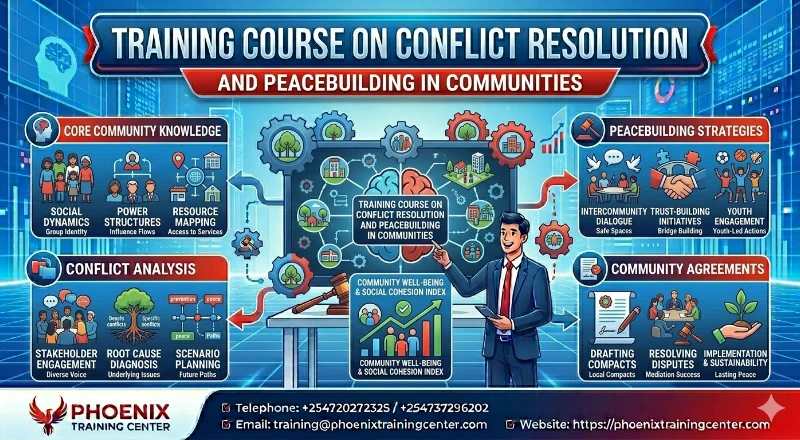
This training course is designed to equip participants with the essential skills and knowledge needed to effectively manage and resolve conflicts while fostering sustainable peace within communities. The course explores the root causes of conflict, mediation techniques, dialogue facilitation, and strategies for long-term peacebuilding. Participants will engage in interactive sessions, case studies, and practical exercises to develop hands-on experience in conflict resolution.
The course covers key topics such as conflict analysis, negotiation strategies, restorative justice, trauma healing, and the role of leadership in peacebuilding. It also addresses the importance of inclusivity, gender sensitivity, and cultural awareness in resolving disputes and promoting social cohesion.
Course Objectives
Upon the successful completion of this Training Course on Conflict Resolution and Peacebuilding in Communities, participants will be able to:
ü Understand the dynamics and root causes of conflicts in communities
ü Develop skills in mediation, negotiation, and dialogue facilitation
ü Learn trauma-informed approaches to conflict resolution
ü Explore restorative justice and reconciliation processes
ü Strengthen their leadership capabilities in peacebuilding initiatives
ü Design sustainable conflict prevention and peacebuilding strategies
Training Methodology
The course is designed to be highly interactive, challenging and stimulating. It will be an instructor led training and will be delivered using a blended learning approach comprising of presentations, discussions, guided sessions of practical exercise, case study review, web-based tutorials, group work, exploration of relevant issues collaborative strength training, performance measurement, and workshops of participants’ displays, all of which adhere to the highest standards of training. The training technique is built on learning by doing, with lecturers using a learner-centered approach to engage participants and provide tasks that allow them to apply what they’ve learned. Experiential knowledge is also given equal importance within the format of training. Our facilitators are seasoned industry professionals with years of expertise in their chosen fields. All facilitation and course materials will be offered in English.
Who Should Attend?
This Training Course on Conflict Resolution and Peacebuilding in Communities would be suitable for, but not limited to:
ü Community Leaders and Elders
ü NGO and Civil Society Workers
ü Government Officials and Policymakers
ü Peacebuilding Practitioners and Mediators
ü Religious and Youth Leaders
ü Security Personnel Involved in Community Engagement
ü Humanitarian and Development Professionals
Personal Benefits
ü Enhanced conflict resolution and communication skills
ü Increased confidence in mediating disputes
ü Greater cultural and gender sensitivity in peacebuilding
ü Improved ability to foster dialogue and collaboration
ü Professional growth in humanitarian and community development work
Organizational Benefits
ü Improved capacity to manage and mitigate community conflicts
ü Strengthened relationships with stakeholders through effective mediation
ü Enhanced reputation as a peacebuilding and conflict-sensitive organization
ü Increased efficiency in implementing development projects in volatile areas
ü Sustainable community engagement strategies
ü Course Duration: 5 Days
ü Training Fee
o Physical Training: USD 1,200
o Online / Virtual Training: USD 800
Module 1: Understanding Conflict Dynamics
ü Definitions and types of conflict
ü Causes and escalation of conflicts
ü The conflict cycle and its phases
ü Impact of conflict on communities
ü Practical Session: Conflict mapping exercise
Module 2: Conflict Analysis and Assessment Tools
ü Frameworks for conflict analysis
ü Stakeholder mapping and power dynamics
ü Early warning signs of conflict
ü Tools for assessing conflict drivers
ü Practical Session: Applying conflict analysis tools to a case study
Module 3: Negotiation Techniques for Peacebuilders
ü Principles of effective negotiation
ü Win-win vs. zero-sum approaches
ü Communication skills for negotiators
ü Dealing with difficult negotiators
ü Practical Session: Simulated negotiation scenarios
Module 4: Mediation and Dialogue Facilitation
ü Role of a mediator in conflict resolution
ü Steps in the mediation process
ü Facilitating inclusive dialogues
ü Managing emotions and tensions in mediation
ü Practical Session: Mediation role-play
Module 5: Restorative Justice and Reconciliation
ü Principles of restorative justice
ü Traditional and modern reconciliation approaches
ü Healing divided communities
ü Building trust and social cohesion
ü Practical Session: Designing a reconciliation workshop
Module 6: Trauma Healing and Psychosocial Support
ü Understanding trauma in conflict-affected communities
ü Psychological first aid
ü Community-based healing approaches
ü Self-care for peacebuilders
ü Practical Session: Trauma awareness exercises
Module 7: Gender and Inclusivity in Peacebuilding
ü Gender-sensitive conflict resolution
ü Engaging women and marginalized groups
ü Addressing sexual and gender-based violence
ü Promoting youth participation in peace processes
ü Practical Session: Gender-responsive peacebuilding planning
Module 8: Leadership and Community Mobilization for Peace
ü Transformational leadership in peacebuilding
ü Mobilizing communities for conflict prevention
ü Building coalitions and networks
ü Advocacy for policy change
ü Practical Session: Developing a community peace action plan
Module 9: Designing Peacebuilding Programs
ü Needs assessment for peace initiatives
ü Logical framework approach for peace projects
ü Resource mobilization and partnerships
ü Conflict-sensitive programming
ü Practical Session: Drafting a peacebuilding project proposal
Module 10: Monitoring and Evaluating Peace Initiatives
ü Indicators for measuring peacebuilding success
ü Participatory evaluation methods
ü Learning and adapting peace programs
ü Reporting and accountability
ü Practical Session: Developing an M&E framework
About the Trainers
Our trainers are seasoned experts in conflict resolution, peacebuilding, and community development with over 15 years of field experience across Africa, Asia, and the Middle East. They have worked with the UN, NGOs, and government agencies, facilitating high-impact training programs and mediation processes.
Quality Statement
We are committed to delivering practical, interactive, and participant-centered training that ensures real-world applicability. Our courses are regularly updated to reflect the latest best practices in peacebuilding.
Tailor-Made Courses
We offer customized training programs to meet the specific needs of organizations, including in-house workshops and sector-specific peacebuilding solutions. For further inquiries, please contact us on Tel: +254720272325 / +254737296202 or Email training@phoenixtrainingcenter.com
ü Participants should be reasonably proficient in English.
ü Applicants must live up to Phoenix Center for Policy, Research and Training admission criteria.
Terms and Conditions
ü Discounts: Organizations sponsoring Four Participants will have the 5th attend Free
ü What is catered for by the Course Fees: Fees cater for all requirements for the training – Learning materials, Lunches, Teas, Snacks and Certification. All participants will additionally cater for their travel and accommodation expenses, visa application, insurance, and other personal expenses.
ü Certificate Awarded: Participants are awarded Certificates of Participation at the end of the training.
ü The program content shown here is for guidance purposes only. Our continuous course improvement process may lead to changes in topics and course structure.
ü Approval of Course: Our Programs are NITA Approved. Participating organizations can therefore claim reimbursement on fees paid in accordance with NITA Rules.
Booking for Training
Simply send an email to the Training Officer on training@phoenixtrainingcenter.com and we will send you a registration form. We advise you to book early to avoid missing a seat to this training. Or call us on +254720272325 / +254737296202
Payment Options
We provide 3 payment options, choose one for your convenience, and kindly make payments at least 5 days before the Training start date to reserve your seat:
ü Groups of 5 People and Above – Cheque Payments to: Phoenix Center for Policy, Research and Training Limited should be paid in advance, 5 days to the training.
ü Invoice: We can send a bill directly to you or your company.
ü Deposit directly into Bank Account (Account details provided upon request)
Cancellation Policy
ü Payment for all courses includes a registration fee, which is non-refundable, and equals 15% of the total sum of the course fee.
ü Participants may cancel attendance 14 days or more prior to the training commencement date.
ü No refunds will be made 14 days or less before the training commencement date. However, participants who are unable to attend may opt to attend a similar training course at a later date or send a substitute participant provided the participation criteria have been met.
Accommodation and Airport Transfer
For physical training attendees, we can assist with recommendations for accommodation near the training venue. Airport pick-up services can also be arranged upon request to ensure a smooth arrival. Please inform us of your travel details in advance if you require these services. For reservations contact the Training Officer on Email: training@phoenixtrainingcenter.com or on Tel: +254720272325 / +254737296202
| Course Dates | Venue | Fees | Enroll |
|---|

Phoenix Training Center
Typically replies in minutes