
Course Overview
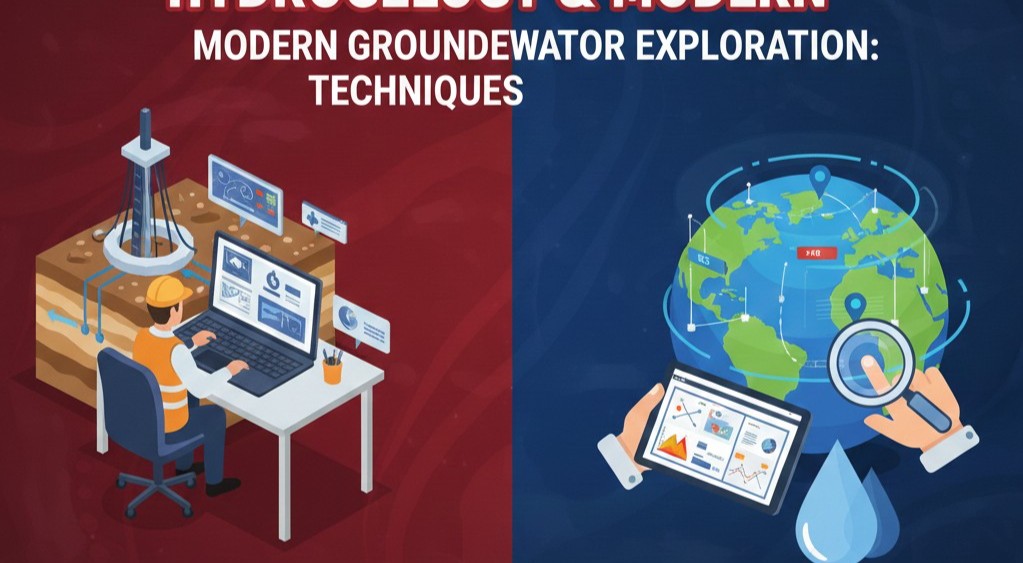
The global demand for sustainable water sources has made technical expertise in subsurface water detection more critical than ever. This course provides an intensive professional deep-dive into the scientific and technical aspects of Groundwater exploration. Participants will transition from fundamental hydrogeological concepts to high-level technical mastery, learning how to integrate geological mapping, geophysical surveys, and remote sensing data to locate and quantify viable aquifers in diverse terrains.
The training program is structured to provide a logical progression from site reconnaissance to final borehole completion. Key topics include the physics of groundwater flow, electrical resistivity tomography, seismic refraction, and the interpretation of borehole logs. Participants will also explore modern GIS applications for mapping groundwater potential zones and learn the essential parameters for sustainable aquifer management to prevent depletion and contamination.
Upon the successful completion of this Training Course on Advanced Hydrogeology & Modern Groundwater Exploration Techniques, participants will be able to:
ü Evaluate the hydrogeological potential of a region using geological and structural data.
ü Select and deploy appropriate geophysical methods for Groundwater exploration.
ü Interpret complex geophysical data to distinguish between fresh, saline, and dry formations.
ü Utilize GIS and Remote Sensing tools to create groundwater vulnerability and potential maps.
ü Oversee drilling operations and design efficient, long-lasting water wells.
Training Methodology
The course is designed to be highly interactive, challenging and stimulating. It will be an instructor led training and will be delivered using a blended learning approach comprising of:
ü Instructor-led interactive lectures and multimedia presentations
ü Case studies of exploration projects in varying geological settings
ü Hands-on software demonstrations (GIS and Hydrogeology modelling tools)
ü Field-based practical equipment demonstrations
ü Group exercises and technical report writing workshops
Our facilitators are seasoned industry professionals with years of expertise in their chosen fields. All facilitation and course materials will be offered in English.
Who Should Attend?
This Training Course on Advanced Hydrogeology & Modern Groundwater Exploration Techniques would be suitable for, but not limited to:
ü Hydrogeologists and Geologists
ü Water Resource Engineers and Hydrologists
ü Environmental Consultants and Researchers
ü Project Managers in WASH (Water, Sanitation, and Hygiene) programs
ü Drilling Contractors and Technical Supervisors
ü Government Officials in Water and Irrigation Ministries
Personal Benefits
ü Master high-demand technical skills in geophysical data interpretation.
ü Gain professional certification from a NITA-approved training provider.
ü Expand your professional network within the water and extractives industry.
ü Increase your marketability as a specialist in sustainable water resource development.
Organizational Benefits
ü Reduce project costs by increasing the success rate of drilling operations.
ü Enhance technical capacity for in-house groundwater assessment and monitoring.
ü Ensure organizational compliance with international environmental and water safety standards.
ü Improve long-term sustainability of water supply projects through accurate aquifer characterization.
ü Course Duration: 5 Days
ü Training Fee
o Physical Training: USD 1,500
o Online / Virtual Training: USD 1,200
Module 1: Principles of Hydrogeology and Aquifer Systems
ü The hydrologic cycle and groundwater's role
ü Classification of aquifers: Confined, unconfined, and perched
ü Rock properties: Porosity, permeability, and transmissivity
ü Groundwater flow dynamics and Darcy’s Law
ü Practical Session: Lab simulation of fluid flow through different porous media.
Module 2: Geological and Structural Mapping for Water
ü Identifying water-bearing rock formations (Lithology)
ü Role of faults, fractures, and lineaments in groundwater movement
ü Stratigraphic correlation and cross-section development
ü Geomorphological indicators of subsurface water
ü Practical Session: Interpreting geological maps to identify potential water-bearing structures.
Module 3: Remote Sensing and GIS in Groundwater Prospecting
ü Introduction to multispectral satellite imagery
ü Using Digital Elevation Models (DEM) for drainage analysis
ü Thematic mapping: Soil, land use, and slope analysis
ü Multi-criteria decision making (MCDM) for potential zones
ü Practical Session: Hands-on exercise using QGIS to overlay layers for a "Groundwater Potential Map."
Module 4: Geophysical Exploration: Electrical Resistivity Methods
ü Fundamentals of electrical resistivity in rocks
ü Vertical Electrical Sounding (VES) and array configurations (Schlumberger vs. Wenner)
ü 2D and 3D Electrical Resistivity Tomography (ERT)
ü Data acquisition and noise reduction strategies
ü Practical Session: Setting up resistivity equipment and conducting a field VES test.
Module 5: Advanced Geophysics: Electromagnetic and Seismic Techniques
ü Principles of Time-Domain Electromagnetics (TDEM)
ü Seismic refraction for bedrock depth determination
ü Magnetometer surveys for intrusive dyke detection
ü Integration of multiple geophysical data sets
ü Practical Session: Interpreting seismic refraction travel-time curves.
Module 6: Borehole Site Selection and Design
ü Synthesizing geological and geophysical findings
ü Optimal site selection based on yield requirements and logistics
ü Well design parameters: Casing, screen slot size, and gravel pack
ü Protection of boreholes from surface contamination
ü Practical Session: Designing a technical well completion plan for a 200m borehole.
Module 7: Drilling Supervision and Lithological Logging
ü Overview of drilling methods: Rotary, Percussion, and DTH
ü Role of the supervisor: Monitoring penetration rates and mud loss
ü Collecting and describing drill cuttings (Lithological logs)
ü Well development techniques: Jetting, surging, and air-lifting
ü Practical Session: Identifying rock samples from drill cuttings and creating a litho-log.
Module 8: Aquifer Hydraulics and Pumping Test Analysis
ü Objectives of pumping tests: Drawdown and recovery
ü Step-drawdown tests vs. constant rate tests
ü Determining Transmissivity (T) and Storage coefficient (S)
ü Theis and Cooper-Jacob methods of analysis
ü Practical Session: Analyzing a sample pumping test data set to calculate aquifer yield.
Module 9: Groundwater Quality and Hydrochemistry
ü Physical, chemical, and biological water quality parameters
ü Interpreting Piper and Stiff diagrams for hydrochemical facies
ü Groundwater contamination: Saline intrusion and anthropogenic pollution
ü Water sampling protocols and field-testing kits
ü Practical Session: Using a portable multi-parameter meter to test water pH, EC, and TDS.
Module 10: Sustainable Management and Project Reporting
ü Safe yield vs. sustainable yield concepts
ü Artificial groundwater recharge techniques
ü Technical report writing for stakeholders and regulators
ü Professional ethics in Groundwater exploration
ü Practical Session: Drafting a professional hydrogeological survey report summary.
About Our Trainers
Our training team consists of PhD and MSc holders in Hydrogeology and Applied Geophysics with over 15 years of field experience. They have successfully led major Groundwater exploration projects across East Africa, the Sahel, and the Middle East for various international NGOs and government bodies.
Quality Statement
Phoenix Training Center is committed to providing industry-leading technical education. Our curriculum is developed in alignment with international hydrogeological standards and is updated annually to include emerging technologies and best practices in the field.
Tailor-Made Courses
We understand that every organization has unique challenges and opportunities as well as unique training needs. Phoenix Training Center offers tailor-made courses designed to address specific requirements and challenges faced by your team or organization. Whether you need a customized curriculum, a specific duration, or on-site delivery, we can adapt our expertise to provide a training solution that perfectly aligns with your objectives. We can customize this Course to focus on your industry, specific risk profile, or internal stakeholder dynamics. Contact us to discuss how we can create a bespoke training program that maximizes value and impact for your team. For further inquiries, please contact us on Tel: +254720272325 / +254737296202 or Email training@phoenixtrainingcenter.com
ü Participants should be reasonably proficient in English.
ü Applicants must live up to Phoenix Center for Policy, Research and Training admission criteria.
Terms and Conditions
ü Discounts: Organizations sponsoring Four Participants will have the 5th attend Free
ü What is catered for by the Course Fees: Fees cater for all requirements for the training – Learning materials, Lunches, Teas, Snacks and Certification. All participants will additionally cater for their travel and accommodation expenses, visa application, insurance, and other personal expenses.
ü Certificate Awarded: Participants are awarded Certificates of Participation at the end of the training.
ü The program content shown here is for guidance purposes only. Our continuous course improvement process may lead to changes in topics and course structure.
ü Approval of Course: Our Programs are NITA Approved. Participating organizations can therefore claim reimbursement on fees paid in accordance with NITA Rules.
Booking for Training
Simply send an email to the Training Officer on training@phoenixtrainingcenter.com and we will send you a registration form. We advise you to book early to avoid missing a seat to this training.
Or call us on +254720272325 / +254737296202
Payment Options
We provide 3 payment options, choose one for your convenience, and kindly make payments at least 5 days before the Training start date to reserve your seat:
ü Groups of 5 People and Above – Cheque Payments to: Phoenix Center for Policy, Research and Training Limited should be paid in advance, 5 days to the training.
ü Invoice: We can send a bill directly to you or your company.
ü Deposit directly into Bank Account (Account details provided upon request)
Cancellation Policy
ü Payment for all courses includes a registration fee, which is non-refundable, and equals 15% of the total sum of the course fee.
ü Participants may cancel attendance 14 days or more prior to the training commencement date.
ü No refunds will be made 14 days or less before the training commencement date. However, participants who are unable to attend may opt to attend a similar training course at a later date or send a substitute participant provided the participation criteria have been met.
Accommodation and Airport Transfer
For physical training attendees, we can assist with recommendations for accommodation near the training venue. Airport pick-up services can also be arranged upon request to ensure a smooth arrival. Please inform us of your travel details in advance if you require these services. For reservations contact the Training Officer on Email: training@phoenixtrainingcenter.com or on Tel: +254720272325 / +254737296202
| Course Dates | Venue | Fees | Enroll |
|---|

Phoenix Training Center
Typically replies in minutes