
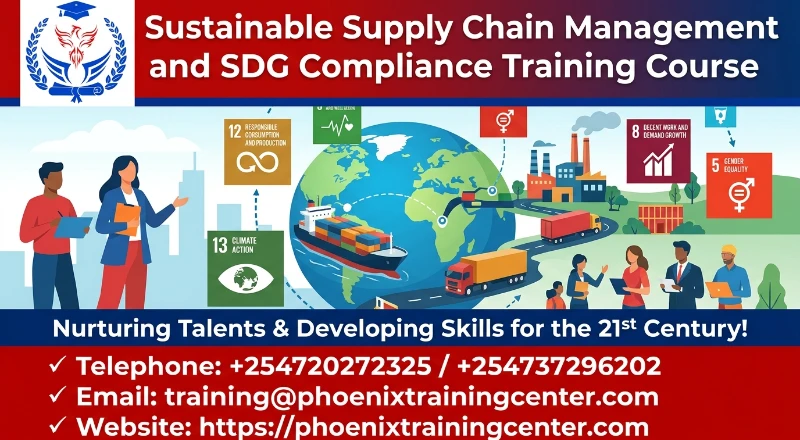
Course Overview
This practical training course provides supply chain directors, procurement managers, and sustainability professionals with actionable frameworks for embedding Environmental, Social, and Governance (ESG) criteria into global value chains. Participants will learn how to align supply chain strategies with the United Nations Sustainable Development Goals (SDGs), ensuring regulatory compliance, mitigating ESG risks, and enhancing operational resilience. Through practical case studies and guided risk-mapping exercises, the course helps organizations transition from traditional procurement models to sustainable, ethical, and circular supply chain networks.
The syllabus covers fundamental sustainable procurement strategies, carbon footprint accounting across Scope 1, 2, and 3 emissions, ethical sourcing, labor standards compliance, circular economy principles, green logistics, supplier ESG audits, and transparent reporting frameworks.
Upon the successful completion of this Sustainable Supply Chain Management and SDG Compliance Training Course, participants will be able to:
ü Integrate UN Sustainable Development Goals (SDGs) and ESG metrics into end-to-end supply chain operations.
ü Formulate and implement sustainable procurement policies to manage tier-N supplier compliance.
ü Measure, report, and reduce Scope 1, 2, and 3 greenhouse gas emissions across logistics networks.
ü Conduct comprehensive supplier ESG audits and human rights due diligence in international value chains.
ü Transition linear supply chain models into resource-efficient, zero-waste circular supply networks.
Training Methodology
The course is delivered through an interactive, application-driven framework. The course is designed to be highly interactive, challenging and stimulating. It will be an instructor led training and will be delivered using a blended learning approach comprising of:
ü Interactive executive lectures and strategic policy insights
ü Practical lab exercises and carbon footprint calculation walkthroughs
ü Real-world international supply chain case evaluations
ü Guided group workshops on supplier auditing and ESG scorecard development
ü Practical application sessions using industry-standard sustainability tools
Our facilitators are seasoned industry professionals with years of expertise in their chosen fields. All facilitation and course materials will be offered in English.
Who Should Attend?
This Sustainable Supply Chain Management and SDG Compliance Training Course would be suitable for, but not limited to:
ü Supply Chain Directors, Managers, and Logistics Operations Leads
ü Procurement Managers and Sustainable Sourcing Officers
ü Corporate Social Responsibility (CSR) and Sustainability Managers
ü ESG Compliance Officers and Risk Management Specialists
ü Operations Executives and Quality Assurance Managers
Benefits of the Training
Personal Benefits
ü Master in-demand sustainable procurement and ESG compliance frameworks.
ü Enhance technical capabilities in Scope 1, 2, and 3 greenhouse gas accounting.
ü Gain expertise in designing effective supplier audit and scorecard frameworks.
ü Position yourself as a strategic leader in corporate sustainability and ESG transition.
Organizational Benefits
ü Protect corporate brand reputation by mitigating supplier human rights and environmental risks.
ü Reduce long-term operational costs through energy efficiency and circular economy strategies.
ü Ensure full compliance with global ESG regulations and institutional investor demands.
ü Strengthen supply chain resilience against climate risks and raw material disruptions.
ü Course Duration: 5 Days
ü Training Fee:
o Physical Training: USD 1,500
o Online / Virtual Training: USD 1,000
Module 1: Foundations of Sustainable Supply Chain Management and the SDGs
ü Mapping global supply chains to the UN Sustainable Development Goals (SDGs)
ü Transitioning from traditional triple-bottom-line concepts to integrated ESG models
ü Identifying key regulatory drivers: CSRD, CSDD, and global supply chain due diligence laws
ü Evaluating environmental, social, and financial tradeoffs in sustainable operations
ü Practical Session: Conducting an SDG gap analysis on your current supply chain setup
Module 2: Sustainable Procurement and ESG Supplier Management
ü Developing a sustainable procurement policy and ethical supplier code of conduct
ü Embedding ESG metrics into supplier qualification, tendering, and RFP processes
ü Designing supplier ESG scorecards and weighting criteria for vendor selection
ü Building collaborative supplier capacity-building and continuous improvement programs
ü Practical Session: Designing an ESG-focused vendor evaluation scorecard for critical suppliers
Module 3: Carbon Footprint Accounting and Decarbonization Strategies
ü Principles of Greenhouse Gas (GHG) Protocol for supply chains
ü Calculating Scope 1, Scope 2, and Scope 3 indirect value chain emissions
ü Setting Science-Based Targets (SBTi) for supply chain decarbonization
ü Strategies for reducing emissions across manufacturing, packaging, and freight operations
ü Practical Session: Calculating Scope 3 freight emissions using standard transportation datasets
Module 4: Ethical Sourcing, Human Rights, and Fair Labor Compliance
ü Implementing human rights due diligence across global tier-1 and sub-tier suppliers
ü Combating forced labor, modern slavery, and child labor in raw material sourcing
ü Ensuring fair wages, occupational health, and safe working conditions across vendor networks
ü Traceability and conflict-free sourcing for high-risk commodities and materials
ü Practical Session: Mapping a multi-tier commodity supply chain to identify human rights vulnerability hotspots
Module 5: Circular Economy Principles and Sustainable Product Life-Cycles
ü Moving from linear "Take-Make-Waste" models to closed-loop circular systems
ü Designing products for durability, repairability, remanufacturing, and recycling
ü Implementing reverse logistics networks for product returns and end-of-life recovery
ü Sustainable packaging choices: Material reduction, biodegradability, and reuse
ü Practical Session: Designing a closed-loop reverse logistics workflow for product packaging recovery
Module 6: Green Logistics, Transportation, and Eco-Efficient Warehousing
ü Freight mode optimization: Shifting to rail, maritime, and electric fleet transportation
ü Route optimization and consolidation to minimize fuel consumption and empty runs
ü Energy-efficient warehouse management: LED lighting, solar integration, and automated HVAC
ü Water stewardship, waste minimization, and zero-waste-to-landfill warehouse policies
ü Practical Session: Modeling route optimization and modal shift scenarios to decrease fuel usage
Module 7: Supplier ESG Auditing, Verification, and Risk Management
ü Planning and conducting desktop and on-site supplier ESG audits
ü Utilizing third-party rating platforms (EcoVadis, SEDEX/SMETA) for supplier verification
ü Developing Corrective Action Plans (CAP) for non-compliant supplier practices
ü Supply chain risk management: Climate physical risks and transition risks
ü Practical Session: Drafting a Corrective Action Plan (CAP) based on a simulated supplier audit report
Module 8: Technology, Blockchain, and Supply Chain Traceability
ü Leveraging IoT, AI, and big data analytics for real-time sustainability monitoring
ü Blockchain applications for end-to-end supply chain transparency and origin tracking
ü Digital product passports (DPP) and raw material provenance verification
ü Automating carbon data collection across disparate logistics software systems
ü Practical Session: Evaluating a digital traceability system architecture for product provenance
Module 9: ESG Reporting, Framework Alignment, and Stakeholder Communication
ü Reporting standards alignment: GRI, SASB, ISSB, and CDP disclosure requirements
ü Communicating sustainability progress to investors, customers, and regulatory bodies
ü Avoiding greenwashing: Ensuring data authenticity, accuracy, and auditability
ü Developing transparent sustainability dashboards and public impact reports
ü Practical Session: Drafting a GRI-compliant supply chain sustainability disclosure statement
Module 10: Designing and Executing Your Sustainable Supply Chain Strategy
ü Aligning sustainability initiatives with overall business growth and profitability
ü Building business cases and calculating Return on Investment (ROI) for ESG projects
ü Assembling cross-functional sustainability implementation teams and defining KPIs
ü Creating a 100-day sustainable supply chain transformation roadmap
ü Practical Session: Formulating a 100-day Sustainable Supply Chain Transformation Plan for your organization
About Our Trainers
Our trainers are senior supply chain executives, certified ESG auditors, and sustainability consultants with extensive international experience advising commercial enterprises, multilateral organizations, and public sector bodies. Each trainer brings a balance of operational management experience and deep regulatory expertise, ensuring that participants receive practical, industry-tested guidance tailored to modern global supply chains.
Quality Statement
Phoenix Training Center is committed to delivering world-class professional development experiences. We maintain rigorous standards through regularly updated curricula, continuous quality feedback mechanisms, practical curriculum delivery, and alignment with modern global standards in professional education.
Tailor-Made Courses
We understand that every organization has unique challenges and opportunities as well as unique training needs. Phoenix Training Center offers tailor-made courses designed to address specific requirements and challenges faced by your team or organization. Whether you need a customized curriculum, a specific duration, or on-site delivery, we can adapt our expertise to provide a training solution that perfectly aligns with your objectives. We can customize this Course to focus on your industry, specific risk profile, or internal stakeholder dynamics. Contact us to discuss how we can create a bespoke training program that maximizes value and impact for your team. For further inquiries, please contact us on Tel: +254720272325 / +254737296202 or Email training@phoenixtrainingcenter.com.
Admission Criteria
ü Participants should be reasonably proficient in English.
ü Applicants must live up to Phoenix Center for Policy, Research and Training admission criteria.
Terms and Conditions
ü Discounts: Organizations sponsoring Four Participants will have the 5th attend Free
ü What is catered for by the Course Fees: Fees cater for all requirements for the training – Learning materials, Lunches, Teas, Snacks and Certification. All participants will additionally cater for their travel and accommodation expenses, visa application, insurance, and other personal expenses.
ü Certificate Awarded: Participants are awarded Certificates of Participation at the end of the training.
ü Course Improvement: The program content shown here is for guidance purposes only. Our continuous course improvement process may lead to changes in topics and course structure.
ü Approval of Course: Our Programs are NITA Approved. Participating organizations can therefore claim reimbursement on fees paid in accordance with NITA Rules.
Booking for Training
Kindly send an email to the Training Officer on training@phoenixtrainingcenter.com and we will send you a registration form. We advise you to book early to avoid missing a seat to this training. Or call us on +254720272325 / +254737296202
Payment Options
We provide 3 payment options, choose one for your convenience, and kindly make payments a week before the training starts (at least 5 to 7 days before the Training start date) to reserve your seat:
ü Groups of 5 People and Above – Cheque Payments to: Phoenix Center for Policy, Research and Training Limited should be paid in advance, a week before the training starts.
ü Invoice: We can send a bill directly to you or your company.
ü Deposit directly into Bank Account (Account details provided upon request)
Cancellation Policy
ü Payment for all courses includes a registration fee, which is non-refundable, and equals 15% of the total sum of the course fee.
ü Participants may cancel attendance 14 days or more prior to the training commencement date.
ü No refunds will be made 14 days or less before the training commencement date. However, participants who are unable to attend may opt to attend a similar training course at a later date or send a substitute participant provided the participation criteria have been met.
Accommodation and Airport Pick-up
For physical training attendees, we can assist with recommendations for accommodation near the training venue. Airport pick-up services can also be arranged upon request to ensure a smooth arrival. Please inform us of your travel details in advance if you require these services. For reservations contact the Training Officer on Email: training@phoenixtrainingcenter.com or on Tel: +254720272325 / +254737296202.
| Course Dates | Venue | Fees | Enroll |
|---|

Phoenix Training Center
Typically replies in minutes