
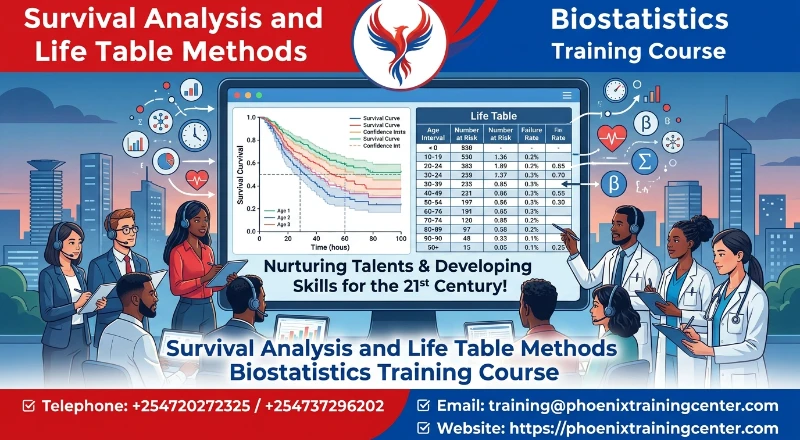
Course Overview
This specialized training course delivers advanced biostatistical expertise in survival analysis and life table methods specifically tailored for epidemiologists and public health researchers. In epidemiological studies, time-to-event outcomes, right censoring, left truncation, and time-varying covariates present unique analytical challenges that standard regression models cannot adequately address. Participants will gain comprehensive training in conceptualizing survival distributions, estimating non-parametric survival curves, building Cox proportional hazards models, constructing life tables, and evaluating competing risks using modern statistical software such as R and Stata.
The course covers key methodologies including the Kaplan-Meier estimator, log-rank tests, actuarial life tables, standard mortality ratios, parametric survival models, proportional hazards assumptions testing, time-dependent covariates, and competing risk analysis. Through practical, hands-on computing sessions using real-world public health datasets (such as clinical trials, cohort studies, and disease surveillance registries), participants will acquire the competencies needed to analyze complex longitudinal health data, interpret hazard ratios, control for confounding, and produce publication-ready biostatistical results.
Upon the successful completion of this Survival Analysis and Life Table Methods Biostatistics Training Course, participants will be able to:
ü Construct, interpret, and compare non-parametric survival curves using the Kaplan-Meier method and log-rank test statistics.
ü Formulate and analyze complete and abridged life tables to evaluate population mortality, life expectancy, and epidemiological person-time indicators.
ü Build and interpret Cox Proportional Hazards regression models to estimate adjusted hazard ratios for binary and multi-category exposure variables.
ü Test and evaluate the proportional hazards assumption using Schoenfeld residuals and fit extended Cox models for time-varying covariates.
ü Analyze parametric survival models (Weibull, Exponential, Log-logistic) to model baseline hazard functions and predict long-term survival probability.
ü Apply competing risk frameworks (Cumulative Incidence Functions and Fine-Gray subdistribution hazards) to address intercurrent clinical events accurately.
Training Methodology
The training employs a participant-centered, practical methodology designed to maximize knowledge retention and real-world application. The course is designed to be highly interactive, challenging and stimulating. It will be an instructor led training and will be delivered using a blended learning approach comprising of:
ü Interactive lectures and expert-led biostatistical presentations
ü Hands-on computer laboratory sessions utilizing statistical software (R/Stata/SAS)
ü Real-world epidemiological case study analyses and dataset management
ü Group discussions and collaborative analytical problem-solving exercises
ü Pre- and post-course assessments and feedback sessions
Our facilitators are seasoned industry professionals with years of expertise in their chosen fields. All facilitation and course materials will be offered in English.
Who Should Attend?
This course is specifically tailored for professionals involved in epidemiological research, biostatistics, public health surveillance, and clinical trials. This Survival Analysis and Life Table Methods Biostatistics Training Course would be suitable for, but not limited to:
ü Epidemiologists and Public Health Researchers
ü Biostatisticians and Data Analysts
ü Clinical Research Associates and Medical Scientists
ü Health Data Managers and Disease Surveillance Officers
ü Academic Researchers and Postgraduate Scholars in Public Health
ü Monitoring and Evaluation (M&E) Officers in Global Health Organizations
ü Pharmaceutical and Clinical Trial Statisticians
Course Benefits
Personal Benefits
ü Master specialized biostatistical skills in time-to-event analysis highly sought after in public health and medical research.
ü Gain hands-on competence in running advanced survival scripts in R/Stata to clean, analyze, and visualize longitudinal data.
ü Enhance research productivity and ability to publish high-impact epidemiological studies with robust statistical modeling.
ü Expand professional credentials and network with international epidemiologists and biostatisticians.
Organizational Benefits
ü Upgrade institutional capacity to analyze complex, long-term disease monitoring datasets and clinical trial cohorts.
ü Ensure high methodological rigor and statistical accuracy in public health surveillance and epidemiological reporting.
ü Improve evidence-based decision-making for public health interventions using accurate life table and survival metrics.
ü Reduce reliance on external statistical consultants by building internal advanced biostatistical expertise.
ü Course Duration: 5 Days
ü Training Fee:
o Physical Training: USD 1,500
o Online / Virtual Training: USD 1,000
Module 1: Introduction to Time-to-Event Data and Censoring Mechanisms
ü Concepts of time-to-event data, survival time, origin time, and event definitions in epidemiology
ü Understanding censoring mechanisms: Right censoring, left censoring, and interval censoring
ü Understanding truncation: Left truncation (delayed entry) and right truncation in cohort studies
ü Probability density function, survival function $S(t)$, hazard function $h(t)$, and cumulative hazard function $H(t)$
ü Practical Session: Importing epidemiological cohort datasets, setting up survival objects, and identifying censoring types in R/Stata
Module 2: Non-Parametric Survival Estimation: The Kaplan-Meier Method
ü Conceptual foundations of the Kaplan-Meier (product-limit) estimator
ü Calculating Greenwood's formula for standard errors and confidence intervals of $S(t)$
ü Estimating median survival time, restricted mean survival time (RMST), and survival probabilities at fixed time points
ü Handling ties in event times (Breslow, Efron, and exact methods)
ü Practical Session: Generating Kaplan-Meier survival curves, customizing plot visuals, and extracting survival estimates
Module 3: Comparing Survival Distributions: Log-Rank and Weighted Tests
ü Hypothesis testing for survival curves across two or more exposure groups
ü Derivation and interpretation of the Log-Rank test (Mantel-Cox test)
ü Stratified log-rank tests to control for baseline confounding factors
ü Alternative weighted log-rank tests: Peto-Peto, Wilcoxon, and Fleming-Harrington tests for early/late treatment effects
ü Practical Session: Performing unstratified and stratified log-rank tests on randomized clinical trial data
Module 4: Fundamentals of Life Table Methods in Epidemiology
ü Principles of cohort (generation) life tables vs. period (current) life tables
ü Constructing complete life tables: Age intervals, person-years at risk, death probabilities ($q_x$), and life expectancy ($e_x$)
ü Constructing abridged life tables using Chiang's method and Greville's conversion formulas
ü Actuarial method for survival estimation in grouped clinical and epidemiological data
ü Practical Session: Building an abridged life table from population mortality registry data using spreadsheet models and R
Module 5: Advanced Life Table Applications and Cause-Eliminated Life Tables
ü Age-standardization of mortality rates using direct and indirect life table methods
ü Standardized Mortality Ratios (SMR) and Cause-Specific Mortality Fractions
ü Cause-eliminated life tables: Estimating gains in life expectancy upon eliminating major causes of death
ü Multiple decrement life tables for evaluating mutually exclusive risks in public health
ü Practical Session: Constructing a cause-eliminated life table to evaluate the impact of cardiovascular disease prevention
Module 6: The Cox Proportional Hazards Regression Model
ü Formulation of the semi-parametric Cox Proportional Hazards model: $h(t\vert{}X) = h_0(t) \exp(\beta X)$
ü Estimation of parameters via partial likelihood functions and interpretation of Hazard Ratios (HR)
ü Fitting multivariable Cox models to control for confounding and evaluate effect modification
ü Estimating baseline hazard functions and baseline survival curves from Cox models
ü Practical Session: Fitting multivariable Cox regression models on cardiovascular cohort data and interpreting HRs
Module 7: Model Diagnostics and Assessing Proportional Hazards Assumptions
ü Key assumptions of the Cox Proportional Hazards regression framework
ü Graphical assessment using $\log(-\log(S(t)))$ plots
ü Formal statistical testing using Schoenfeld residuals and Scaled Schoenfeld residual plots
ü Identifying influential observations and non-linearity using Martingale and Deviance residuals
ü Practical Session: Performing comprehensive Cox model diagnostics and generating residual plots in R/Stata
Module 8: Extended Cox Models and Time-Dependent Covariates
ü Handling violations of the proportional hazards assumption using stratified Cox models
ü Concepts of time-varying exposure variables vs. time-dependent effects
ü Structuring counting process datasets (start, stop, event) for time-varying covariates
ü Fitting extended Cox regression models with step-function or continuous time-dependent variables
ü Practical Session: Transforming longitudinal hospital follow-up data into counting process format and fitting extended Cox models
Module 9: Parametric Survival Analysis Models and Accelerating Failure Time (AFT)
ü Overview of fully parametric survival models: Exponential, Weibull, Log-normal, and Log-logistic distributions
ü Accelerated Failure Time (AFT) models: Formulation and interpretation of Time Ratios (TR)
ü Likelihood ratio tests and Information Criteria (AIC/BIC) for model selection among parametric distributions
ü Predicting long-term survival probabilities and hazard trajectories using parametric functions
ü Practical Session: Fitting Weibull and Log-logistic AFT models on cancer survival data and comparing fit metrics against Cox models
Module 10: Competing Risks, Recurrent Events, and Advanced Survival Topics
ü Limitations of standard Kaplan-Meier and Cox models in the presence of competing risks
ü Estimating Cumulative Incidence Functions (CIF) using Kalbfleisch-Prentice / Gray's methods
ü Subdistribution hazard models (Fine-Gray model) vs. Cause-Specific Cox models for competing events
ü Introduction to recurrent event analysis (Andersen-Gill and Prentice-Williams-Peterson models)
ü Practical Session: Modeling competing risks for cause-specific mortality using Fine-Gray subdistribution hazards
About Our Trainers
Our training facilitators are seasoned biostatisticians, epidemiologists, and quantitative health researchers with extensive academic and field experience. They possess advanced postgraduate qualifications (PhDs and Masters) in Biostatistics and Epidemiology and have advised national ministries of health, the World Health Organization (WHO), and international research institutes. They bring deep, practical expertise in analyzing large-scale epidemiological datasets, managing clinical trial cohorts, and publishing survival analysis studies in peer-reviewed medical journals.
Quality Statement
Phoenix Training Center is committed to delivering world-class, practical, and impact-driven professional development programs. Our courses are meticulously researched, continuously updated, and designed to meet international educational standards. We adhere to rigorous quality assurance protocols to ensure our training solutions address contemporary industry challenges, comply with regulatory standards, and deliver maximum return on investment for both individual participants and sponsoring organizations.
Tailor-Made Courses
We understand that every organization has unique challenges and opportunities as well as unique training needs. Phoenix Training Center offers tailor-made courses designed to address specific requirements and challenges faced by your team or organization. Whether you need a customized curriculum, a specific duration, or on-site delivery, we can adapt our expertise to provide a training solution that perfectly aligns with your objectives. We can customize this Course to focus on your industry, specific risk profile, or internal stakeholder dynamics. Contact us to discuss how we can create a bespoke training program that maximizes value and impact for your team. For further inquiries, please contact us on Tel: +254720272325 / +254737296202 or Email: training@phoenixtrainingcenter.com.
Admission Criteria
ü Participants should be reasonably proficient in English.
ü Applicants must live up to Phoenix Center for Policy, Research and Training admission criteria.
Terms and Conditions
ü Discounts: Organizations sponsoring Four Participants will have the 5th attend Free
ü What is catered for by the Course Fees: Fees cater for all requirements for the training – Learning materials, Lunches, Teas, Snacks and Certification. All participants will additionally cater for their travel and accommodation expenses, visa application, insurance, and other personal expenses.
ü Certificate Awarded: Participants are awarded Certificates of Participation at the end of the training.
ü Course Improvement: The program content shown here is for guidance purposes only. Our continuous course improvement process may lead to changes in topics and course structure.
ü Approval of Course: Our Programs are NITA Approved. Participating organizations can therefore claim reimbursement on fees paid in accordance with NITA Rules.
Booking for Training
Kindly send an email to the Training Officer on training@phoenixtrainingcenter.com and we will send you a registration form. We advise you to book early to avoid missing a seat to this training. Or call us on +254720272325 / +254737296202
Payment Options
We provide 3 payment options, choose one for your convenience, and kindly make payments a week before the training starts (at least 5 to 7 days before the Training start date) to reserve your seat:
ü Groups of 5 People and Above – Cheque Payments to: Phoenix Center for Policy, Research and Training Limited should be paid in advance, a week before the training starts.
ü Invoice: We can send a bill directly to you or your company.
ü Deposit directly into Bank Account (Account details provided upon request)
Cancellation Policy
ü Payment for all courses includes a registration fee, which is non-refundable, and equals 15% of the total sum of the course fee.
ü Participants may cancel attendance 14 days or more prior to the training commencement date.
ü No refunds will be made 14 days or less before the training commencement date. However, participants who are unable to attend may opt to attend a similar training course at a later date or send a substitute participant provided the participation criteria have been met.
Accommodation and Airport Pick-up
For physical training attendees, we can assist with recommendations for accommodation near the training venue. Airport pick-up services can also be arranged upon request to ensure a smooth arrival. Please inform us of your travel details in advance if you require these services. For reservations contact the Training Officer on Email: training@phoenixtrainingcenter.com or on Tel: +254720272325 / +254737296202.
| Course Dates | Venue | Fees | Enroll |
|---|

Phoenix Training Center
Typically replies in minutes