
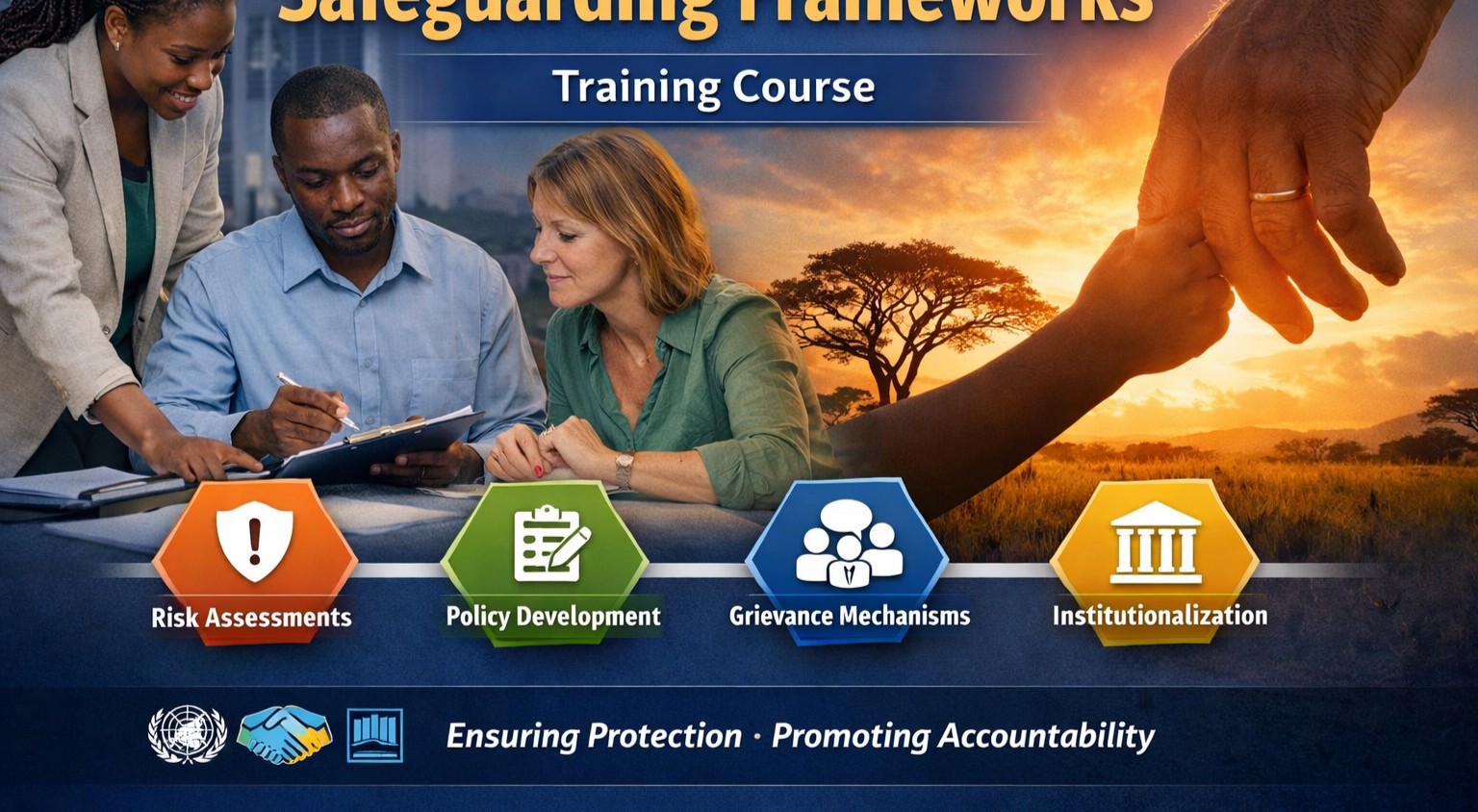
Safeguarding is no longer optional; it is a fundamental requirement for ethical, accountable, and sustainable organizations. This training course is designed to strengthen institutional capacity in safeguarding through practical technical leadership, structured assessments, policy development, and systems strengthening. It supports organizations to move beyond compliance toward embedding safeguarding as part of their culture, governance, and operational systems.
The course covers safeguarding risk assessments, environmental and social safeguards integration, governance and accountability systems, grievance redress mechanisms, safeguarding policy design, prevention of sexual exploitation and abuse (PSEA), risk management frameworks, and institutionalization strategies aligned with international standards such as ILO conventions, ISO 45001, IFC Performance Standards, and the World Bank Environmental and Social Framework (ESF).
Who Should Attend
This course is designed for:
Objectives of the Training
By the end of this course, participants will be able to:
Personal Benefits
Participants will:
Organizational Benefits
Organizations will benefit through:
Training Methodology
Course Duration & Fee
Duration: 10 Days (Intensive)
Course Fee: USD 3,000 per participant
(Fee includes training materials, certification, and refreshments.)
Experience of the Trainers
The training team comprises senior safeguarding and Environmental & Social (E&S) experts with over 15–20 years of experience working with:
Trainers bring regional and global experience in Africa and beyond, with practical expertise in risk assessment, institutional capacity building, governance reform, and compliance advisory services.
We are committed to delivering high-quality, context-relevant training that blends international best practices with local institutional realities. Our approach emphasizes practical application, adaptive management, and measurable institutional improvement.
Tailor-Made Courses
This course can be customized to meet specific organizational needs, including:
Module 1: Foundations of Safeguarding
Module 2: Safeguarding Risk Assessment
Module 3: Policy Development & Review
Module 4: Governance & Accountability
Module 5: Grievance Redress Mechanisms (GRM)
Module 6: Environmental & Social Safeguards Integration
Module 7: Training & Institutional Capacity Building
Module 8: Monitoring & Reporting
Module 9: Incident Response & Case Management
Module 10: Institutionalization & Sustainability
Requirements
Participants should be reasonably proficient in English.
Applicants must live up to Phoenix Training Center admission criteria.
Terms and Conditions
1. Discounts: Organizations sponsoring Four Participants will have the 5th attend Free
2. What is catered for by the Course Fees: Fees cater for all requirements for the training – Learning materials, Lunches, Teas, Snacks and Certification. All participants will additionally cater for their travel and accommodation expenses, visa application, insurance, and other personal expenses.
3. Certificate Awarded: Participants are awarded Certificates of Participation at the end of the training.
4. The program content shown here is for guidance purposes only. Our continuous course improvement process may lead to changes in topics and course structure.
5. Approval of Course: Our Programs are NITA Approved. Participating organizations can therefore claim reimbursement on fees paid in accordance with NITA Rules.
Booking for Training
Simply send an email to the Training Officer on training@phoenixtrainingcenter.com and we will send you a registration form. We advise you to book early to avoid missing a seat to this training.
Or call us on +254720272325 / +254725012095 / +254724452588
Payment Options
We provide 3 payment options, choose one for your convenience, and kindly make payments at least 5 days before the Training start date to reserve your seat:
1. Groups of 5 People and Above – Cheque Payments to: Armstrong Global Training & Development Center Limited should be paid in advance, 5 days to the training.
2. Invoice: We can send a bill directly to you or your company.
3. Deposit directly into Bank Account (Account details provided upon request)
Cancellation Policy
1. Payment for all courses includes a registration fee, which is non-refundable, and equals 15% of the total sum of the course fee.
2. Participants may cancel attendance 14 days or more prior to the training commencement date.
3. No refunds will be made 14 days or less before the training commencement date. However, participants who are unable to attend may opt to attend a similar training course at a later date or send a substitute participant provided the participation criteria have been met.
Tailor Made Courses
This training course can also be customized for your institution upon request for a minimum of 5 participants. You can have it conducted at our Training Centre or at a convenient location. For further inquiries, please contact us on Tel: +254720272325 / +254725012095 / +254724452588 or Email training@phoenixtrainingcenter.com
Accommodation and Airport Transfer
Accommodation and Airport Transfer is arranged upon request and at extra cost. For reservations contact the Training Officer on Email: training@phoenixtrainingcenter.com or on Tel: +254720272325 / +254725012095 / +254724452588
| Course Dates | Venue | Fees | Enroll |
|---|---|---|---|
| Oct 05 - Oct 16 2026 | Nanyuki | $3,000 |
|
| Nov 09 - Nov 20 2026 | Dubai | $7,800 |
|

Phoenix Training Center
Typically replies in minutes