
Course Overview
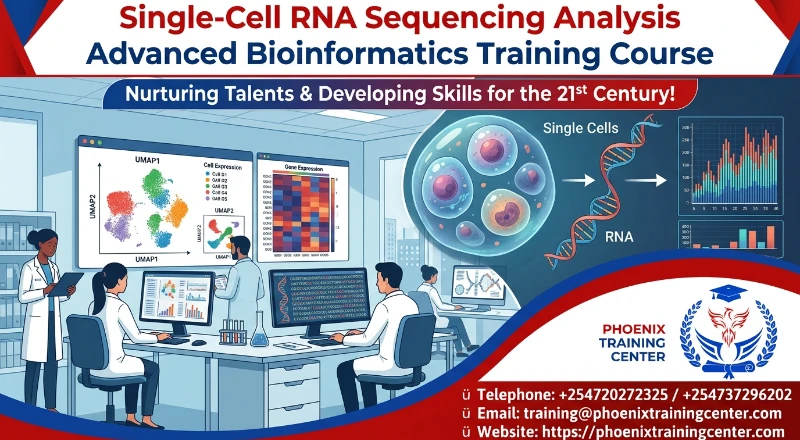
This advanced bioinformatics training course provides bioinformaticians, computational biologists, genomics researchers, and biomedical scientists with theoretical knowledge and practical skills required to analyze single-cell RNA sequencing (scRNA-seq) data. Single-cell genomics has revolutionized life science research by enabling the resolution of cellular heterogeneity, cell fate trajectories, and gene expression dynamics at single-cell resolution. Participants will learn how to process raw sequencing files, perform quality control, normalize transcript counts, correct for batch effects, cluster cell populations, annotate cell types, and conduct cell-cell communication modeling using industry-standard computational pipelines.
The course covers essential analytical toolsets and computational platforms including Cell Ranger, Seurat (R), Scanpy (Python), Harmony, Monocle 3, CellPhoneDB, and spatial transcriptomics integration tools. Through intensive hands-on computer laboratory sessions using real-world single-cell datasets, participants will gain practical experience in scripting, executing quality control pipelines, running dimensionality reduction algorithms (PCA, UMAP, t-SNE), detecting marker genes, and reconstructing developmental trajectories. Attendees will leave equipped to design robust scRNA-seq experiments and extract actionable biological insights from high-throughput transcriptomic data.
Upon the successful completion of this Single-Cell RNA Sequencing Analysis Advanced Bioinformatics Training Course, participants will be able to:
ü Understand single-cell library preparation technologies, sequencing platforms, and experimental design principles.
ü Process raw FASTQ files using Cell Ranger to generate gene-cell expression matrices.
ü Perform quality control filtering, doublets detection, count normalization, and feature selection in R and Python.
ü Execute dimensionality reduction (PCA, UMAP, t-SNE) and unsupervised clustering to identify novel cell types and subpopulations.
ü Annotate cell clusters using differential gene expression analysis, marker gene databases, and automated cell annotation pipelines.
ü Reconstruct developmental pseudotime trajectories, analyze cell-cell interactions, and integrate multi-sample spatial transcriptomics datasets.
Training Methodology
The training employs a participant-centered, practical methodology designed to maximize knowledge retention and real-world application. The course is designed to be highly interactive, challenging and stimulating. It will be an instructor led training and will be delivered using a blended learning approach comprising of:
ü Interactive lectures and expert-led bioinformatic presentations
ü Hands-on computational lab exercises using R (Seurat) and Python (Scanpy) in cloud Jupyter/RStudio environments
ü Real-world single-cell genomics case studies and dataset re-analysis
ü Collaborative script debugging workshops and pipeline construction exercises
ü Pre- and post-course assessments and feedback sessions
Our facilitators are seasoned industry professionals with years of expertise in their chosen fields. All facilitation and course materials will be offered in English.
Who Should Attend?
This course is specifically tailored for life science researchers, computational scientists, and healthcare professionals seeking to master single-cell genomic data analytics. This Single-Cell RNA Sequencing Analysis Advanced Bioinformatics Training Course would be suitable for, but not limited to:
ü Bioinformaticians and Computational Biologists
ü Genomic Researchers and Molecular Biologists
ü Postdoctoral Fellows and Academic Faculty in Life Sciences
ü Clinical Researchers and Translational Medicine Specialists
ü Biotechnology and Pharmaceutical R&D Scientists
ü Biostatisticians and Data Scientists transitioning into Single-Cell Genomics
ü Core Facility Managers supervising Next-Generation Sequencing (NGS) laboratories
Course Benefits
Personal Benefits
ü Acquire high-demand computational skills in single-cell transcriptomics, R (Seurat), and Python (Scanpy).
ü Gain independence in analyzing complex high-throughput genomic datasets without relying solely on external bioinformatic core facilities.
ü Boost publication capability by learning how to generate publication-ready plots (UMAP, volcano plots, dot plots, heatmaps).
ü Expand career opportunities across high-growth sectors such as precision medicine, oncology research, and pharmaceutical drug discovery.
Organizational Benefits
ü Enhance internal genomic research capabilities and accelerate project delivery timelines.
ü Reduce research costs by empowering internal teams to execute complex bioinformatics pipelines independently.
ü Improve data quality and research reproducibility across single-cell genomics workflows.
ü Maximize the return on investment from high-cost Next-Generation Sequencing (NGS) platform technologies.
ü Course Duration: 5 Days
ü Training Fee:
o Physical Training: USD 1,500
o Online / Virtual Training: USD 1,000
Module 1: Single-Cell Technologies, Experimental Design, and Raw Data Processing
ü Overview of single-cell RNA sequencing platforms (10x Genomics Chromium, SMART-seq, Drop-seq)
ü Experimental design considerations: Sample size, sequencing depth, biological replicates, and multiplexing
ü Demultiplexing, alignment, and Unique Molecular Identifier (UMI) counting
ü Running the 10x Genomics Cell Ranger pipeline for raw data processing
ü Practical Session: Executing Cell Ranger commands to align raw FASTQ files and generate count matrices
Module 2: Quality Control, Filtering, and Doublet Identification
ü Key single-cell quality control metrics: UMI counts, gene detection rate, and mitochondrial read percentages
ü Visualizing QC metrics using violin plots, scatter plots, and empirical cumulative distributions
ü Filtering low-quality cells, damaged cells, and empty droplets
ü Detecting and removing homotypic and heterotypic doublets using DoubletFinder and Scrublet
ü Practical Session: Loading raw count matrices into Seurat/Scanpy, visualizing QC distributions, and removing doublets
Module 3: Data Normalization, Variance Stabilization, and Feature Selection
ü Understanding technical noise and library size variation in single-cell data
ü Global scaling normalization methods (LogNormalize, CPM) vs. regularized negative binomial regression (SCTransform)
ü Identifying highly variable genes (HVGs) for downstream feature selection
ü Mitigating confounding biological variation (cell cycle phase, mitochondrial content) through regression models
ü Practical Session: Normalizing single-cell counts with SCTransform and performing cell-cycle scoring and regression in R
Module 4: Dimensionality Reduction, Batch Effect Correction, and Data Integration
ü Linear dimensionality reduction: Principal Component Analysis (PCA) and elbow plot evaluation
ü Non-linear dimensionality reduction: t-Distributed Stochastic Neighbor Embedding (t-SNE) and Uniform Manifold Approximation and Projection (UMAP)
ü Identifying batch effects and technical variation across experimental runs and donors
ü Batch effect correction and data integration algorithms: Harmony, Seurat v5 Anchor Integration, and Scanorama
ü Practical Session: Performing PCA, running UMAP projections, and applying Harmony to integrate scRNA-seq datasets across multiple donors
Module 5: Unsupervised Cell Clustering and Subpopulation Identification
ü Graph-based clustering algorithms: Shared Nearest Neighbor (SNN) graphs, Louvain, and Leiden algorithms
ü Optimizing clustering resolution parameters for biological relevance
ü Assessing cluster stability and over-clustering hazards using tree-based diagnostics
ü Hierarchical clustering and sub-clustering analysis for rare cell population discovery
ü Practical Session: Constructing SNN graphs, optimizing Leiden/Louvain clustering resolutions, and evaluating cluster stability
Module 6: Differential Gene Expression Analysis and Marker Gene Identification
ü Statistical frameworks for single-cell differential expression (Wilcoxon rank-sum, MAST, DESeq2 pseudobulk)
ü Identifying cluster-specific marker genes and conserved cell-type markers
ü Controlling false discovery rate (FDR) and interpreting log fold-change metrics
ü Visualizing marker genes: Dot plots, heatmaps, feature plots, and ridge plots
ü Practical Session: Running differential gene expression testing in Seurat, generating Volcano plots, and producing publication-ready heatmaps
Module 7: Automated Cell Type Annotation and Reference Mapping
ü Manual cell type annotation using canonical marker gene databases (CellMarker, PanglaoDB)
ü Automated cell type classification using reference datasets (SingleR, Azimuth, CellTypist)
ü Transferring cell-type labels from annotated reference atlases to query datasets
ü Validating automated annotations with biological literature and domain knowledge
ü Practical Session: Running SingleR and Azimuth to automatically annotate immune cell populations against public reference atlases
Module 8: Trajectory Inference, Pseudotime Modeling, and RNA Velocity
ü Concepts of cell fate decisions, continuous biological processes, and lineage differentiation
ü Reconstructing developmental trajectories using Monocle 3 and Slingshot
ü Ordering cells along pseudotime axes and identifying trajectory-variable genes
ü Introduction to RNA velocity mechanics (spliced vs. unspliced reads) using scVelo
ü Practical Session: Building developmental trajectories in Monocle 3 and mapping pseudotime gene expression patterns along lineage branches
Module 9: Cell-Cell Communication Analysis and Ligand-Receptor Interaction Modeling
ü Principles of cell-cell communication modeling from transcriptomic profiles
ü Ligand-receptor pair databases and interaction score calculations
ü Inferring intercellular communication networks using CellPhoneDB, CellChat, and NicheNet
ü Visualizing cellular signaling networks: Circle plots, bubble plots, and signaling pathway networks
ü Practical Session: Executing CellChat to model cross-talk between tumor cells and tumor-infiltrating immune cells
Module 10: Multi-Modal Single-Cell Omics and Spatial Transcriptomics Integration
ü Overview of multi-modal technologies: CITE-seq (surface proteins) and single-cell ATAC-seq (chromatin accessibility)
ü Introduction to Spatial Transcriptomics platforms (10x Visium, Xenium, MERFISH)
ü Integrating spatial transcriptomics with scRNA-seq data via cell-type deconvolution
ü Best practices for reproducible single-cell workflows, containerization (Docker/Singularity), and data submission to GEO
ü Practical Session: Deconvoluting spatial transcriptomics spots using scRNA-seq reference profiles and visualizing spatial gene expression patterns
About Our Trainers
Our training facilitators are senior bioinformaticians, principal computational biologists, and genomics data scientists with over 15 years of combined research and industry experience. Holding PhD degrees in Bioinformatics, Computational Biology, or Molecular Genetics, they have published extensively in high-impact peer-reviewed journals and developed custom analytical pipelines for leading biotechnology companies, medical centers, and academic institutes globally. Each trainer brings deep expertise in R, Python, high-performance computing, and single-cell transcriptomics to deliver interactive, practical instruction.
Quality Statement
Phoenix Training Center is committed to delivering world-class, practical, and impact-driven professional development programs. Our courses are meticulously researched, continuously updated, and designed to meet international educational standards. We adhere to rigorous quality assurance protocols to ensure our training solutions address contemporary industry challenges, comply with regulatory standards, and deliver maximum return on investment for both individual participants and sponsoring organizations.
Tailor-Made Courses
We understand that every organization has unique challenges and opportunities as well as unique training needs. Phoenix Training Center offers tailor-made courses designed to address specific requirements and challenges faced by your team or organization. Whether you need a customized curriculum, a specific duration, or on-site delivery, we can adapt our expertise to provide a training solution that perfectly aligns with your objectives. We can customize this Course to focus on your industry, specific risk profile, or internal stakeholder dynamics. Contact us to discuss how we can create a bespoke training program that maximizes value and impact for your team. For further inquiries, please contact us on Tel: +254720272325 / +254737296202 or Email: training@phoenixtrainingcenter.com.
Admission Criteria
ü Participants should be reasonably proficient in English.
ü Applicants must live up to Phoenix Center for Policy, Research and Training admission criteria.
Terms and Conditions
ü Discounts: Organizations sponsoring Four Participants will have the 5th attend Free
ü What is catered for by the Course Fees: Fees cater for all requirements for the training – Learning materials, Lunches, Teas, Snacks and Certification. All participants will additionally cater for their travel and accommodation expenses, visa application, insurance, and other personal expenses.
ü Certificate Awarded: Participants are awarded Certificates of Participation at the end of the training.
ü Course Improvement: The program content shown here is for guidance purposes only. Our continuous course improvement process may lead to changes in topics and course structure.
ü Approval of Course: Our Programs are NITA Approved. Participating organizations can therefore claim reimbursement on fees paid in accordance with NITA Rules.
Booking for Training
Kindly send an email to the Training Officer on training@phoenixtrainingcenter.com and we will send you a registration form. We advise you to book early to avoid missing a seat to this training. Or call us on +254720272325 / +254737296202
Payment Options
We provide 3 payment options, choose one for your convenience, and kindly make payments a week before the training starts (at least 5 to 7 days before the Training start date) to reserve your seat:
ü Groups of 5 People and Above – Cheque Payments to: Phoenix Center for Policy, Research and Training Limited should be paid in advance, a week before the training starts.
ü Invoice: We can send a bill directly to you or your company.
ü Deposit directly into Bank Account (Account details provided upon request)
Cancellation Policy
ü Payment for all courses includes a registration fee, which is non-refundable, and equals 15% of the total sum of the course fee.
ü Participants may cancel attendance 14 days or more prior to the training commencement date.
ü No refunds will be made 14 days or less before the training commencement date. However, participants who are unable to attend may opt to attend a similar training course at a later date or send a substitute participant provided the participation criteria have been met.
Accommodation and Airport Pick-up
For physical training attendees, we can assist with recommendations for accommodation near the training venue. Airport pick-up services can also be arranged upon request to ensure a smooth arrival. Please inform us of your travel details in advance if you require these services. For reservations contact the Training Officer on Email: training@phoenixtrainingcenter.com or on Tel: +254720272325 / +254737296202.
| Course Dates | Venue | Fees | Enroll |
|---|

Phoenix Training Center
Typically replies in minutes