
Course Overview
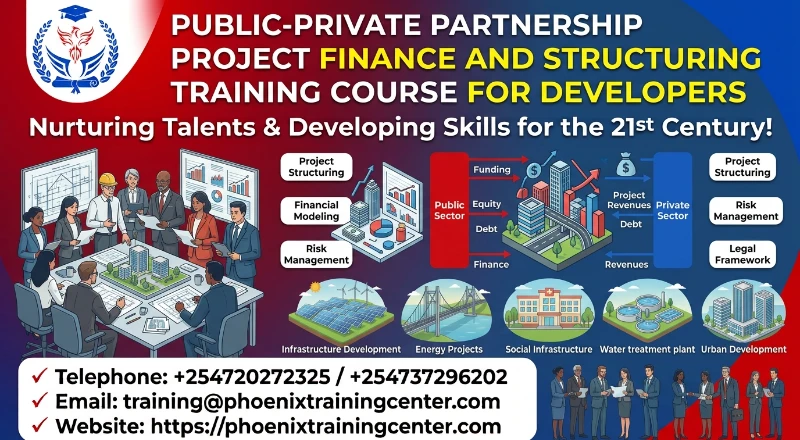
This comprehensive training course equips project developers, infrastructure sponsors, investment bankers, legal advisors, and public sector professionals with the essential skills required to structure, finance, and close bankable Public-Private Partnership (PPP) projects. As infrastructure demands expand globally, securing non-recourse and limited-recourse project financing requires sophisticated risk allocation, robust financial modeling, and strategic contract structuring. Participants will explore the entire project finance lifecycle, from initial feasibility studies and value-for-money analysis to concession agreement design, credit enhancement mechanisms, and financial close.
The curriculum covers critical project finance concepts and market practices across ten specialized modules. Learners will examine revenue models, including availability payments, user fees, and shadow tolls, alongside debt structuring, equity syndication, and mezzanine financing solutions. Advanced topics include financial modeling, sensitivity testing, credit enhancement tools provided by Multilateral Development Banks (MDBs), and risk mitigation strategies for political, currency, and construction risks. By evaluating real-world international case studies in transport, energy, water, and social infrastructure, participants will gain actionable expertise to navigate complex lender negotiations and drive PPP initiatives to successful commercial and financial execution.
Upon the successful completion of this Public-Private Partnership Project Finance and Structuring Training Course for Developers, participants will be able to:
ü Formulate bankable project structures for large-scale PPP infrastructure concessions.
ü Evaluate project feasibility using cash flow modeling, Debt Service Coverage Ratios (DSCR), and internal rates of return (IRR).
ü Design risk-sharing mechanisms that effectively allocate political, commercial, construction, and operational risks among stakeholders.
ü Structure optimal capital stacks combining senior debt, subordinated debt, equity, and credit enhancements.
ü Negotiate key project documentation, including Concession Agreements, Power Purchase Agreements (PPAs), EPC contracts, and Intercreditor Agreements.
ü Leverage guarantees and risk-mitigation instruments from Multilateral Development Banks (MDBs) and Development Finance Institutions (DFIs).
ü Navigate the path from commercial close to financial close, managing condition precedents and loan syndication.
Training Methodology
The course uses a practical, interactive, and participant-centered methodology designed to bridge theoretical principles with real-world project development. The course is designed to be highly interactive, challenging and stimulating. It will be an instructor led training and will be delivered using a blended learning approach comprising of:
ü Expert-led interactive lectures detailing project finance standards, market trends, and legal frameworks
ü Real-world PPP case study analyses examining successful transactions and failed deal structures
ü Hands-on practical lab sessions in every module focusing on financial modeling, term sheet analysis, and risk matrix creation
ü Group negotiation exercises simulating sponsor-lender-government contract dynamics
ü Open plenary discussions, continuous Q&A sessions, and instructor feedback
Our facilitators are seasoned industry professionals with years of expertise in their chosen fields. All facilitation and course materials will be offered in English.
Who Should Attend?
This course is tailored for professionals involved in developing, financing, or regulating PPP infrastructure projects. This Public-Private Partnership Project Finance and Structuring Training Course for Developers would be suitable for, but not limited to:
ü Project Developers and Infrastructure Sponsors
ü Investment Bankers and Project Finance Specialists
ü Public Sector PPP Unit Officers and Infrastructure Ministry Officials
ü Financial Analysts and Investment Managers in Infrastructure Funds
ü Legal Advisors, Transaction Advisors, and Commercial Consultants
ü Risk Managers and Credit Officers in Commercial Banks and DFIs
ü Executive Directors and Strategy Officers in Utility and Construction Companies
Benefits of the Training
Personal Benefits
ü Build core competency in structuring bankable project finance transactions for PPP infrastructure.
ü Enhance financial modeling capabilities to evaluate project metrics, coverage ratios, and downside sensitivities.
ü Develop specialized negotiation skills for aligning interests across government authorities, lenders, and sponsors.
ü Expand career opportunities into senior infrastructure finance, transaction advisory, and project development roles.
Organizational Benefits
ü Accelerate project execution timelines by drafting bankable concession structures early in development.
ü Optimize capital costs by effectively blending commercial debt, DFI financing, and government support.
ü Minimize exposure to project default through comprehensive risk identification, allocation, and hedging strategies.
ü Enhance institutional capacity to engage with international lenders, MDBs, and private investors effectively.
ü Course Duration: 5 Days
ü Training Fee
o Physical Training: USD 1,500
o Online / Virtual Training: USD 1,000
Module 1: Fundamentals of PPP Project Finance & Concession Structuring
ü Introduction to non-recourse and limited-recourse project finance mechanisms
ü Distinguishing corporate finance from project finance in infrastructure delivery
ü Roles and objectives of key stakeholders: Sponsors, Lenders, Granting Authorities, and Offtakers
ü Common PPP concession models: BOT, BOOT, DBFO, and Concession Agreements
ü Practical Session: Structuring the Special Purpose Vehicle (SPV) corporate architecture and stakeholder mapping for a greenfield infrastructure project
Module 2: Project Feasibility, Value for Money (VfM) & Revenue Models
ü Conducting technical, legal, environmental, and financial feasibility studies
ü Evaluating Public Sector Comparator (PSC) and Value for Money (VfM) frameworks
ü Designing revenue mechanisms: Availability payments, user-pay tariffs, and shadow tolls
ü Offtake agreements, volume risk allocation, and minimum take-or-pay guarantees
ü Practical Session: Formulating a comparative VfM evaluation and selecting the optimal revenue mechanism for a toll road PPP
Module 3: Project Risk Allocation, Identification & Mitigation Frameworks
ü Principles of risk allocation: Assigning risk to the party best able to manage it
ü Analyzing pre-construction, construction, completion, and operational risks
ü Managing sovereign risk, political risk, expropriation, and regulatory changes
ü Currency risk, interest rate exposure, and inflation indexation strategies
ü Practical Session: Constructing a comprehensive Project Risk Matrix and draft allocation strategy for a water treatment plant
Module 4: Capital Structure Optimization & Debt Structuring
ü Designing the optimal capital stack: Equity, Mezzanine Debt, and Senior Debt
ü Senior debt instruments: Commercial bank loans, syndicated facilities, and infrastructure bonds
ü Sizing debt capacity using Debt Service Coverage Ratio (DSCR) constraints
ü Subordinated debt, shareholder loans, and equity bridge facilities
ü Practical Session: Developing a debt sizing model based on target DSCRs and sculpting debt service profiles
Module 5: Financial Modeling, Coverage Ratios & Sensitivity Analysis
ü Key inputs and structure of a project finance financial model
ü Calculating financial viability metrics: Project IRR, Equity IRR, and NPV
ü Analyzing debt metrics: DSCR, Loan Life Coverage Ratio (LLCR), and Project Life Coverage Ratio (PLCR)
ü Running stress tests, scenario analysis, and downside sensitivity models
ü Practical Session: Building a dynamic financial model dashboard to run sensitivity analysis on construction cost overruns and tariff adjustments
Module 6: Key Project Documentation & Contractual Architecture
ü Anatomy of the Concession Agreement and direct agreements with lenders
ü Engineering, Procurement, and Construction (EPC) turnkey contracts and performance guarantees
ü Operation and Maintenance (O&M) agreements and service level obligations
ü Offtake agreements, Power Purchase Agreements (PPAs), and input supply contracts
ü Practical Session: Reviewing a draft EPC contract term sheet to identify liability caps, liquidated damages, and completion guarantees
Module 7: Role of DFIs, MDBs & Credit Enhancement Instruments
ü Engaging Development Finance Institutions (DFIs) and Multilateral Development Banks (MDBs)
ü Political Risk Insurance (PRI) from MIGA and national export credit agencies
ü Partial Risk Guarantees (PRG) and Partial Credit Guarantees (PCG)
ü Blended finance, viability gap funding (VGF), and government subsidies
ü Practical Session: Structuring a credit enhancement package using MDB guarantees to achieve investment-grade credit ratings
Module 8: Negotiating Loan Agreements & Intercreditor Dynamics
ü Key clauses in Project Loan Agreements: Representations, warranties, and covenants
ü Drawdown conditions precedent, disbursement schedules, and retention accounts
ü Cash waterfall mechanisms, debt service reserve accounts (DSRA), and dividend distribution traps
ü Intercreditor agreements, step-in rights, and enforcement of security packages
ü Practical Session: Simulating a cash waterfall distribution exercise during operational shortfalls and evaluating lock-up triggers
Module 9: Managing Environmental, Social, and Governance (ESG) Standards in Project Finance
ü Equator Principles and IFC Performance Standards in project finance appraisal
ü Environmental and Social Impact Assessments (ESIA) and management plans
ü Community engagement, land acquisition, and involuntary resettlement frameworks
ü Monitoring ongoing ESG compliance during construction and operational phases
ü Practical Session: Developing an ESG compliance review checklist aligned with IFC Performance Standards for an energy project
Module 10: Reaching Financial Close & Managing Post-Close Refinancing
ü Managing the transition from commercial close to financial close
ü Satisfying conditions precedent (CPs), legal opinions, and insurance reviews
ü Post-closing project monitoring, lender engineer audits, and reporting
ü Refinancing strategies: Re-leveraging, interest rate margin reduction, and gain-sharing mechanisms
ü Practical Session: Drafting a comprehensive Conditions Precedent tracker and executing a mock refinancing feasibility assessment
About Our Trainers
Our training team comprises seasoned project finance specialists, infrastructure developers, and transaction advisors with extensive field expertise across global markets. Each instructor possesses over 15 years of industry experience, having led deal teams in closing complex, multi-million-dollar PPP transactions across energy, transportation, water, and social infrastructure sectors. Holding advanced credentials in finance, law, and engineering alongside certifications from recognized financial bodies, our trainers bring real-world deal structures, practical modeling frameworks, and battle-tested negotiation insights directly to the course.
Quality Statement
Phoenix Training Center is committed to delivering world-class, outcome-driven professional education. We guarantee the highest educational standards by maintaining industry-aligned curricula, engaging certified senior practitioners, and providing state-of-the-art hands-on learning environments. Every course undergoes continuous review and updates based on evolving technology trends, regulatory shifts, and participant feedback. Our mission is to empower professionals and organizations with practical skills that translate directly into operational excellence and tangible business value.
Tailor-Made Courses
We understand that every organization has unique challenges and opportunities as well as unique training needs. Phoenix Training Center offers tailor-made courses designed to address specific requirements and challenges faced by your team or organization. Whether you need a customized curriculum, a specific duration, or on-site delivery, we can adapt our expertise to provide a training solution that perfectly aligns with your objectives. We can customize this Course to focus on your industry, specific risk profile, or internal stakeholder dynamics. Contact us to discuss how we can create a bespoke training program that maximizes value and impact for your team. For further inquiries, please contact us on Tel: +254720272325 / +254737296202 or Email training@phoenixtrainingcenter.com.
Admission Criteria
ü Participants should be reasonably proficient in English.
ü Applicants must live up to Phoenix Center for Policy, Research and Training admission criteria.
Terms and Conditions
ü Discounts: Organizations sponsoring Four Participants will have the 5th attend Free
ü What is catered for by the Course Fees: Fees cater for all requirements for the training – Learning materials, Lunches, Teas, Snacks and Certification. All participants will additionally cater for their travel and accommodation expenses, visa application, insurance, and other personal expenses.
ü Certificate Awarded: Participants are awarded Certificates of Participation at the end of the training.
ü Course Improvement: The program content shown here is for guidance purposes only. Our continuous course improvement process may lead to changes in topics and course structure.
ü Approval of Course: Our Programs are NITA Approved. Participating organizations can therefore claim reimbursement on fees paid in accordance with NITA Rules.
Booking for Training
Kindly send an email to the Training Officer on training@phoenixtrainingcenter.com and we will send you a registration form. We advise you to book early to avoid missing a seat to this training. Or call us on +254720272325 / +254737296202
Payment Options
We provide 3 payment options, choose one for your convenience, and kindly make payments a week before the training starts (at least 5 to 7 days before the Training start date) to reserve your seat:
ü Groups of 5 People and Above – Cheque Payments to: Phoenix Center for Policy, Research and Training Limited should be paid in advance, a week before the training starts.
ü Invoice: We can send a bill directly to you or your company.
ü Deposit directly into Bank Account (Account details provided upon request)
Cancellation Policy
ü Payment for all courses includes a registration fee, which is non-refundable, and equals 15% of the total sum of the course fee.
ü Participants may cancel attendance 14 days or more prior to the training commencement date.
ü No refunds will be made 14 days or less before the training commencement date. However, participants who are unable to attend may opt to attend a similar training course at a later date or send a substitute participant provided the participation criteria have been met.
Accommodation and Airport Pick-up
For physical training attendees, we can assist with recommendations for accommodation near the training venue. Airport pick-up services can also be arranged upon request to ensure a smooth arrival. Please inform us of your travel details in advance if you require these services. For reservations contact the Training Officer on Email: training@phoenixtrainingcenter.com or on Tel: +254720272325 / +254737296202.
| Course Dates | Venue | Fees | Enroll |
|---|

Phoenix Training Center
Typically replies in minutes