
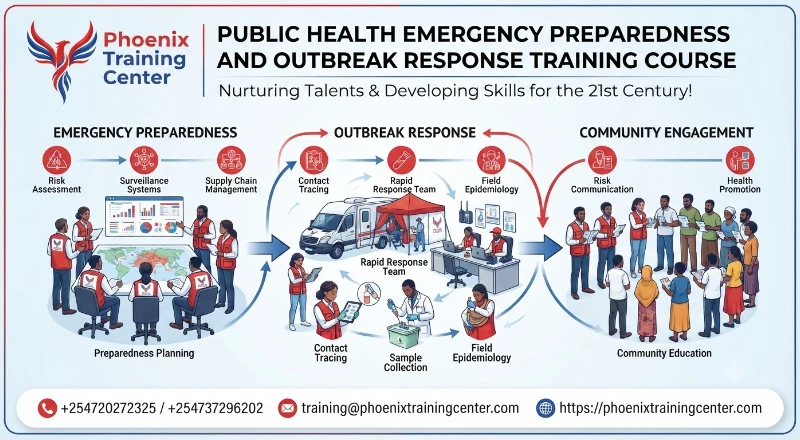
Course Overview
The Public Health Emergency Preparedness and Outbreak Response Training Course is designed to build critical operational capacities among healthcare coordinators, emergency responders, and public health leaders. In an era marked by rapid urbanization, climate shifts, and emerging infectious agents, the ability to anticipate, detect, and swiftly counter health emergencies is paramount. This intensive professional program bridges theoretical epidemiological surveillance with field-tested emergency command structures, providing participants with the tactical toolkits required to protect populations and optimize institutional resource distribution during high-stress health crises.
Throughout this comprehensive program, participants will systematically explore the complete lifecycle of emergency management, ranging from early-warning surveillance metrics to multi-agency coordination structures. The curriculum uncovers modern disease surveillance methodologies, rapid field response mechanics, crisis communications, data-driven decision-making, and pharmaceutical supply chain stabilization during pandemics. By analyzing global case studies and engaging in live simulations, attendees will develop the advanced leadership capabilities necessary to establish secure health infrastructures and drive rapid, compliant containment strategies within their organizations.
Upon the successful completion of this Public Health Emergency Preparedness and Outbreak Response Training Course, participants will be able to:
ü Equip participants with the skills to design, audit, and execute agile national and regional public health emergency preparedness plans.
ü Master the establishment and operation of Incident Command Systems (ICS) and Public Health Emergency Operations Centers (PHEOC).
ü Introduce modern epidemiological investigation protocols, active contact tracing methodologies, and biological field sampling standards.
ü Strengthen risk communication frameworks and community engagement strategies to counter misinformation during health threats.
ü Build resilient supply chain and logistics capabilities for distributing life-saving medical countermeasures under restricted conditions.
Training Methodology
The course is designed to be highly interactive, challenging and stimulating. It will be an instructor led training and will be delivered using a blended learning approach comprising of:
ü Interactive problem-solving lectures and technical briefs led by frontline crisis containment experts.
ü Computer-based laboratory practicals focusing on real-time disease modeling and spatial hotspot mapping.
ü Desktop crisis simulation exercises evaluating multi-agency deployment trade-offs under high-stress constraints.
ü Comparative case study reviews identifying institutional vulnerabilities and successful international containment models.
ü Structured role-playing scenarios covering hostile media management, risk reporting, and community-level containment interventions.
Our facilitators are seasoned industry professionals with years of expertise in their chosen fields. All facilitation and course materials will be offered in English.
Who Should Attend?
This Public Health Emergency Preparedness and Outbreak Response Training Course would be suitable for, but not limited to:
ü National and County Disease Surveillance Officers
ü Disaster Response Coordinators and Emergency Management Personnel
ü Public Health Directors, Medical Officers, and Hospital Administrators
ü Epidemiologists, Biostatisticians, and Laboratory Directors
ü NGO Health Program Managers and Humanitarian Relief Officers
ü Ministry of Health Advisors and Border Health Inspection Specialists
Personal Benefits
ü Master the design, implementation, and coordination of comprehensive outbreak containment pipelines, accelerating career advancement.
ü Develop confidence in commanding emergency operations, managing multi-sector tasks, and advising political decision-makers during crises.
ü Advance analytical capabilities to isolate operational logistical bottlenecks and mitigate system vulnerabilities in real-time.
ü Acquire a globally recognized professional credential confirming specialized expertise in high-stakes epidemic management.
Organizational Benefits
ü Streamline institutional emergency reaction times through the adoption of standardized incident command operational protocols.
ü Enhance institutional resource protection and minimize financial loss via predictive data-justified material deployment.
ü Secure greater access to global health emergency funds through the formulation of compliance-driven project frameworks.
ü Cultivate highly autonomous internal emergency response units capable of deploying rapid field investigations independently.
ü Course Duration: 5 Days
ü Training Fee:
o Physical Training: USD 1,500
o Online / Virtual Training: USD 1,000
Module 1: Foundations of Emergency Preparedness and International Health Regulations
ü Concepts, definitions, and types of public health emergencies: Biological, chemical, radiological, and zoonotic threats.
ü Analyzing the core capacities of the WHO International Health Regulations (IHR 2005) framework.
ü Legal and ethical frameworks governing mandatory disease notification and international border health controls.
ü Risk assessment matrices: Conducting national and sub-national Multi-Hazard Preparedness Audits.
ü Practical Session: Evaluating a country-level IHR self-assessment report to isolate critical vulnerability gaps in border biosafety protocols.
Module 2: Designing Public Health Emergency Operations Centers and Incident Command Systems
ü Functional components of a Public Health Emergency Operations Center (PHEOC): Infrastructure, plans, and data lines.
ü Incident Command System (ICS) principles: Span of control, unity of command, and management by objectives.
ü Defining operational cell structures: Planning, logistics, operations, finance, and safety commands.
ü Activating, escalating, and de-escalating emergency center activation levels during escalating threats.
ü Practical Session: Constructing a comprehensive Incident Action Plan (IAP) detailing operational objectives and cell command hierarchies for a high-threat biological scenario.
Module 3: Early Warning Systems, Syndromic Surveillance, and Data Informatics
ü Designing sensitive, indicator-based and event-based digital disease surveillance networks.
ü Utilizing artificial intelligence and community syndromic signals for early disease anomaly detection.
ü Data integration challenges: Linking community clinical records, veterinary data, and laboratory networks.
ü Visualizing outbreak trends: Creating automated dashboard architectures for decision-making bodies.
ü Practical Session: Interrogating a raw syndromic data set within an open-source health intelligence platform to isolate and verify hidden anomaly clusters.
Module 4: Outbreak Investigation Protocols and Rapid Field Deployment Mechanics
ü Chronological steps of a formal outbreak investigation: Confirming diagnoses to executing control actions.
ü Constructing standardized field line lists, epidemic curves (Epi Curves), and calculating attack rates.
ü Contact tracing methodologies: Ring-fencing, digital geo-tracking tools, and source-identification strategies.
ü Deploying Rapid Response Teams (RRT): Equipment checklists, roster structures, and dynamic field safety standard operating procedures.
ü Practical Session: Constructing an interactive epidemic curve and generating a calculated line list based on raw field data points from a localized contamination cluster.
Module 5: Laboratory Biosafety, Specimen Logistics, and Diagnostic Networks
ü Aligning diagnostic structures: Biosafety Level 1 through Level 4 (BSL-1 to BSL-4) laboratory design standards.
ü Field collection, stabilization, cold-chain management, and international transport compliance for hazardous biological samples.
ü Integrating point-of-care rapid testing deployment frameworks with central confirmatory reference laboratories.
ü Managing diagnostic supply bottlenecks and cross-contamination prevention guidelines in temporary field labs.
ü Practical Session: Simulating a field specimen triple-packaging exercise under strict international safety regulations and charting a zero-break cold chain logistics pathway.
Module 6: Crisis Communication, Media Management, and Community Engagement
ü Core principles of WHO Risk Communication and Community Engagement (RCCE) strategies during severe health panics.
ü Message optimization: Translating technical epidemiological concepts into clear, non-alarmist public advisories.
ü Managing hostile media interactions, addressing fake news, and combating digital misinformation vectors.
ü Engaging community gatekeepers, cultural influencers, and religious leaders to overcome public intervention resistance.
ü Practical Session: Conducting an on-camera mock press conference responding to an escalating community disease outbreak and defending institutional remediation choices.
Module 7: Emergency Supply Chains, Procurement, and Medical Countermeasures Logistics
ü Forecasting and quantification of Personal Protective Equipment (PPE), medications, and diagnostic inventories during global shortages.
ü Fast-track emergency procurement processes, international vendor screening, and anti-price-gouging safeguards.
ü Last-mile supply chain management: Establishing forward-operating deployment depots in isolated target zones.
ü Strategic stock management: Cold chain integrity tracking for vaccines and therapeutic countermeasure distributions.
ü Practical Session: Building an emergency supply demand matrix and dynamic allocation pipeline adjusting for unexpected transport corridor shutdowns.
Module 8: Mass Casualty Management, Quarantine Frameworks, and Non-Pharmaceutical Interventions
ü Clinical triage principles and field surge capacity optimization plans for highly overwhelmed hospital facilities.
ü Operationalizing community non-pharmaceutical interventions: Social distancing, assembly bans, and border closures.
ü Legal, logistical, and humanitarian management of voluntary vs. mandatory isolation and regional quarantine spaces.
ü Managing dignified, safe, and culturally adapted mass casualty management and safe burial protocols.
ü Practical Session: Developing a rapid spatial conversion design blueprint transforming a standard municipal facility into a secure, fully functional isolation ward.
Module 9: Vulnerable Populations, Mental Health Support, and Ethics in Emergencies
ü Safeguarding marginalized groups: Managing outbreak responses in refugee camps, prisons, and low-income urban informal settlements.
ü Providing Mental Health and Psychosocial Support (MHPSS) frameworks for frontline healthcare staff and affected communities.
ü Resource rationing ethics: Deciding equitable therapeutic allocations during acute severe medical equipment constraints.
ü Human rights protections during state-enforced public health containment decrees and lock-downs.
ü Practical Session: Formulating an inclusive allocation framework that delivers testing and medical care access equitably to high-density, low-resource settlement clusters.
Module 10: After-Action Reviews, Simulation Testing, and Post-Crisis Policy Integration
ü Methodology for conducting rigorous post-crisis After-Action Reviews (AAR) to document institutional shortcomings.
ü Designing and executing functional, tabletop, and full-scale disaster simulation exercises for continuous workforce testing.
ü Mainstreaming emergency lessons learned into national budget changes and permanent healthcare policy updates.
ü Building long-term institutional memory and managing regional inter-agency mutual aid treaties.
ü Practical Session: Designing a tabletop simulation exercise blueprint, complete with trigger injects and performance evaluation checklists, for an organization's internal validation review.
About Our Trainers
Our instructional team comprises globally recognized crisis containment pioneers, field epidemiologists, and emergency response coordinators with over 20 years of collective operational field exposure. These experts have actively commanded disaster operations and field containment efforts on behalf of international organizations such as the WHO, CDC, and various ministries of health during major global health emergencies. Having directed high-risk pathogen control campaigns and built state-level Emergency Operations Centers, our facilitators provide realistic, tested operational insights that transcend textbook theory.
Quality Statement
Phoenix Training Center is committed to providing premium-grade, scientifically validated professional education programs. Our course structures strictly reflect modern international health consensus models, advanced pedagogic techniques, and evidence-based field standards. By utilizing continuous curriculum auditing loops and reviewing real-world disaster dynamics, we ensure our educational materials provide immediately actionable utility. We guarantee an intellectually rigorous, professional environment designed to equip leaders to protect human life with absolute command.
Tailor-Made Courses
We understand that every organization has unique challenges and opportunities as well as unique training needs. Phoenix Training Center offers tailor-made courses designed to address specific requirements and challenges faced by your team or organization. Whether you need a customized curriculum, a specific duration, or on-site delivery, we can adapt our expertise to provide a training solution that perfectly aligns with your objectives. We can customize this Course to focus on your industry, specific risk profile, or internal stakeholder dynamics. Contact us to discuss how we can create a bespoke training program that maximizes value and impact for your team. For further inquiries, please contact us on Tel: +254720272325 / +254737296202 or Email: training@phoenixtrainingcenter.com.
Admission Criteria
ü Participants should be reasonably proficient in English.
ü Applicants must live up to Phoenix Center for Policy, Research and Training admission criteria.
Terms and Conditions
ü Discounts: Organizations sponsoring Four Participants will have the 5th attend Free
ü What is catered for by the Course Fees: Fees cater for all requirements for the training – Learning materials, Lunches, Teas, Snacks and Certification. All participants will additionally cater for their travel and accommodation expenses, visa application, insurance, and other personal expenses.
ü Certificate Awarded: Participants are awarded Certificate of Completion at the end of the training.
ü Course Improvement: The program content shown here is for guidance purposes only. Our continuous course improvement process may lead to changes in topics and course structure.
ü Approval of Course: Our Programs are NITA Approved. Participating organizations can therefore claim reimbursement on fees paid in accordance with NITA Rules.
Booking for Training
Kindly send an email to the Training Officer on training@phoenixtrainingcenter.com and we will send you a registration form. We advise you to book early to avoid missing a seat to this training. Or call us on +254720272325 / +254737296202
Payment Options
We provide 3 payment options, choose one for your convenience, and kindly make payments a week before the training starts (at least 5 to 7 days before the Training start date) to reserve your seat:
ü Groups of 5 People and Above – Cheque Payments to: Phoenix Center for Policy, Research and Training Limited should be paid in advance, a week before the training starts.
ü Invoice: We can send a bill directly to you or your company.
ü Deposit directly into Bank Account (Account details provided upon request)
Cancellation Policy
ü Payment for all courses includes a registration fee, which is non-refundable, and equals 15% of the total sum of the course fee.
ü Participants may cancel attendance 14 days or more prior to the training commencement date.
ü No refunds will be made 14 days or less before the training commencement date. However, participants who are unable to attend may opt to attend a similar training course at a later date or send a substitute participant provided the participation criteria have been met.
Accommodation and Airport Pick-up
For physical training attendees, we can assist with recommendations for accommodation near the training venue. Airport pick-up services can also be arranged upon request to ensure a smooth arrival. Please inform us of your travel details in advance if you require these services. For reservations contact the Training Officer on Email: training@phoenixtrainingcenter.com or on Tel: +254720272325 / +254737296202.
| Course Dates | Venue | Fees | Enroll |
|---|---|---|---|
| Sep 21 - Sep 25 2026 | Naivasha | $1,500 |
|
| Sep 28 - Oct 02 2026 | Zoom | $1,000 |
|
| Oct 05 - Oct 09 2026 | Nairobi | $1,500 |
|
| Oct 12 - Oct 16 2026 | Nairobi | $1,500 |
|
| Oct 19 - Oct 23 2026 | Mombasa | $1,500 |
|
| Oct 26 - Oct 30 2026 | Eldoret | $1,500 |
|

Phoenix Training Center
Typically replies in minutes