
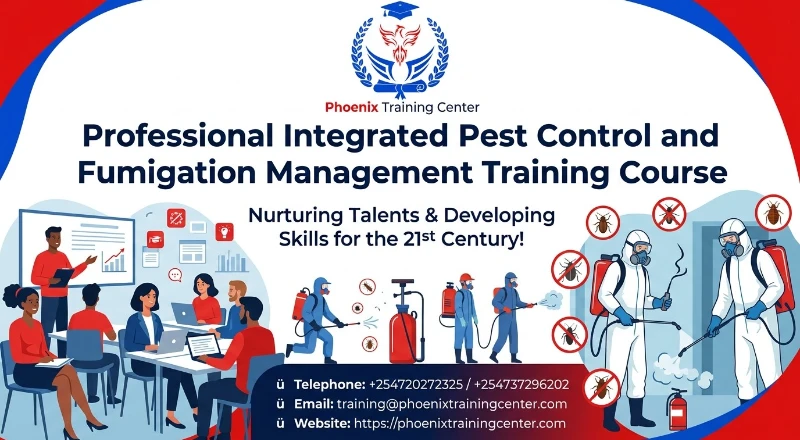
Course Overview
Pest infestation presents significant operational, health, and economic risks to public health facilities, agriculture, commercial property, and international trade. This intensive course provides a practical foundation in modern Integrated Pest Management (IPM), chemical application protocols, structural fumigation, and biosafety compliance. Participants will learn how to design targeted vector control programs, select safe chemical formulations, operate specialized equipment, and strictly follow international environmental safety regulations.
The course moves logically from fundamental pest biology and identification to advanced field execution and regulatory governance. Early modules examine common urban, agricultural, and stored-product pests, transitioning into chemical dosage calculation, application equipment calibration, and non-chemical control methods. Advanced sessions focus on structural and containerized fumigation mechanics, Personal Protective Equipment (PPE) standards, emergency response protocols, and quality assurance auditing for commercial pest control operations.
Upon the successful completion of this Professional Integrated Pest Control and Fumigation Management Training Course, participants will be able to:
ü Identify major urban, agricultural, and stored-product pest species and assess infestation levels.
ü Design and execute tailored Integrated Pest Management (IPM) plans for commercial and residential facilities.
ü Calculate precise chemical dosage rates and safely calibrate spraying and fogging equipment.
ü Conduct structural, soil, and commodity fumigation in compliance with international safety protocols.
ü Implement robust Occupational Health and Safety (OHS) measures and manage chemical exposure risks.
ü Establish regulatory compliance documentation, quality control auditing, and record-keeping systems.
Training Methodology
The course is designed to be highly interactive, challenging and stimulating. It will be an instructor led training and will be delivered using a blended learning approach comprising of:
ü Interactive lectures led by senior entomologists and certified pest control operators
ü Hands-on equipment calibration and chemical mixing demonstrations
ü Case study reviews of complex commercial and agricultural infestation scenarios
ü Practical field simulations covering inspection, spraying, and enclosure sealing
ü Interactive group exercises focusing on IPM strategy formulation and safety audits
Our facilitators are seasoned industry professionals with years of expertise in their chosen fields. All facilitation and course materials will be offered in English.
Who Should Attend?
This Professional Integrated Pest Control and Fumigation Management Training Course would be suitable for, but not limited to:
ü Pest Control Operators and Technicians
ü Environmental Health and Safety (EHS) Officers
ü Public Health Inspectors and Officers
ü Facility Managers and Operations Supervisors
ü Agricultural Extension Officers and Farm Managers
ü Quality Assurance Managers in Food Processing and Storage Facilities
Benefits of the Training
Personal Benefits
ü Acquire recognized practical expertise in advanced pest management and fumigation techniques.
ü Master precise chemical handling, safety protocols, and emergency response procedures.
ü Expand professional competence and career opportunities in environmental health and facility management.
Organizational Benefits
ü Reduce risk of product contamination, structural damage, and financial losses from pest infestations.
ü Ensure full compliance with national environmental regulations and international quarantine standards.
ü Improve operational efficiency through optimized pesticide usage and proper equipment maintenance.
ü Course Duration: 5 Days
ü Training Fee:
o Physical Training: USD 1,500
o Online / Virtual Training: USD 1,000
Module 1: Biology, Identification, and Behavior of Common Pests
ü Classification and lifecycle of urban pests: Cockroaches, rodents, bed bugs, and termites
ü Agricultural and stored-product pests: Weevils, beetles, moths, and grain borers
ü Signs of infestation, harborage inspection, and population estimation
ü Behavioral patterns and seasonal dynamics of vector species
ü Practical Session: Identifying pest species and damage patterns using field specimens and magnifying tools
Module 2: Principles of Integrated Pest Management (IPM)
ü Core philosophy and structural components of IPM programs
ü Physical, mechanical, biological, and cultural control strategies
ü Setting action thresholds and establishing monitoring schedules
ü Building sanitation, structural exclusion, and proofing techniques
ü Practical Session: Conducting a comprehensive facility site inspection and drafting an IPM action plan
Module 3: Pesticide Chemistry, Formulations, and Toxicology
ü Classification of pesticides: Insecticides, rodenticides, termiticides, and larvicides
ü Chemical formulations: Emulsifiable concentrates, wettable powders, baits, and dusts
ü Understanding modes of action, target specificity, and resistance management
ü Toxicity ratings, Safety Data Sheets (SDS), and reading chemical labels correctly
ü Practical Session: Performing chemical dilution calculations and bait formulation preparation
Module 4: Application Equipment, Calibration, and Maintenance
ü Operation of compression sprayers, mist blowers, and thermal foggers
ü Cold foggers (ULV), bait applicators, and dust injectors
ü Nozzle selection, spray patterns, and pressure management
ü Routine maintenance, troubleshooting, and equipment decontamination
ü Practical Session: Calibrating a compression sprayer and mist blower for uniform target area coverage
Module 5: Structural Pest Control and Vector Management
ü Termite control: Pre-construction and post-construction soil treatments
ü Rodent control strategies: Trapping networks, bait stations, and rodent-proofing
ü Mosquito and fly management in commercial and public spaces
ü Bird control systems: Spikes, netting, and repellent gels
ü Practical Session: Installing and configuring a secure rodent baiting and trapping network for a warehouse
Module 6: Principles and Practice of Commercial Fumigation
ü Introduction to fumigants: Phosphine, sulfuryl fluoride, and alternative agents
ü Enclosure sealing methods: Tarpaulin containment and gas-tight sealing
ü Fumigant dosage calculation, exposure periods, and gas distribution
ü Aeration protocols, clearance testing, and gas detection monitoring
ü Practical Session: Simulating tarp sealing and gas leak detection testing using electronic gas detectors
Module 7: Stored Product Protection and Commodity Fumigation
ü Silo, container, and stack fumigation techniques
ü Monitoring temperature, moisture, and gas concentration during treatment
ü Preventing residue accumulation in food commodities
ü Quarantine and pre-shipment treatment standards for international trade
ü Practical Session: Setting up a mini-stack tarp containment system for grain bag fumigation
Module 8: Occupational Health, Safety, and PPE Compliance
ü Hazard identification and Risk Assessment for chemical handling
ü Personal Protective Equipment (PPE) selection: Respirators, suits, and gloves
ü Fit testing, cleaning, and maintenance of full-face respirators
ü First aid procedures for pesticide exposure and emergency toxicity response
ü Practical Session: Conducting a respirator fit test and executing a mock chemical spill response protocol
Module 9: Environmental Protection and Waste Disposal Regulations
ü Preventing water source contamination, spray drift, and non-target exposure
ü Safe disposal of unused pesticide mixtures and rinse water
ü Triple rinsing techniques and empty container management
ü Regulatory frameworks and environmental compliance guidelines
ü Practical Session: Executing triple-rinse protocols for empty chemical containers and managing wash water
Module 10: Pest Control Business Operations and Audit Management
ü Service contract design, scope definition, and client communication
ü Maintaining service logs, inspection reports, and trend analysis charts
ü Preparing for third-party quality and food safety audits (AIB, BRC, ISO)
ü Continuous quality control, technician safety management, and record retention
ü Practical Session: Assembling a compliant pest control audit folder and trend report for a commercial client
About Our Trainers
Our training programs are delivered by a team of distinguished industry experts, senior entomologists, and certified public health specialists. Each trainer brings over 15 years of hands-on field experience in urban pest management, agricultural vector control, commercial fumigation, and environmental safety compliance. They combine deep technical knowledge with practical insights to deliver an engaging, high-impact learning experience.
Quality Statement
Phoenix Training Center is dedicated to delivering high-quality, practical, and outcome-focused professional development programs. Our course materials are continuously updated to align with global environmental standards, modern chemical safety guidelines, and modern application technologies. We prioritize interactive learning environments to ensure participants gain actionable skills that enhance operational safety and organizational excellence.
Tailor-Made Courses
We understand that every organization has unique challenges and opportunities as well as unique training needs. Phoenix Training Center offers tailor-made courses designed to address specific requirements and challenges faced by your team or organization. Whether you need a customized curriculum, a specific duration, or on-site delivery, we can adapt our expertise to provide a training solution that perfectly aligns with your objectives. We can customize this Course to focus on your industry, specific risk profile, or internal stakeholder dynamics. Contact us to discuss how we can create a bespoke training program that maximizes value and impact for your team. For further inquiries, please contact us on Tel: +254720272325 / +254737296202 or Email: training@phoenixtrainingcenter.com.
Admission Criteria
ü Participants should be reasonably proficient in English.
ü Applicants must live up to Phoenix Center for Policy, Research and Training admission criteria.
Terms and Conditions
ü Discounts: Organizations sponsoring Four Participants will have the 5th attend Free
ü What is catered for by the Course Fees: Fees cater for all requirements for the training – Learning materials, Lunches, Teas, Snacks and Certification. All participants will additionally cater for their travel and accommodation expenses, visa application, insurance, and other personal expenses.
ü Certificate Awarded: Participants are awarded Certificates of Participation at the end of the training.
ü Course Improvement: The program content shown here is for guidance purposes only. Our continuous course improvement process may lead to changes in topics and course structure.
ü Approval of Course: Our Programs are NITA Approved. Participating organizations can therefore claim reimbursement on fees paid in accordance with NITA Rules.
Booking for Training
Kindly send an email to the Training Officer on training@phoenixtrainingcenter.com and we will send you a registration form. We advise you to book early to avoid missing a seat to this training. Or call us on +254720272325 / +254737296202
Payment Options
We provide 3 payment options, choose one for your convenience, and kindly make payments a week before the training starts (at least 5 to 7 days before the Training start date) to reserve your seat:
ü Groups of 5 People and Above – Cheque Payments to: Phoenix Center for Policy, Research and Training Limited should be paid in advance, a week before the training starts.
ü Invoice: We can send a bill directly to you or your company.
ü Deposit directly into Bank Account (Account details provided upon request)
Cancellation Policy
ü Payment for all courses includes a registration fee, which is non-refundable, and equals 15% of the total sum of the course fee.
ü Participants may cancel attendance 14 days or more prior to the training commencement date.
ü No refunds will be made 14 days or less before the training commencement date. However, participants who are unable to attend may opt to attend a similar training course at a later date or send a substitute participant provided the participation criteria have been met.
Accommodation and Airport Pick-up
For physical training attendees, we can assist with recommendations for accommodation near the training venue. Airport pick-up services can also be arranged upon request to ensure a smooth arrival. Please inform us of your travel details in advance if you require these services. For reservations contact the Training Officer on Email: training@phoenixtrainingcenter.com or on Tel: +254720272325 / +254737296202.
| Course Dates | Venue | Fees | Enroll |
|---|---|---|---|
| Sep 21 - Sep 25 2026 | Mombasa | $1,500 |
|
| Sep 28 - Oct 02 2026 | Zoom | $1,000 |
|
| Oct 05 - Oct 09 2026 | Nairobi | $1,500 |
|
| Oct 12 - Oct 16 2026 | Nairobi | $1,500 |
|
| Oct 19 - Oct 23 2026 | Nakuru | $1,500 |
|
| Oct 26 - Oct 30 2026 | Naivasha | $1,500 |
|
| Oct 26 - Oct 30 2026 | Zoom | $1,000 |
|
| Nov 02 - Nov 06 2026 | Nairobi | $1,500 |
|
| Nov 09 - Nov 13 2026 | Nairobi | $1,500 |
|
| Nov 16 - Nov 20 2026 | Kisumu | $1,500 |
|
| Nov 23 - Nov 27 2026 | Naivasha | $1,500 |
|
| Nov 30 - Dec 04 2026 | Zoom | $1,000 |
|
| Dec 07 - Dec 11 2026 | Nairobi | $1,500 |
|
| Dec 14 - Dec 18 2026 | Naivasha | $1,500 |
|
| Dec 28 - Jan 01 2027 | Zoom | $1,000 |
|

Phoenix Training Center
Typically replies in minutes