
Course Overview
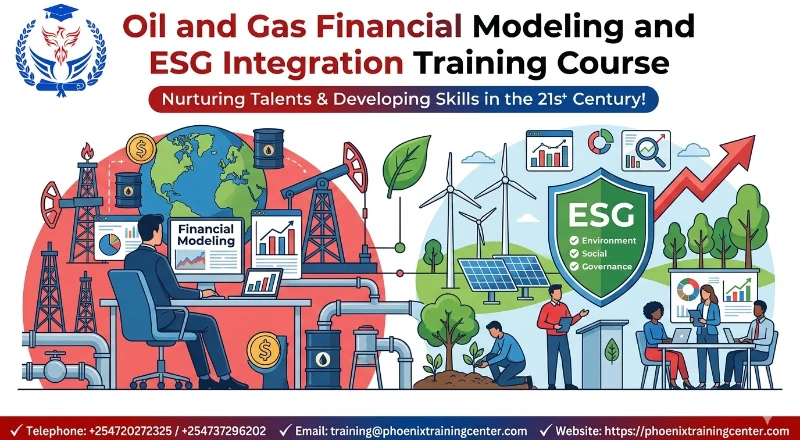
This comprehensive training course is strategically engineered to bridge the gap between advanced financial modeling and the rapidly evolving ESG (Environmental, Social, and Governance) compliance landscape within the energy sector. Participants will delve deep into building robust, dynamic, and flexible financial models tailored specifically for upstream, midstream, and downstream oil and gas projects. The curriculum seamlessly integrates modern valuation techniques with sophisticated risk assessment matrices to address the unique capital structures and volatile commodity pricing mechanisms inherent in the global energy market.
Moving beyond traditional financial metrics, the course places a heavy emphasis on incorporating ESG parameters into asset valuation and investment decision-making frameworks. Over five days, professionals will explore topics ranging from oil and gas accounting and fiscal regimes to carbon pricing mechanisms, climate risk quantification, and green financing strategies. Through hands-on modeling exercises, attendees will master the art of transforming complex operational data and ESG metrics into actionable financial insights, ensuring their organizations remain resilient, compliant, and highly competitive.
Upon the successful completion of this Oil and Gas Financial Modeling and ESG Integration Training Course, participants will be able to:
ü Master the design and construction of complex financial models for the oil and gas lifecycle.
ü Integrate ESG metrics, carbon taxes, and sustainability risks directly into valuation models.
ü Analyze and evaluate different international petroleum fiscal regimes, including PSCs and royalty/tax systems.
ü Conduct sophisticated sensitivity, scenario, and Monte Carlo simulations for volatile commodity markets.
ü Evaluate green financing options and optimize the cost of capital based on corporate ESG performance.
ü Structure bankable financial forecasts that satisfy stringent institutional investor and regulatory standards.
Training Methodology
The course is designed to be highly interactive, challenging and stimulating. It will be an instructor led training and will be delivered using a blended learning approach comprising of:
ü Interactive lectures and presentations framing theoretical concepts within real-world energy contexts.
ü Step-by-step Excel-based modeling laboratories utilizing raw industry data sets.
ü Detailed case studies reviewing actual oil and gas asset divestments and ESG integration failures.
ü Group problem-solving sessions focusing on risk mitigation and investment decision-making.
ü Practical Session integrated into every module to translate conceptual knowledge into hands-on technical proficiency.
Our facilitators are seasoned industry professionals with years of expertise in their chosen fields. All facilitation and course materials will be offered in English.
Who Should Attend?
This Oil and Gas Financial Modeling and ESG Integration Training Course would be suitable for, but not limited to:
ü Financial Analysts and Investment Bankers in the Energy Sector
ü Oil and Gas Chief Financial Officers, Controllers, and Finance Managers
ü Corporate Strategy and Business Development Professionals
ü ESG Officers and Sustainability Directors in Energy Companies
ü Petroleum Engineers and Project Managers transitioning into commercial roles
ü Government Regulators and Ministry of Petroleum Officials
ü Risk Managers and Internal Auditors within the extractive industries
Personal Benefits
ü Build elite-level financial models from scratch tailored to complex energy infrastructure assets.
ü Command a high-demand skill set at the intersection of traditional energy finance and modern ESG compliance.
ü Confidently advise senior leadership on investment viability, capital allocation, and risk management.
ü Enhance professional credibility and career mobility within global energy markets, investment banks, and consulting firms.
Organizational Benefits
ü Deploy robust financial frameworks that accurately mitigate commodity price and ESG-related risks.
ü Improve corporate access to capital by aligning investment pipelines with international green financing standards.
ü Optimize strategic planning through highly accurate, stress-tested cash flow forecasts and asset valuations.
ü Ensure seamless alignment between corporate financial objectives and evolving regional sustainability regulations.
ü Course Duration: 5 Days
ü Training Fee:
o Physical Training: USD 1,400
o Online / Virtual Training: USD 1,000
Module 1: Foundations of Oil and Gas Financial Modeling
ü Best practices in financial model architecture and spreadsheet design for energy assets
ü Constructing integrated income statements, balance sheets, and cash flow forecasts
ü Designing flexible timing flags and chronological frameworks for multi-decade projects
ü Setting up dynamic global assumptions for Brent and WTI crude, natural gas, and LNG pricing
ü Practical Session: Building a fully dynamic, integrated 3-statement template in Excel from raw operational assumptions.
Module 2: Modeling the Upstream, Midstream, and Downstream Lifecycles
ü Upstream production profiles: Decline curve analysis (DCA) and reserve calculations ($P_{10}$, $P_{50}$, $P_{90}$)
ü Midstream modeling: Tariff structures, throughput volumes, and pipeline capacity financial dynamics
ü Downstream economics: Refining margins, crack spreads, and petrochemical yield optimization
ü Forecasting capital expenditure (CAPEX) and operating expenditure (OPEX) across distinct asset classes
ü Practical Session: Constructing an upstream production and revenue forecast model incorporating variable decline curves.
Module 3: Petroleum Fiscal Regimes and Tax Structures
ü Concessionary systems: Modeling royalties, corporate income taxes, and resource rent taxes
ü Production Sharing Contracts (PSCs): Cost oil recovery, profit oil splits, and state participation mechanics
ü Modeling signature bonuses, production bonuses, and domestic market obligations (DMO)
ü Ring-fencing regulations and its impact on multi-asset corporate cash flows
ü Practical Session: Designing a comprehensive PSC distribution waterfall model to calculate investor vs. host government takes.
Module 4: Incorporating ESG Metrics into Financial Valuation
ü Translating qualitative ESG scores into quantitative financial model adjustments
ü Modeling the financial impact of environmental regulations, water management costs, and biodiversity offsets
ü Quantifying social license to operate risks and community development investment outlays
ü Adjusting asset beta and cash flow discount rates based on corporate governance and ESG risk profiles
ü Practical Session: Building an ESG risk-adjustment matrix that automatically feeds into an asset's Weighted Average Cost of Capital (WACC).
Module 5: Carbon Accounting, Pricing, and Tax Modeling
ü Introduction to Scope 1, 2, and 3 emissions quantification methodologies for energy projects
ü Integrating internal carbon pricing (ICP) and shadow carbon pricing into investment appraisal
ü Modeling financial exposures under compliance carbon markets (EU ETS) and voluntary carbon credits
ü Simulating the impact of carbon border adjustment mechanisms (CBAM) on global oil and gas export revenues
ü Practical Session: Building a carbon tax overlay module that calculates net project liabilities based on projected greenhouse gas emissions.
Module 6: Advanced Risk Analysis, Scenarios, and Sensitivity Modeling
ü Designing multi-variable scenario managers for macro-energy shifts (e.g., rapid energy transition vs. status quo)
ü Constructing dynamic data tables for two-way sensitivity analysis on price and volume
ü Using VBA and Excel add-ins to implement Monte Carlo simulations for asset valuation
ü Stress testing project cash flows against geopolitical supply shocks and unexpected regulatory revisions
ü Practical Session: Programming a dynamic scenario switchboard that updates the entire project model across five distinct macroeconomic futures.
Module 7: Cost of Capital Optimization and Green Financing
ü The evolution of energy financing: Traditional reserve-based lending (RBL) vs. sustainability-linked loans
ü Modeling the pricing mechanisms of green bonds, social bonds, and transition finance instruments
ü Calculating the economic benefits of ESG premium margin adjustments on corporate debt
ü Structuring project finance debt sizing, debt service cover ratios (DSCR), and loan life cover ratios (LLCR)
ü Practical Session: Developing a debt sculpting and repayment schedule that responds dynamically to sustainability-linked key performance indicators (KPIs).
Module 8: Asset Retirement Obligations (ARO) and Decommissioning Modeling
ü Regulatory frameworks governing oil and gas site restoration and asset retirement obligations
ü Estimating and escalating future decommissioning liabilities using inflation and risk-free rates
ü Modeling the accounting treatment of ARO: Asset retirement costs (ARC) capitalization and accretion expense
ü Building restricted decommissioning trust funds and sinking fund schedules into financial projections
ü Practical Session: Designing an ARO model that calculates annual accretion and builds a fully funded sinking fund for offshore platform decommissioning.
Module 9: Investment Appraisal, Valuation, and Decision Metrics
ü Discounted Cash Flow (DCF) analysis: Calculating Free Cash Flow to Firm (FCFF) and Equity (FCFE)
ü Evaluating investment returns via Net Present Value (NPV), Internal Rate of Return (IRR), and Payback Period
ü Utilizing modern portfolio theory and real options valuation for phased energy field developments
ü Benchmarking financial performance metrics against international peer groups and ESG indices
ü Practical Session: Developing a master investment dashboard comparing corporate investment metrics with and without ESG/carbon price integration.
Module 10: Model Audit, Stress Testing, and Reporting Dashboards
ü Techniques for auditing complex formulas, locating circular references, and ensuring model integrity
ü Designing clear, interactive executive summaries and reporting dashboards for C-suite presentation
ü Creating dynamic charts, waterfalls, and bridge diagrams to explain valuation movements
ü Final review and stress testing of full comprehensive models against unexpected operational failures
ü Practical Session: Executing a rigorous peer model-audit exercise and building a presentation-ready executive visual dashboard of the finalized model.
About Our Trainers
Our facilitators are elite financial consultants, seasoned investment bankers, and ESG energy specialists with over 15 years of active global experience. They have designed and audited multi-billion-dollar financial models for major national oil companies (NOCs), international oil companies (IOCs), and prominent financial institutions across the Middle East, Africa, and Europe. Combining deep technical mastery of financial engineering in Excel with practical knowledge of international ESG compliance framework implementations, our trainers ensure that concepts are grounded in current marketplace realities.
Quality Statement
Phoenix Training Center is committed to delivering world-class, high-impact professional development programs. Our courses are meticulously researched, continuously updated to reflect evolving industry dynamics, and designed to meet the highest international educational standards. We utilize rigorous quality control frameworks, peerless training materials, and interactive delivery platforms to guarantee that every training session provides substantial, tangible organizational value and transforms professional capabilities.
Tailor-Made Courses
We understand that every organization has unique challenges and opportunities as well as unique training needs. Phoenix Training Center offers tailor-made courses designed to address specific requirements and challenges faced by your team or organization. Whether you need a customized curriculum, a specific duration, or on-site delivery, we can adapt our expertise to provide a training solution that perfectly aligns with your objectives. We can customize this Course to focus on your industry, specific risk profile, or internal stakeholder dynamics. Contact us to discuss how we can create a bespoke training program that maximizes value and impact for your team. For further inquiries, please contact us on Tel: +254720272325 / +254737296202 or Email training@phoenixtrainingcenter.com.
Admission Criteria
ü Participants should be reasonably proficient in English.
ü Applicants must live up to Phoenix Center for Policy, Research and Training admission criteria.
Terms and Conditions
ü Discounts: Organizations sponsoring Four Participants will have the 5th attend Free
ü What is catered for by the Course Fees: Fees cater for all requirements for the training – Learning materials, Lunches, Teas, Snacks and Certification. All participants will additionally cater for their travel and accommodation expenses, visa application, insurance, and other personal expenses.
ü Certificate Awarded: Participants are awarded Certificates of Participation at the end of the training.
ü Course Improvement: The program content shown here is for guidance purposes only. Our continuous course improvement process may lead to changes in topics and course structure.
ü Approval of Course: Our Programs are NITA Approved. Participating organizations can therefore claim reimbursement on fees paid in accordance with NITA Rules.
Booking for Training
Kindly send an email to the Training Officer on training@phoenixtrainingcenter.com and we will send you a registration form. We advise you to book early to avoid missing a seat to this training. Or call us on +254720272325 / +254737296202
Payment Options
We provide 3 payment options, choose one for your convenience, and kindly make payments a week before the training starts (at least 5 to 7 days before the Training start date) to reserve your seat:
ü Groups of 5 People and Above – Cheque Payments to: Phoenix Center for Policy, Research and Training Limited should be paid in advance, a week before the training starts.
ü Invoice: We can send a bill directly to you or your company.
ü Deposit directly into Bank Account (Account details provided upon request)
Cancellation Policy
ü Payment for all courses includes a registration fee, which is non-refundable, and equals 15% of the total sum of the course fee.
ü Participants may cancel attendance 14 days or more prior to the training commencement date.
ü No refunds will be made 14 days or less before the training commencement date. However, participants who are unable to attend may opt to attend a similar training course at a later date or send a substitute participant provided the participation criteria have been met.
Accommodation and Airport Pick-up
For physical training attendees, we can assist with recommendations for accommodation near the training venue. Airport pick-up services can also be arranged upon request to ensure a smooth arrival. Please inform us of your travel details in advance if you require these services. For reservations contact the Training Officer on Email: training@phoenixtrainingcenter.com or on Tel: +254720272325 / +254737296202.
| Course Dates | Venue | Fees | Enroll |
|---|

Phoenix Training Center
Typically replies in minutes