
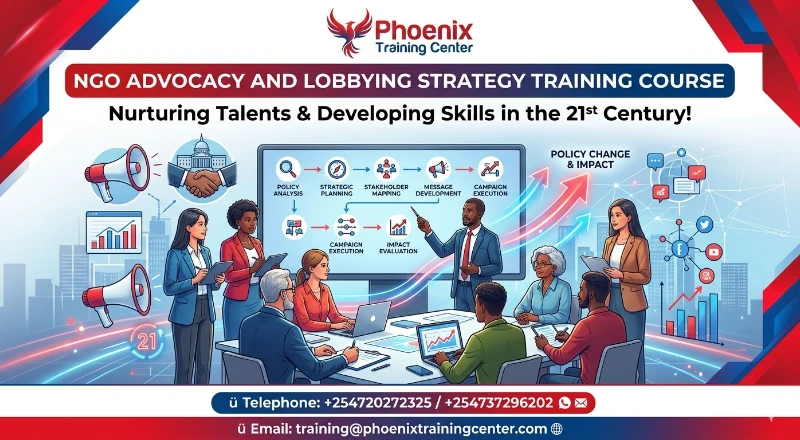
Course Overview
This professional-grade training program is specifically designed to equip NGO program officers, project managers, and civil society leaders with the strategic tools necessary to influence policy architecture and drive systemic change. In an era where operating spaces for non-governmental organizations are fluid, mastering the mechanics of structural influence is crucial for translating grassroots evidence into binding institutional policy.
The curriculum balances analytical depth with frontline campaign execution. Over five days, participants will master advanced stakeholder mapping, legislative drafting processes, coalition mechanics, and risk mitigation. By moving beyond traditional public awareness campaigns, this training prioritizes direct, high-impact lobbying methodologies that secure measurable policy reforms and organizational advancements.
Upon the successful completion of this NGO Advocacy and Lobbying Strategy Training Course, participants will be able to:
ü Deconstruct complex public policy lifecycles to isolate strategic intervention windows.
ü Formulate evidence-based policy briefs that convert field data into clear legislative arguments.
ü Map power dynamics within government agencies to accurately target real decision-makers.
ü Build resilient institutional coalitions that withstand political and economic opposition.
ü Design integrated digital advocacy campaigns that safely mobilize public and media pressure.
Training Methodology
The course is designed to be highly interactive, challenging and stimulating. It will be an instructor led training and will be delivered using a blended learning approach comprising of:
ü Case-driven comparative analysis of successful regional policy interventions
ü Simulated legislative committee hearings and policy defense panels
ü Peer-to-peer strategic review sessions using actual ongoing institutional projects
ü Interactive policy memo drafting laboratories utilizing real-world political datasets
ü Practical Session: Designing an end-to-end operational advocacy campaign map tailored to your organization's current core policy objective
Our facilitators are seasoned industry professionals with years of expertise in their chosen fields. All facilitation and course materials will be offered in English.
Who Should Attend?
This NGO Advocacy and Lobbying Strategy Training Course would be suitable for, but not limited to:
ü NGO Program Officers and Project Directors
ü Civil Society Policy Analysts and Researchers
ü Public Affairs Managers and Governance Specialists
ü Human Rights Defenders and Legal Advocates
ü Community Mobilization Coordinators
Personal Benefits
ü Navigate high-level political environments and legislative bodies with technical authority.
ü Employ structured negotiation and persuasion techniques with senior government officials.
ü Design rigorous, fundable advocacy proposals that elevate personal professional standing.
Organizational Benefits
ü Shift from reactive project management to proactive systemic policy influence.
ü Mitigate operational, legal, and reputational risks associated with public policy campaigns.
ü Maximize the return on campaign budgets through targeted, high-yield lobbying strategies.
ü Course Duration: 5 Days
ü Training Fee:
o Physical Training: USD 1,400 |
o Online / Virtual Training: USD 1,000
Module 1: Policy Lifecycles and Structural Advocacy Frameworks
ü Demarcating the technical operational boundaries between advocacy, public education, and formal lobbying
ü Analyzing steps of systemic agenda-setting within executive and legislative branches
ü Pinpointing structural leverage points within municipal, national, and regional decision-making tracks
ü Aligning long-term organizational objectives with fast-moving political legislative calendars
ü Practical Session: Mapping a real-world policy problem against a localized legislative lifecycle to locate optimal intervention windows
Module 2: Evidence-Based Policy Analysis and Legal Research
ü Translating raw field data and monitoring metrics into definitive, authoritative policy arguments
ü Reviewing constitutional provisions, statutory baselines, and active regulatory structures
ü Drafting clear, concise policy briefs designed for time-constrained legislative readers
ü Utilizing comparative regional data to demonstrate the feasibility of alternative policy models
ü Practical Session: Structuring an authoritative two-page policy brief from an unorganized project dataset
Module 3: Advanced Stakeholder Mapping and Power Matrices
ü Utilizing influence, interest, and authority indices to execute comprehensive actor mapping
ü Deconstructing internal ministerial hierarchies to find informal gatekeepers and true technical drivers
ü Formulating specific strategies to engage, neutralize, or convert active policy opponents
ü Managing state, private sector, and multi-lateral institutional competing agendas
ü Practical Session: Constructing a real-time Power-Interest Matrix for an active legislative reform proposal
Module 4: Message Architecture and Strategic Public Communication
ü Building a core messaging hierarchy tailored across state, media, and public audiences
ü Framing technical, dry policy language into urgent economic and social imperatives
ü Deploying human-interest storytelling frameworks validated by empirical research and data
ü Managing press relations, editorial boards, and organizing formal media briefings
ü Practical Session: Framing a complex regulatory issue into distinct pitches for a minister and a prime-time news editor
Module 5: Coalition Architecture and Alliance Governance
ü Evaluating strategic advantages, institutional trade-offs, and structural hazards of joint campaigns
ü Designing operational governance, decision-making, and consensus rules for diverse networks
ü Managing identity, resource competition, and ego friction across civil society organizations
ü Structuring temporary tactical alliances with non-traditional partners and private sector entities
ü Practical Session: Drafting a formal multi-party Memorandum of Understanding (MOU) for a national advocacy coalition
Module 6: Direct Lobbying Mechanics and Diplomatic Negotiation
ü Securing, structuring, and maximizing high-level meetings with executive officials and lawmakers
ü Mastering principled negotiation techniques to find common ground without compromising values
ü Drafting model legislative amendments and policy clauses ready for structural adoption
ü Understanding the psychology of political actors and leveraging their institutional incentives
ü Practical Session: Conducting a simulated, timed negotiation with a skeptical parliamentary committee chairperson
Module 7: Digital Mobilization and Grassroots Micro-Targeting
ü Designing multi-channel digital campaigns that convert passive online clicks into real civic action
ü Utilizing data analytics and segmentation to reach targeted demographics with advocacy calls
ü Navigating algorithmic distributions to maximize low-cost public campaign visibility
ü Integrating digital public pressure campaigns with direct, behind-the-scenes legislative lobbying
ü Practical Session: Designing an interactive digital mobilization campaign map for a localized policy demand
Module 8: Sustainable Resource Allocation and Campaign Budgeting
ü Costing out long-term systemic campaigns across research, communications, and institutional engagement
ü Structuring fundable advocacy proposals that meet strict international donor tracking requirements
ü Optimizing limited budgets through shared coalition resources and volunteer deployments
ü Ensuring long-term organizational sustainability over multi-year legislative struggles
ü Practical Session: Building a comprehensive line-item operational budget for a twelve-month policy campaign
Module 9: Metrics, Tracking, and Evaluation of Policy Influence
ü Developing practical indicators to measure incremental changes in political attitudes and legislative positions
ü Disentangling organizational contributions from broader historical and social shifts
ü Utilizing contribution analysis and outcome harvesting methodologies for complex policy tracks
ü Reporting advocacy progress to boards, institutional donors, and grassroots constituents
ü Practical Session: Constructing a monitoring and evaluation matrix for a non-linear policy reform initiative
Module 10: Political Risk Mitigation and Operational Security
ü Conducting institutional risk assessments across regulatory, financial, and reputational vectors
ü Navigating strict non-profit compliance acts, transparency registries, and lobbying disclosure laws
ü Securing sensitive organizational information, internal communications, and database systems
ü Formulating institutional contingency protocols for rapidly shifting political climates
ü Practical Session: Engineering a comprehensive rapid-response risk mitigation protocol for a sensitive civic space campaign
About Our Trainers
The faculty at Phoenix Training Center comprises prominent international policy experts, former legislative legal counsels, and veteran directors of continental civil society campaigns. Each instructor brings over fifteen years of frontline experience navigating parliamentary structures, ministerial offices, and regional bodies. Our trainers hold advanced qualifications in public policy, law, and international development, ensuring that academic frameworks are directly paired with practical tactical instructions.
Quality Statement
Phoenix Training Center maintains international standards across all educational offerings. Our programs are designed following extensive training needs assessments (TNA) and are under continuous review by our technical quality assurance board. We utilize highly interactive adult learning methodologies, ensuring immediate practical application. Every training asset, from case documentation to simulation matrices, is vetted to reflect current socio-political environments.
Tailor-Made Courses
We understand that every organization has unique challenges and opportunities as well as unique training needs. Phoenix Training Center offers tailor-made courses designed to address specific requirements and challenges faced by your team or organization. Whether you need a customized curriculum, a specific duration, or on-site delivery, we can adapt our expertise to provide a training solution that perfectly aligns with your objectives. We can customize this Course to focus on your industry, specific risk profile, or internal stakeholder dynamics. Contact us to discuss how we can create a bespoke training program that maximizes value and impact for your team. For further inquiries, please contact us on Tel: +254720272325 / +254737296202 or Email training@phoenixtrainingcenter.com.
Admission Criteria
ü Participants should be reasonably proficient in English.
ü Applicants must live up to Phoenix Center for Policy, Research and Training admission criteria.
Terms and Conditions
ü Discounts: Organizations sponsoring Four Participants will have the 5th attend Free
ü What is catered for by the Course Fees: Fees cater for all requirements for the training – Learning materials, Lunches, Teas, Snacks and Certification. All participants will additionally cater for their travel and accommodation expenses, visa application, insurance, and other personal expenses.
ü Certificate Awarded: Participants are awarded Certificates of Participation at the end of the training.
ü Course Improvement: The program content shown here is for guidance purposes only. Our continuous course improvement process may lead to changes in topics and course structure.
ü Approval of Course: Our Programs are NITA Approved. Participating organizations can therefore claim reimbursement on fees paid in accordance with NITA Rules.
Booking for Training
Kindly send an email to the Training Officer on training@phoenixtrainingcenter.com and we will send you a registration form. We advise you to book early to avoid missing a seat to this training. Or call us on +254720272325 / +254737296202
Payment Options
We provide 3 payment options, choose one for your convenience, and kindly make payments a week before the training starts (at least 5 to 7 days before the Training start date) to reserve your seat:
ü Groups of 5 People and Above – Cheque Payments to: Phoenix Center for Policy, Research and Training Limited should be paid in advance, a week before the training starts.
ü Invoice: We can send a bill directly to you or your company.
ü Deposit directly into Bank Account (Account details provided upon request)
Cancellation Policy
ü Payment for all courses includes a registration fee, which is non-refundable, and equals 15% of the total sum of the course fee.
ü Participants may cancel attendance 14 days or more prior to the training commencement date.
ü No refunds will be made 14 days or less before the training commencement date. However, participants who are unable to attend may opt to attend a similar training course at a later date or send a substitute participant provided the participation criteria have been met.
Accommodation and Airport Pick-up
For physical training attendees, we can assist with recommendations for accommodation near the training venue. Airport pick-up services can also be arranged upon request to ensure a smooth arrival. Please inform us of your travel details in advance if you require these services. For reservations contact the Training Officer on Email: training@phoenixtrainingcenter.com or on Tel: +254720272325 / +254737296202.
| Course Dates | Venue | Fees | Enroll |
|---|

Phoenix Training Center
Typically replies in minutes