
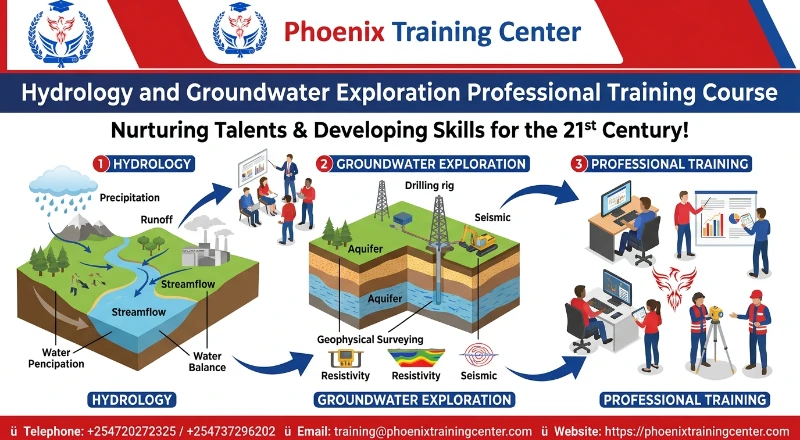
Course Overview
The Hydrology and Groundwater Exploration Professional Training Course provides an exhaustive, hands-on deep dive into modern surface water and groundwater resource management. As global water scarcity increases, professionals must master technical frameworks to accurately locate, evaluate, model, and sustainably manage subterranean aquifers. This intensive program bridges theoretical hydrogeological principles with advanced geophysical field technologies, ensuring that participants develop actionable competencies in watershed analysis, well hydraulics, remote sensing application, and water quality testing protocols.
This comprehensive curriculum spans 18 core modules meticulously structured to deliver a 360-degree technical capacity-building experience. Participants will progress through foundational fluid dynamics, geological aquifer characterization, specialized borehole drilling engineering, and GIS-based catchment modeling. The course heavily emphasizes field-ready expertise, detailing advanced electrical resistivity surveys, seismic refraction methods, isotope hydrology, and numerical groundwater flow simulation. Additionally, the syllabus addresses critical contemporary issues such as managed aquifer recharge, saltwater intrusion mitigation, contaminant transport modeling, and transboundary water governance.
Upon the successful completion of this Hydrology and Groundwater Exploration Professional Training Course, participants will be able to:
ü Master the principles of surface hydrology, water balance equations, and catchment-level runoff mechanisms.
ü Conduct field-level geophysical surveys using electrical resistivity, electromagnetic, and seismic techniques to locate high-yield aquifers.
ü Design, supervise, and optimize borehole drilling, well construction, and well development operations.
ü Analyze pumping test data using analytical methods to determine critical aquifer parameters like transmissivity and storativity.
ü Deploy GIS, remote sensing, and numerical modeling tools for groundwater mapping and predictive resource management.
ü Implement robust groundwater quality monitoring networks and evaluate water chemistry data using hydrochemical plots.
ü Design sustainable groundwater exploitation strategies, including managed aquifer recharge (MAR) systems and climate change adaptation plans.
Training Methodology
The course is designed to be highly interactive, challenging and stimulating. It will be an instructor led training and will be delivered using a blended learning approach comprising of:
ü Interactive lectures and multimedia technical presentations
ü Step-by-step software demonstrations and computing laboratory exercises (GIS, MODFLOW, and pumping test software)
ü Real-world engineering case studies and exploratory data analysis
ü Collaborative group problem-solving and peer-reviewed design projects
ü Comprehensive hands-on field equipment simulation and data interpretation workshops
Our facilitators are seasoned industry professionals with years of expertise in their chosen fields. All facilitation and course materials will be offered in English.
Who Should Attend?
This Hydrology and Groundwater Exploration Professional Training Course would be suitable for, but not limited to:
ü Hydrogeologists and Geologists
ü Hydrologists and Surface Water Engineers
ü Civil, Environmental, and Agricultural Engineers
ü Water Resource Managers and Planners
ü Geophysical Survey Specialists
ü Drilling Supervisors and Technicians
ü Environmental Consultants and Impact Assessment Officers
ü Technical personnel from municipal water authorities and environmental regulatory bodies
Personal Benefits
ü Confidently deploy specialized geophysical equipment to pinpoint optimal borehole drilling locations.
ü Interpret complex hydrogeological datasets, chemical profiles, and pumping test curves with professional precision.
ü Enhance professional marketability and career progression as a certified expert in groundwater exploration and watershed management.
ü Formulate data-driven technical solutions to mitigate borehole failure rates and groundwater contamination issues.
Organizational Benefits
ü Maximize drilling success rates, thereby significantly reducing capital expenditure on dry or low-yield boreholes.
ü Build internal institutional capacity to execute sophisticated hydrological and geophysical studies without relying on costly external consultants.
ü Ensure organizational compliance with local and international environmental frameworks and water extraction regulations.
ü Safeguard corporate and public water supplies through the implementation of advanced aquifer protection and monitoring protocols.
ü Course Duration: 10 Days
ü Training Fee:
o Physical Training: USD 3,000
o Online / Virtual Training: USD 2,200
Module 1: Introduction to Hydrology and the Hydrological Cycle
ü Global distribution of water and global water balance dynamics
ü Precipitation mechanisms, measurement networks, and data processing
ü Evaporation, transpiration, and interception processes
ü Infiltration theories, Horton’s model, and soil infiltration capacity measurement
ü Practical Session: Calculating catchment-scale water budgets and processing missing precipitation data using statistical interpolation techniques.
Module 2: Hydrogeology and Aquifer System Dynamics
ü Geological formations and their water-bearing properties
ü Classification of aquifers: Unconfined, confined, leaky, and perched systems
ü Porosity, specific yield, and specific retention across diverse rock types
ü Structural geology influences on groundwater occurrence and localized preferential flow paths
ü Practical Session: Core logging analysis and geological cross-section construction to map regional aquifer layouts.
Module 3: Principles of Groundwater Flow and Hydraulics
ü Darcy’s Law: Validity, experimental setup, and hydraulic gradient analysis
ü Hydraulic conductivity, transmissivity, and intrinsic permeability calculations
ü Governing equations for steady and unsteady groundwater flow in confined/unconfined media
ü Flownets: Derivation, construction, and estimation of groundwater seepage rates
ü Practical Session: Constructing and solving two-dimensional flownets for groundwater flow under a retaining structure.
Module 4: Surface Water Hydrology and Watershed Catchment Analysis
ü Delineation of watersheds, stream order classification, and morphometric analysis
ü Hydrograph analysis: Baseflow separation, unit hydrographs, and synthetic unit hydrographs
ü Overland flow modeling and flood routing mechanisms through reservoirs and channels
ü Streamflow measurement techniques, stage-discharge rating curves, and gauging stations
ü Practical Session: Delineating a river basin and generating a design storm hydrograph using digital elevation models (DEMs).
Module 5: Geophysical Exploration Techniques for Groundwater Assessment
ü Electrical Resistivity Tomography (ERT) and Vertical Electrical Sounding (VES) configurations
ü Electromagnetic (EM) methods and transient electromagnetic (TEM) applications
ü Seismic refraction physics and application in mapping bedrock geometry
ü Borehole geophysical logging: Gamma, resistivity, and spontaneous potential logs
ü Practical Session: Interpreting 1D Vertical Electrical Sounding (VES) data curves using specialized inversion software to locate water-bearing fracture zones.
Module 6: Borehole Drilling Technologies and Well Design Engineering
ü Selection criteria for drilling methods: Rotary, percussion, reverse circulation, and air-hammer drilling
ü Drilling fluids: Functions, properties, mud design, and environmental impacts
ü Design of well casing, screen slots, and custom filter pack design optimization
ü Borehole instability problems, fishing tools, and remediation of collapsed holes
ü Practical Session: Calculating optimal screen slot sizes and gravel pack grading based on formation sieve analysis data.
Module 7: Well Development, Pumping Tests, and Aquifer Parameter Estimation
ü Well development methods: Jetting, surging, acidizing, and air-lifting
ü Design of pumping tests: Step-drawdown, constant-rate, and recovery tests
ü Analytical solutions: Theis, Cooper-Jacob, and Neuman methods for parameter estimation
ü Well loss vs. formation loss analysis and calculation of well efficiency
ü Practical Session: Analyzing time-drawdown data from a multi-well pumping test using Cooper-Jacob diagnostic plots to derive transmissivity (T) and storativity (S).
Module 8: Hydrochemistry, Water Quality Analysis, and Sampling Protocols
ü Major ions, minor elements, and trace metal chemistry in natural groundwater
ü Groundwater contamination sources: Agricultural, industrial, and municipal landfill leachates
ü Field sampling protocols: Purging, filtration, acidification, and chain-of-custody documentation
ü Graphical representations of water quality data: Piper, Durov, and Stiff diagrams
ü Practical Session: Executing charge balance error calculations and plotting field hydrochemical datasets onto a Piper diagram to determine water facies.
Module 9: Application of GIS and Remote Sensing in Groundwater Mapping
ü Fundamentals of remote sensing: Satellite imagery, spectral bands, and indices
ü GIS data integration: Soil maps, land use/land cover (LULC), lineaments, and drainage density
ü Multi-Criteria Decision Analysis (MCDA) using the Analytic Hierarchy Process (AHP)
ü Mapping groundwater potential zones and localized recharge vulnerability indices
ü Practical Session: Developing an integrated GIS model to map groundwater potential zones within an urbanizing watershed catchment.
Module 10: Numerical Groundwater Flow and Contaminant Transport Modeling
ü Introduction to numerical modeling concepts: Finite-difference vs. finite-element methods
ü Model conceptualization, boundary condition definition, and grid design constraints
ü Model calibration (steady-state and transient), sensitivity analysis, and validation protocols
ü Advection, dispersion, and chemical retardation modeling in porous media
ü Practical Session: Setting up a basic 3D groundwater flow simulation scenario and tracking a conservative plume using MODFLOW/MT3DMS software frameworks.
Module 11: Managed Aquifer Recharge (MAR) and Rainwater Harvesting Systems
ü Typology of MAR: Spreading basins, recharge wells, check dams, and subsurface barriers
ü Hydrogeological site selection criteria and source water quality considerations for injection
ü Clogging mechanisms in recharge structures: Physical, chemical, and biological remediation
ü Institutional planning, cost-benefit analyses, and monitoring of MAR efficiency
ü Practical Session: Designing a multi-tiered check-dam network and infiltration basin structure based on site-specific runoff and soil infiltration curves.
Module 12: Groundwater Management in Coastal and Arid Regions
ü Physics of freshwater-saltwater interfaces: The Ghyben-Herzberg relation and upconing dynamics
ü Monitoring, modeling, and engineered barriers against saltwater intrusion
ü Arid zone hydrogeology: Wadis, ephemeral stream recharge, and deep fossil aquifers
ü Desalination brine disposal and brackish groundwater exploitation strategies
ü Practical Session: Applying the Ghyben-Herzberg analytical equation to calculate the safe yield of a coastal unconfined aquifer system without triggering upconing.
Module 13: Soil Moisture Dynamics, Vadose Zone Hydrology, and Evapotranspiration
ü Physics of the unsaturated zone: Matrix suction, soil water retention curves, and Richard’s equation
ü Instruments for soil moisture tracking: Tensiometers, TDR probes, and neutron probes
ü Actual vs. potential evapotranspiration modeling using the Penman-Monteith methodology
ü Groundwater-surface water-atmosphere interactions and capillary rise calculations
ü Practical Session: Computing daily actual evapotranspiration and vadose zone water flux using localized weather station dataset profiles.
Module 14: Isotope Hydrology and Advanced Tracer Techniques
ü Stable isotopes in the hydrological cycle and the Meteoric Water Line
ü Radioactive isotopes for groundwater dating and age calculation
ü Environmental and artificial tracers (dyes, salts) for conduit routing in karst terrains
ü Mixing cell models and source partitioning using isotopic mass balance equations
ü Practical Session: Calculating the percentage of modern vs. fossil water components in an urban well field using stable isotope mixing equations.
Module 15: Environmental Impact Assessment (EIA) for Groundwater Extraction Projects
ü Regulatory frameworks and environmental clearance procedures for massive water abstractions
ü Assessment of land subsidence risks driven by intensive aquifer dewatering
ü Impacts of groundwater drawdown on groundwater-dependent ecosystems (GDEs) and baseflow
ü Mitigation strategies, monitoring plans, and environmental management programs (EMPs)
ü Practical Session: Compiling a comprehensive matrix-based Environmental Management Plan for a proposed industrial well-field extraction project.
Module 16: Climate Change Impacts on Hydrological Systems and Aquifer Vulnerability
ü Global climate model (GCM) downscaling methods for localized hydrological assessments
ü Impacts of shifting precipitation patterns and intense droughts on aquifer replenishment
ü Assessing aquifer vulnerability using standardized DRASTIC index weighting frameworks
ü Adaptive water infrastructure and resilient regional development strategies
ü Practical Session: Calculating and mapping a regional aquifer vulnerability score using the DRASTIC index weighting method within a GIS platform.
Module 17: Groundwater Governance, Transboundary Aquifers, and Water Law
ü Principles of water law: Riparian rights, prior appropriation, and public trust doctrines
ü Institutional frameworks for groundwater allocation, pricing mechanisms, and extraction capping
ü International law and management frameworks for transboundary aquifer systems
ü Stakeholder engagement strategies and community-based groundwater management paradigms
ü Practical Session: Simulating a transboundary water conflict negotiation based on a shared transboundary aquifer model experiencing localized over-extraction.
Module 18: Integrated Water Resources Management (IWRM) and Capstone Field Data Integration
ü The IWRM paradigm: Coordinating land, water, and related resource development sectors
ü Convective conjunctive use optimization strategies for surface water and groundwater resources
ü Data integration workflows: Combining geophysical, geochemical, and hydraulic datasets
ü Practical Session: Synthesizing geophysical charts, borehole logs, chemical reports, and community demand projections into a comprehensive, multi-year Water Resource Development Master Plan.
About Our Trainers
Our instructional team comprises highly accomplished hydrogeologists, geophysicists, and water resource engineers who possess extensive international experience. Each trainer holds a minimum of a Master’s degree (with multiple PhD-level instructors) alongside over 15 years of active field consultancy and research experience across Sub-Saharan Africa, Europe, and the Middle East. They possess deep competencies in executing multi-million-dollar water exploration initiatives, drilling supervision, regional groundwater modeling, and advising transboundary water ministries.
Quality Statement
Phoenix Training Center is dedicated to delivering industry-standard professional capacity development. Our curriculum undergoes peer review by professional bodies to ensure strict compliance with modern technological advancements and international environmental standards. We maintain a strict ratio of practical-to-theoretical instruction, utilizing cutting-edge equipment and validated engineering software, ensuring that our training programs deliver maximum return on investment for participating organizations.
Tailor-Made Courses
We understand that every organization has unique challenges and opportunities as well as unique training needs. Phoenix Training Center offers tailor-made courses designed to address specific requirements and challenges faced by your team or organization. Whether you need a customized curriculum, a specific duration, or on-site delivery, we can adapt our expertise to provide a training solution that perfectly aligns with your objectives. We can customize this Course to focus on your industry, specific risk profile, or internal stakeholder dynamics. Contact us to discuss how we can create a bespoke training program that maximizes value and impact for your team. For further inquiries, please contact us on Tel: +254720272325 / +254737296202 or Email training@phoenixtrainingcenter.com.
Admission Criteria
ü Participants should be reasonably proficient in English.
ü Applicants must live up to Phoenix Center for Policy, Research and Training admission criteria.
Terms and Conditions
ü Discounts: Organizations sponsoring Four Participants will have the 5th attend Free
ü What is catered for by the Course Fees: Fees cater for all requirements for the training – Learning materials, Lunches, Teas, Snacks and Certification. All participants will additionally cater for their travel and accommodation expenses, visa application, insurance, and other personal expenses.
ü Certificate Awarded: Participants are awarded Certificate of Completion at the end of the training.
ü Course Improvement: The program content shown here is for guidance purposes only. Our continuous course improvement process may lead to changes in topics and course structure.
ü Approval of Course: Our Programs are NITA Approved. Participating organizations can therefore claim reimbursement on fees paid in accordance with NITA Rules.
Booking for Training
Kindly send an email to the Training Officer on training@phoenixtrainingcenter.com and we will send you a registration form. We advise you to book early to avoid missing a seat to this training. Or call us on +254720272325 / +254737296202
Payment Options
We provide 3 payment options, choose one for your convenience, and kindly make payments at least 5 days before the Training start date to reserve your seat:
ü Groups of 5 People and Above – Cheque Payments to: Phoenix Center for Policy, Research and Training Limited should be paid in advance, 5 days to the training.
ü Invoice: We can send a bill directly to you or your company.
ü Deposit directly into Bank Account (Account details provided upon request)
Cancellation Policy
ü Payment for all courses includes a registration fee, which is non-refundable, and equals 15% of the total sum of the course fee.
ü Participants may cancel attendance 14 days or more prior to the training commencement date.
ü No refunds will be made 14 days or less before the training commencement date. However, participants who are unable to attend may opt to attend a similar training course at a later date or send a substitute participant provided the participation criteria have been met.
Accommodation and Airport Pick-up
For physical training attendees, we can assist with recommendations for accommodation near the training venue. Airport pick-up services can also be arranged upon request to ensure a smooth arrival. Please inform us of your travel details in advance if you require these services. For reservations contact the Training Officer on Email: training@phoenixtrainingcenter.com or on Tel: +254720272325 / +254737296202.
| Course Dates | Venue | Fees | Enroll |
|---|

Phoenix Training Center
Typically replies in minutes