
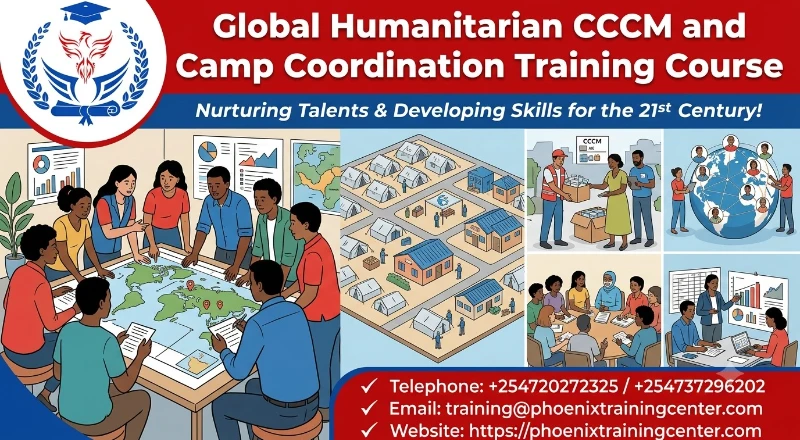
Course Overview
The Global Humanitarian CCCM Course and Camp Coordination Training Course is designed to build the capacity of humanitarian practitioners, camp managers, and field officers handling displacement crises. Effective field response requires a robust alignment with international frameworks, but many teams on the ground lack the unified operational skills required to coordinate services smoothly. This program provides an authoritative CCCM training environment that turns theoretical humanitarian standards into practical, life-saving operational capacity. Utilizing globally recognized frameworks, this intensive syllabus stands as a CCCM training best practice pathway for professionals who manage displacement settings, collective centers, and spontaneous camp sites.
The curriculum is built entirely upon established international standards and core displacement field tools. Throughout this foundational CCCM course, participants will dive into stakeholder coordination, community participation structures, information management systems, and the application of minimum sphere indicators. Celebrated across the sector as a CCCM course best framework, the program provides comprehensive instructions on protection mainstreaming, environmental sustainability, and camp closure or transition management. By pairing formal classroom guidance with hands-on scenario planning, this CCCM certification training package, CCCM course, CCCM training experience delivers the field-ready skills needed to protect the dignity and safety of displaced populations.
Upon the successful completion of this Global Humanitarian CCCM and Camp Coordination Training Course, participants will be able to:
ü Interpret and enforce international legal frameworks, humanitarian principles, and foundational CCCM training responsibilities in displacement sites.
ü Establish transparent, representative camp governance structures that maximize community participation and protect vulnerable populations.
ü Organize multi-sectoral humanitarian partners to eliminate service gaps and avoid duplication using structured information management systems.
ü Mainstream gender-based violence (GBV) mitigation, child protection, and general protection principles across all camp activities.
ü Design and execute sustainable site maintenance plans, facility upgrades, and safe camp closure or transition strategies.
Training Methodology
The course is designed to be highly interactive, challenging and stimulating. It will be an instructor led training and will be delivered using a blended learning approach comprising of:
ü Interactive technical lectures based on global CCCM training package guidelines
ü Real-world humanitarian case studies detailing camp setups, displacement crises, and solutions
ü Collaborative peer groups, table-top simulations, and structured field role-play assignments
ü Information management dashboards, data collection tools, and service monitoring templates
ü Guided scenario-based emergency response simulation labs
Our facilitators are seasoned industry professionals with years of expertise in their chosen fields. All facilitation and course materials will be offered in English.
Who Should Attend?
This Global Humanitarian CCCM and Camp Coordination Training Course would be suitable for, but not limited to:
ü Camp Managers, Camp Coordinators, and Site Officers working in displacement settings
ü Humanitarian Project Managers and Field Coordinators from UN agencies and NGOs
ü Government Disaster Management Officers and Emergency Response Personnel
ü Protection Officers, Social Workers, and Human Rights Advocates in emergency zones
ü Logistics, Water, Sanitation, and Hygiene (WASH), and Shelter Specialists seeking a complete CCCM course view
Benefits of the Training
Personal Benefits
ü Attainment of a vital humanitarian skillset that builds professional credibility and qualifies you for leadership roles in global displacement responses.
ü Deepened technical competency in site management, collaborative coordination, and community engagement methodologies.
ü Greater confidence to manage multi-sectoral humanitarian operations, handle security emergencies, and advocate for displaced populations.
Organizational Benefits
ü Standardized implementation of camp management practices that closely align with global humanitarian benchmarks.
ü Improved operational coordination between your team, local authorities, UN agencies, and international NGOs.
ü Enhanced protection monitoring and risk mitigation, drastically reducing service gaps and improving the safety of beneficiaries.
ü Course Duration: 5 Days
ü Training Fee:
o Physical Training: USD 1,500
o Online / Virtual Training: USD 1,000
Module 1: Introduction to CCCM Concepts, Roles, and Humanitarian Principles
ü Definition, scope, and objectives of Camp Coordination and Camp Management (CCCM)
ü Differentiating between Camp Coordination, Camp Management, and Site Support functions
ü Core humanitarian principles: Humanity, neutrality, impartiality, and operational independence
ü Overview of displacement typologies: Planned camps, collective centers, and spontaneous sites
ü Practical Session: Mapping a localized displacement scenario to identify core CCCM training priority responses
Module 2: International Legal Frameworks, Human Rights, and Protection Foundations
ü Understanding the Guiding Principles on Internal Displacement and international refugee law
ü Core rights of Internally Displaced Persons (IDPs) and host community dynamics
ü Introduction to the central role of protection in any standard CCCM course
ü Identifying and addressing vulnerability criteria: Age, gender, and structural diversity factors
ü Practical Session: Evaluating a field scenario case study to identify human rights violations and protection gaps
Module 3: Roles and Responsibilities: Agency, Authority, and Coordinator Dynamics
ü Defining the mandate of the Lead Camp Coordination Agency at national and global levels
ü Analyzing the role of national authorities and sovereign government counterparts in camp settings
ü Day-to-day responsibilities of the Camp Management Agency within physical site boundaries
ü Managing relationships, resolving friction, and building collaborative coordination mechanisms
ü Practical Session: Role-playing a tripartite coordination meeting between authorities, coordinators, and managers
Module 4: Community Participation and Governance Structures in Displacement Sites
ü Core concepts of community-led participation, representation, and community empowerment
ü Establishing inclusive camp committees: Ensuring gender, age, and minority representation
ü Creating accessible, confidential, and responsive Accountability to Affected Populations (AAP) feedback loops
ü Mobilizing community resources for self-governance and localized dispute resolution
ü Practical Session: Designing a comprehensive community engagement and feedback matrix for a multi-ethnic displacement site
Module 5: Information Management, Service Monitoring, and Reporting Tools
ü Foundations of data collection, population registration, and demographic profiling in camps
ü Designing and updates to 3W (Who, What, Where) databases and camp service mapping tools
ü Establishing inter-agency indicator monitoring frameworks based on Sphere Minimum Standards
ü Protecting sensitive personal data: Protocols for secure information handling and sharing
ü Practical Session: Populating a camp monitoring template and building an operational service gap report
Module 6: Site Planning, Infrastructure Maintenance, and Environment Management
ü Minimum spatial standards, layout rules, and accessibility principles for camp infrastructure
ü Coordinating shelter allocations, distribution zones, and administrative spaces
ü Developing routine, preventative, and corrective maintenance programs for site facilities
ü Mitigating environmental degradation, managing waste disposal, and setting energy protocols
ü Practical Session: Group structural review using site maps to reorganize unsafe and overcrowded camp zones
Module 7: Protection Mainstreaming and Gender-Based Violence (GBV) Mitigation
ü Practical steps for mainstreaming protection across all sector actions within the camp
ü Identifying and eliminating structural safety risks linked to layout, lighting, and wash zones
ü Establishing clear, survivor-centric referral pathways for Gender-Based Violence (GBV) cases
ü Child protection in emergencies: Safe spaces, tracing networks, and unaccompanied minor protocols
ü Practical Session: Conducting a comprehensive camp safety walk simulation to identify and fix high-risk protection zones
Module 8: Multi-Sector Coordination: Food Security, WASH, Health, and Shelter Integration
ü Coordinating with WASH partners to monitor water supply safety and sanitation coverage
ü Streamlining food assistance distributions, nutrition programs, and marketplace areas
ü Integrating public health interventions, vaccination campaigns, and medical referral vectors
ü Managing non-food item (NFI) pipelines, targeting criteria, and post-distribution reviews
ü Practical Session: Organizing a simulated emergency distribution plan following an unannounced pipeline disruption
Module 9: Contingency Planning, Security Management, and Emergency Response
ü Developing comprehensive multi-hazard contingency plans for displacement sites
ü Assessing security risks, camp policing dynamics, and keeping humanitarian access safe
ü Managing civilian-military coordination boundaries based on international guidelines
ü Fire safety, flood mitigation, and immediate medical evacuation protocols in high-density sites
ü Practical Session: Running a table-top fire emergency simulation lab to practice rapid communication and evacuation paths
Module 10: Camp Transition, Sustainable Closure, and Durable Solutions
ü Strategic definitions of durable solutions: Sustainable return, local integration, or resettlement
ü Developing benchmarks, timelines, and multi-stakeholder plans for camp closures
ü Environmental remediation and decommissioning protocols for structural camp facilities
ü Managing asset handovers, legal land hand-backs, and administrative closure files
ü Practical Session: Formulating a 90-day camp transition and closure roadmap for a stabilizing displacement region
About Our Trainers
Our trainers are veteran humanitarian professionals and emergency response coordinators with over 15 years of active field operations across complex emergency deployments, conflict zones, and natural disaster settings globally. Holding advanced degrees in Humanitarian Action, International Law, and Development Studies, they are certified trainers within the global CCCM cluster framework. They have led complex field setups, managed sprawling displacement cities, and advised international bodies on protection engineering, ensuring every session is packed with battle-tested solutions and real operational value.
Quality Statement
Phoenix Training Center is dedicated to providing high-impact professional education that fulfills the highest global benchmarks of humanitarian excellence. Our course curricula are continuously updated, peer-reviewed, and rigorously evaluated against evolving guidelines from the Global CCCM Cluster and international standard-setting bodies. By prioritizing interactive learning models, authentic case metrics, and field-tested tool kits, we guarantee an educational environment that builds actionable competencies and drives exceptional field outcomes.
Tailor-Made Courses
We understand that every organization has unique challenges and opportunities as well as unique training needs. Phoenix Training Center offers tailor-made courses designed to address specific requirements and challenges faced by your team or organization. Whether you need a customized curriculum, a specific duration, or on-site delivery, we can adapt our expertise to provide a training solution that perfectly aligns with your objectives. We can customize this Course to focus on your industry, specific risk profile, or internal stakeholder dynamics. Contact us to discuss how we can create a bespoke training program that maximizes value and impact for your team. For further inquiries, please contact us on Tel: +254720272325 / +254737296202 or Email training@phoenixtrainingcenter.com.
Admission Criteria
ü Participants should be reasonably proficient in English.
ü Applicants must live up to Phoenix Center for Policy, Research and Training admission criteria.
Terms and Conditions
ü Discounts: Organizations sponsoring Four Participants will have the 5th attend Free
ü What is catered for by the Course Fees: Fees cater for all requirements for the training – Learning materials, Lunches, Teas, Snacks and Certification. All participants will additionally cater for their travel and accommodation expenses, visa application, insurance, and other personal expenses.
ü Certificate Awarded: Participants are awarded Certificate of Completion at the end of the training.
ü Course Improvement: The program content shown here is for guidance purposes only. Our continuous course improvement process may lead to changes in topics and course structure.
ü Approval of Course: Our Programs are NITA Approved. Participating organizations can therefore claim reimbursement on fees paid in accordance with NITA Rules.
Booking for Training
Kindly send an email to the Training Officer on training@phoenixtrainingcenter.com and we will send you a registration form. We advise you to book early to avoid missing a seat to this training. Or call us on +254720272325 / +254737296202
Payment Options
We provide 3 payment options, choose one for your convenience, and kindly make payments a week before the training starts (at least 5 to 7 days before the Training start date) to reserve your seat:
ü Groups of 5 People and Above – Cheque Payments to: Phoenix Center for Policy, Research and Training Limited should be paid in advance, a week before the training starts.
ü Invoice: We can send a bill directly to you or your company.
ü Deposit directly into Bank Account (Account details provided upon request)
Cancellation Policy
ü Payment for all courses includes a registration fee, which is non-refundable, and equals 15% of the total sum of the course fee.
ü Participants may cancel attendance 14 days or more prior to the training commencement date.
ü No refunds will be made 14 days or less before the training commencement date. However, participants who are unable to attend may opt to attend a similar training course at a later date or send a substitute participant provided the participation criteria have been met.
Accommodation and Airport Pick-up
For physical training attendees, we can assist with recommendations for accommodation near the training venue. Airport pick-up services can also be arranged upon request to ensure a smooth arrival. Please inform us of your travel details in advance if you require these services. For reservations contact the Training Officer on Email: training@phoenixtrainingcenter.com or on Tel: +254720272325 / +254737296202.
| Course Dates | Venue | Fees | Enroll |
|---|---|---|---|
| Sep 28 - Oct 02 2026 | Zoom | $1,000 |
|
| Sep 21 - Sep 25 2026 | Naivasha | $1,500 |
|
| Oct 05 - Oct 09 2026 | Nairobi | $1,500 |
|
| Oct 12 - Oct 16 2026 | Mombasa | $1,500 |
|
| Oct 19 - Oct 23 2026 | Eldoret | $1,500 |
|
| Oct 19 - Oct 23 2026 | Zoom | $1,000 |
|
| Oct 26 - Oct 30 2026 | Naivasha | $1,500 |
|

Phoenix Training Center
Typically replies in minutes