
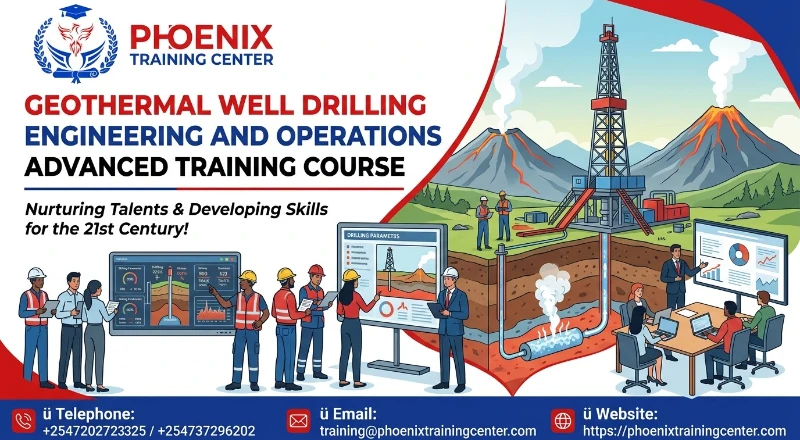
Course Overview
Geothermal well drilling presents unique technical challenges compared to conventional oil and gas operations, requiring specialized knowledge in high-temperature thermodynamics, severe lost circulation control, and hard-rock drilling techniques. This comprehensive program provides energy sector professionals with end-to-end expertise in planning, executing, and optimizing high-enthalpy and low-enthalpy geothermal drilling projects. Participants will explore advanced casing design, specialized drilling fluids, high-temperature directional drilling, and well completion strategies to minimize non-productive time and maximize resource recovery.
The program systematically guides participants through the foundational and advanced phases of geothermal exploration and production drilling. Key topics include subsurface geological risk mitigation, drill bit selection for abrasive formations, high-temperature cement formulations, well control in steam-dominated reservoirs, and environmental sustainability standards. Through practical case studies and real-world simulations, attendees will gain actionable insights into cost reduction, safety management, and well longevity in extreme geothermal environments.
Upon the successful completion of this Geothermal Well Drilling Engineering and Operations Advanced Training Course, participants will be able to:
ü Design safe, cost-effective geothermal well architecture for high-temperature and high-pressure reservoirs.
ü Formulate specialized drilling fluids to mitigate severe lost circulation and maintain hole stability in hard rock formations.
ü Apply high-temperature casing and cementing best practices to prevent casing collapse and steam leaks.
ü Select and optimize drill bits, bottom hole assemblies (BHAs), and directional drilling tools for abrasive sub-surface conditions.
ü Execute effective well control tactics specific to geothermal steam, gas kick, and blowouts.
ü Implement robust health, safety, and environmental (HSE) management systems during drilling operations.
Training Methodology
The course is designed to be highly interactive, challenging and stimulating. It will be an instructor led training and will be delivered using a blended learning approach comprising of:
ü Interactive lectures led by senior field experts
ü Real-world geothermal field case studies and dynamic problem-solving sessions
ü Practical software-based modeling exercises and BHA design simulations
ü Daily interactive Q&A and peer-to-peer technical knowledge exchanges
ü Group syndicate work evaluating actual geothermal drilling datasets
Our facilitators are seasoned industry professionals with years of expertise in their chosen fields. All facilitation and course materials will be offered in English.
Who Should Attend?
This Geothermal Well Drilling Engineering and Operations Advanced Training Course would be suitable for, but not limited to:
ü Drilling Engineers and Operations Managers
ü Geothermal Asset Managers and Project Leaders
ü Reservoir Engineers and Production Engineers
ü Geoscientists and Subsurface Exploration Teams
ü Drilling Contractors, Rig Superintendents, and Wellsite Supervisors
ü Energy Transition Executives and Technical Consultants
Benefits of the Training
Personal Benefits
ü Master cutting-edge engineering techniques specific to high-temperature geothermal wells.
ü Enhance career mobility in the rapidly expanding renewable and geothermal energy sectors.
ü Develop operational troubleshooting skills to prevent expensive downhole failures.
ü Expand professional networks with global geothermal industry peers and specialists.
Organizational Benefits
ü Reduce overall well construction costs and minimize non-productive time (NPT).
ü Enhance well integrity and extend the operational lifespan of geothermal production assets.
ü Mitigate environmental, well control, and operational risk factors during drilling.
ü Accelerate project delivery schedules through optimized drilling engineering practices.
ü Course Duration: 5 Days
ü Training Fee:
o Physical Training: USD 1,500
o Online / Virtual Training: USD 1,000
Module 1: Introduction to Geothermal Geology and Reservoir Thermodynamics
ü Classification of geothermal resources (Low, Medium, and High Enthalpy)
ü Subsurface temperature gradients and rock mechanics in volcanic/granitic settings
ü Reservoir pressure dynamics and fluid composition challenges
ü Identifying formation hazards: thermal stress, hard abrasives, and natural fractures
ü Practical Session: Reservoir thermal profile analysis and well targeting simulation
Module 2: Geothermal Well Architecture and Casing Design
ü Structural requirements for thermal expansion and cyclic stress
ü API vs. non-API casing steel grades for hydrogen sulfide (H2S) and high heat environments
ü Premium connection selection to prevent steam leaks and connection failures
ü Conductor, surface, intermediate, and production casing sizing strategies
ü Practical Session: Casing stress calculation exercise under maximum thermal expansion loading
Module 3: Drilling Bits and Hydraulics Optimization for Hard Rock
ü Selection of PDC, Roller Cone, and Impregnated bits for abrasive formations
ü Minimizing bit wear, vibration, and stick-slip in hard basement rocks
ü Hydraulics modeling for high-flow-rate hole cleaning
ü Air drilling, mist, and aerated fluid hydraulics for reduced hydrostatic pressure
ü Practical Session: Bit selection matrix development and downhole hydraulics calculation
Module 4: Geothermal Drilling Fluids and Lost Circulation Management
ü High-temperature mud degradation and thermal stability of additives
ü Water-based vs. synthetic drilling muds in geothermal environments
ü Identifying and quantifying lost circulation zones during drilling
ü Applying lost circulation materials (LCM), cement plugs, and polyurethane foams
ü Practical Session: Formulating a high-temperature mud fluid system and LCM blend workshop
Module 5: High-Temperature Well Cementing Operations
ü Silica flour additives to prevent thermal strength retrogression of Portland cement
ü Primary cementing techniques for complete annular coverage to surface
ü Micro-annuli prevention and gas/steam migration mitigation
ü Cement bond log (CBL) interpretation in high-temperature environments
ü Practical Session: Cement slurry formulation design and CBL diagnostic interpretation exercise
Module 6: Directional Drilling and High-Temperature Downhole Tools
ü Directional well trajectory design: S-curve, Slant, and Horizontal geothermal wells
ü Temperature limitations of MWD/LWD equipment and thermal shielding strategies
ü Mud motors vs. Rotary Steerable Systems (RSS) in hot formations
ü Downhole survey techniques and wellbore anti-collision monitoring
ü Practical Session: Designing a directional geothermal well profile using trajectory software
Module 7: Well Control and Steam Kick Management
ü Causes of kicks in geothermal wells: steam expansion, gas pockets, and loss of head
ü Geothermal well control equipment: High-temp BOPs, rotating heads, and diverters
ü Shut-in procedures for steam kicks vs. oil/gas kicks
ü Constant bottom-hole pressure methods and well-killing procedures
ü Practical Session: Simulator-based steam kick detection and well-kill procedure execution
Module 8: Geothermal Well Completion and Testing Strategies
ü Slotted liner vs. open hole vs. perforated casing completions
ü Wellhead equipment and master valve selection for thermal cycling
ü Air lifting, nitrogen injection, and well stimulation techniques (acidizing/hydraulic)
ü Short-term flow testing and enthalpy measurement techniques
ü Practical Session: Completion equipment selection and production test data interpretation
Module 9: Drilling Rig Selection, Operations, and Maintenance
ü Rig sizing and hook-load capacity selection for deep geothermal wells
ü Mud cooling systems (cooling towers, heat exchangers) design and operation
ü Top drive systems and iron roughnecks for hard rock operations
ü Preventing drill pipe fatigue and corrosion from geothermal gases (CO2, H2S)
ü Practical Session: Sizing mud cooling systems based on predicted return mud temperatures
Module 10: Environmental Safety, Risk Management, and Economics
ü Managing noise, geothermal fluids disposal, and H2S gas emissions
ü Geothermal drilling cost estimation and Authorization for Expenditure (AFE) creation
ü Non-Productive Time (NPT) root-cause analysis and continuous improvement
ü Risk mitigation matrix for geothermal drilling operations
ü Practical Session: Developing an integrated AFE and HSE risk matrix for a geothermal field project
About Our Trainers
Our instructors are seasoned geothermal drilling engineers, project managers, and subsurface specialists with over 20 years of hands-on field experience in major geothermal basins worldwide. They have successfully planned and executed high-enthalpy drilling campaigns across East Africa, Southeast Asia, Europe, and the Americas. Combining deep theoretical expertise with practical field insights, our trainers ensure that participants receive world-class, actionable instruction tailored to real-world operational challenges.
Quality Statement
Phoenix Training Center is committed to delivering highest-caliber professional development programs. Our course materials are continuously updated to reflect the latest technological advancements, international engineering standards, and industry best practices. We guarantee rigorous quality control, expert instruction, and high-impact learning experiences that drive measurable operational performance for organizations worldwide.
Tailor-Made Courses
We understand that every organization has unique challenges and opportunities as well as unique training needs. Phoenix Training Center offers tailor-made courses designed to address specific requirements and challenges faced by your team or organization. Whether you need a customized curriculum, a specific duration, or on-site delivery, we can adapt our expertise to provide a training solution that perfectly aligns with your objectives. We can customize this Course to focus on your industry, specific risk profile, or internal stakeholder dynamics. Contact us to discuss how we can create a bespoke training program that maximizes value and impact for your team. For further inquiries, please contact us on Tel: +254720272325 / +254737296202 or Email training@phoenixtrainingcenter.com.
Admission Criteria
ü Participants should be reasonably proficient in English.
ü Applicants must live up to Phoenix Center for Policy, Research and Training admission criteria.
Terms and Conditions
ü Discounts: Organizations sponsoring Four Participants will have the 5th attend Free
ü What is catered for by the Course Fees: Fees cater for all requirements for the training – Learning materials, Lunches, Teas, Snacks and Certification. All participants will additionally cater for their travel and accommodation expenses, visa application, insurance, and other personal expenses.
ü Certificate Awarded: Participants are awarded Certificates of Participation at the end of the training.
ü Course Improvement: The program content shown here is for guidance purposes only. Our continuous course improvement process may lead to changes in topics and course structure.
ü Approval of Course: Our Programs are NITA Approved. Participating organizations can therefore claim reimbursement on fees paid in accordance with NITA Rules.
Booking for Training
Kindly send an email to the Training Officer on training@phoenixtrainingcenter.com and we will send you a registration form. We advise you to book early to avoid missing a seat to this training. Or call us on +254720272325 / +254737296202
Payment Options
We provide 3 payment options, choose one for your convenience, and kindly make payments a week before the training starts (at least 5 to 7 days before the Training start date) to reserve your seat:
ü Groups of 5 People and Above – Cheque Payments to: Phoenix Center for Policy, Research and Training Limited should be paid in advance, a week before the training starts.
ü Invoice: We can send a bill directly to you or your company.
ü Deposit directly into Bank Account (Account details provided upon request)
Cancellation Policy
ü Payment for all courses includes a registration fee, which is non-refundable, and equals 15% of the total sum of the course fee.
ü Participants may cancel attendance 14 days or more prior to the training commencement date.
ü No refunds will be made 14 days or less before the training commencement date. However, participants who are unable to attend may opt to attend a similar training course at a later date or send a substitute participant provided the participation criteria have been met.
Accommodation and Airport Pick-up
For physical training attendees, we can assist with recommendations for accommodation near the training venue. Airport pick-up services can also be arranged upon request to ensure a smooth arrival. Please inform us of your travel details in advance if you require these services. For reservations contact the Training Officer on Email: training@phoenixtrainingcenter.com or on Tel: +254720272325 / +254737296202.
| Course Dates | Venue | Fees | Enroll |
|---|---|---|---|
| Sep 21 - Sep 25 2026 | Mombasa | $1,500 |
|
| Sep 28 - Oct 02 2026 | Zoom | $1,000 |
|
| Oct 05 - Oct 09 2026 | Nairobi | $1,500 |
|
| Oct 12 - Oct 16 2026 | Nairobi | $1,500 |
|
| Oct 19 - Oct 23 2026 | Nakuru | $1,500 |
|
| Oct 26 - Oct 30 2026 | Naivasha | $1,500 |
|
| Oct 26 - Oct 30 2026 | Zoom | $1,000 |
|
| Nov 02 - Nov 06 2026 | Nairobi | $1,500 |
|
| Nov 09 - Nov 13 2026 | Nairobi | $1,500 |
|
| Nov 16 - Nov 20 2026 | Mombasa | $1,500 |
|
| Nov 23 - Nov 27 2026 | Naivasha | $1,500 |
|
| Nov 30 - Dec 04 2026 | Zoom | $1,000 |
|
| Dec 07 - Dec 11 2026 | Nairobi | $1,500 |
|
| Dec 14 - Dec 18 2026 | Nairobi | $1,500 |
|
| Dec 28 - Jan 01 2027 | Zoom | $1,000 |
|

Phoenix Training Center
Typically replies in minutes