
Course Overview
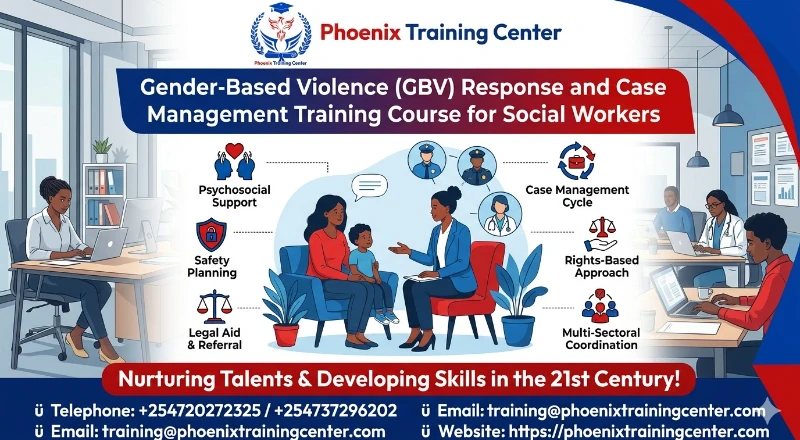
This specialized training program is designed to provide social workers with the advanced clinical and practical skills required to effectively address the global epidemic of Gender-Based Violence (GBV). In many contexts, social workers are the primary point of contact for survivors, yet they often face complex ethical dilemmas and a lack of standardized response protocols. This course bridges that gap by offering a human rights-based, survivor-centered approach to prevention and intervention. It focuses on empowering social workers to navigate the intricate biological, psychological, and social dimensions of violence while maintaining professional boundaries and personal well-being.
The curriculum provides a deep dive into the diverse manifestations of GBV, including domestic violence, sexual assault, and harmful traditional practices. Over five days, participants will explore the "Power and Control" wheel, master the Inter-Agency Standing Committee (IASC) guidelines for GBV interventions, and develop proficiency in the Multi-Sectoral Referral Pathway. From the initial intake and safety planning to long-term psychosocial support and legal advocacy, the course provides a holistic toolkit for social workers to facilitate healing and justice for survivors of all ages and backgrounds.
Upon the successful completion of this Gender-Based Violence (GBV) Response and Case Management Training for Social Workers participants will be able to:
ü Identify the various forms and root causes of Gender-Based Violence in diverse socio-cultural contexts.
ü Implement a survivor-centered approach that prioritizes safety, confidentiality, and respect.
ü Conduct comprehensive GBV risk assessments and develop collaborative safety plans.
ü Navigate the legal and medical referral pathways effectively to support survivor rights.
ü Apply self-care and resilience strategies to prevent vicarious trauma and burnout.
Training Methodology
The course is designed to be highly interactive, challenging and stimulating. It will be an instructor led training and will be delivered using a blended learning approach comprising of:
ü Interactive lectures and facilitated thematic discussions
ü Case study analysis based on real-world GBV scenarios
ü Role-playing exercises for survivor intake and counseling
ü Small group workshops for safety planning and referral mapping
ü Multimedia presentations and survivor narrative analysis
Our facilitators are seasoned industry professionals with years of expertise in their chosen fields. All facilitation and course materials will be offered in English.
Who Should Attend?
This Gender-Based Violence (GBV) Response and Case Management Training for Social Workers would be suitable for, but not limited to:
ü Social Workers and Case Managers
ü Community Development Officers
ü Counselors and Psychologists
ü Child Protection Officers
ü NGO Program Managers in the Human Rights sector
ü Healthcare Workers in SGBV Units
ü Shelter and Safe-House Coordinators
Personal Benefits
Social workers will gain advanced clinical competencies that significantly enhance their ability to handle high-stakes cases with professional confidence. By mastering specialized GBV case management, you will elevate your professional profile as a critical expert in the social protection sector, while also learning vital emotional regulation techniques to protect your own mental health while working on sensitive cases.
Organizational Benefits
Organizations will improve the quality and safety of their service delivery, ensuring that GBV interventions meet international humanitarian standards. This training fosters a standardized response protocol within the team, reducing institutional liability, improving survivor outcomes, and strengthening the organization’s reputation as a leader in rights-based social work.
ü Course Duration: 5 Days
ü Training Fee
o Physical Training: USD 1,400
o Online / Virtual Training: USD 1,000
Module 1: Foundations: Understanding the GBV Continuum and Power Dynamics
ü Definitions and types of GBV: Physical, Sexual, Psychological, and Economic
ü The root causes: Gender inequality and harmful social norms
ü Understanding the "Cycle of Violence" and the "Power and Control" Wheel
ü GBV in conflict and emergency settings
ü Practical Session: Group mapping exercise to identify local drivers of GBV
Module 2: The Survivor-Centered Approach and Ethical Principles
ü The four pillars: Safety, Confidentiality, Respect, and Non-discrimination
ü Informed consent and the right to self-determination
ü Understanding survivor agency and resilience
ü Ethical dilemmas in GBV reporting
ü Practical Session: Role-play exercise on practicing "Informed Consent" in a sensitive intake scenario
Module 3: Clinical Skills: Psychological First Aid (PFA) for GBV Survivors
ü Principles of PFA: Look, Listen, and Link
ü Recognizing signs of acute stress and trauma
ü Active listening and non-judgmental communication
ü Stabilizing a survivor in crisis
ü Practical Session: Simulation of a first-response counseling session using PFA protocols
Module 4: GBV Case Management: The 6-Step Process
ü Introduction to the GBV Case Management lifecycle
ü Step 1-3: Introduction, Assessment, and Case Planning
ü Step 4-6: Implementation, Follow-up, and Case Closure
ü Documentation and data protection (GBVIMS)
ü Practical Session: Drafting a case management file for a hypothetical survivor profile
Module 5: Risk Assessment and Collaborative Safety Planning
ü Identifying lethality indicators and immediate threats
ü Collaborative vs. prescriptive safety planning
ü Tailoring plans for domestic vs. community-based violence
ü Digital safety and stalking prevention
ü Practical Session: Designing a comprehensive safety plan for a survivor returning to a high-risk environment
Module 6: Multi-Sectoral Referral Pathways: Medical, Legal, and Livelihood
ü Mapping the "Referral Web": Who does what?
ü Time-sensitive medical needs: PEP and Emergency Contraception
ü Legal options: Protection orders and criminal proceedings
ü Livelihood support for survivor independence
ü Practical Session: Mapping a local referral pathway for a specific geographic area
Module 7: Child Protection and GBV: Specialized Interventions for Minors
ü Understanding GBV against children: Signs and symptoms
ü The "Best Interests of the Child" principle
ü Mandatory reporting vs. confidentiality in minor cases
ü Age-appropriate communication techniques
ü Practical Session: Role-playing a child-friendly intake interview
Module 8: Community-Based Prevention and Advocacy Strategies
ü Engaging men and boys in GBV prevention
ü SASA! and other community mobilization models
ü Media advocacy and social media campaigning
ü Targeting social norms and behavioral change
ü Practical Session: Designing a 12-month community GBV prevention roadmap
Module 9: Legal Frameworks and Human Rights Protocols (National & International)
ü CEDAW and the Beijing Platform for Action
ü National Acts on Domestic Violence and Sexual Offenses
ü The role of the social worker in the court of law
ü Advocacy for legislative change
ü Practical Session: Mock court session: Preparing a social worker's expert testimony
Module 10: Vicarious Trauma and Resilience for Social Workers
ü Understanding the cost of caring: Compassion fatigue
ü Recognizing symptoms of secondary traumatic stress
ü Institutionalizing self-care within social work teams
ü Building personal and professional resilience plans
ü Practical Session: Creating a personalized 30-day self-care and resilience toolkit
About Our Trainers
Our trainers are senior clinical social workers and GBV specialists with over 15 years of field experience in diverse settings, including refugee camps, urban crisis centers, and policy development units. They have worked extensively with international agencies such as UNFPA and UNHCR to develop national GBV response protocols. Their expertise ensures that the training is not just theoretical but deeply rooted in the practical realities of frontline social work.
Quality Statement
Phoenix Center for Policy, Research and Training is dedicated to providing high-impact, evidence-based training. Our GBV programs are NITA Approved and strictly adhere to the Inter-Agency Standing Committee (IASC) Guidelines for Integrating GBV Interventions. We provide a safe, ethical, and inclusive learning environment where professional integrity and survivor dignity are paramount.
Tailor-Made Courses
We understand that every organization has unique challenges and opportunities as well as unique training needs. Phoenix Training Center offers tailor-made courses designed to address specific requirements and challenges faced by your team or organization. Whether you need a customized curriculum, a specific duration, or on-site delivery, we can adapt our expertise to provide a training solution that perfectly aligns with your objectives. We can customize this Course to focus on your industry, specific risk profile, or internal stakeholder dynamics. Contact us to discuss how we can create a bespoke training program that maximizes value and impact for your team. For further inquiries, please contact us on Tel: +254720272325 / +254737296202 or Email training@phoenixtrainingcenter.com
ü Participants should be reasonably proficient in English.
ü Applicants must live up to Phoenix Center for Policy, Research and Training admission criteria.
Terms and Conditions
ü Discounts: Organizations sponsoring Four Participants will have the 5th attend Free
ü What is catered for by the Course Fees: Fees cater for all requirements for the training – Learning materials, Lunches, Teas, Snacks and Certification. All participants will additionally cater for their travel and accommodation expenses, visa application, insurance, and other personal expenses.
ü Certificate Awarded: Participants are awarded Certificates of Participation at the end of the training.
ü The program content shown here is for guidance purposes only. Our continuous course improvement process may lead to changes in topics and course structure.
ü Approval of Course: Our Programs are NITA Approved. Participating organizations can therefore claim reimbursement on fees paid in accordance with NITA Rules.
Booking for Training
Simply send an email to the Training Officer on training@phoenixtrainingcenter.com and we will send you a registration form. We advise you to book early to avoid missing a seat to this training. Or call us on +254720272325 / +254737296202
Payment Options
We provide 3 payment options, choose one for your convenience, and kindly make payments at least 5 days before the Training start date to reserve your seat:
ü Groups of 5 People and Above – Cheque Payments to: Phoenix Center for Policy, Research and Training Limited should be paid in advance, 5 days to the training.
ü Invoice: We can send a bill directly to you or your company.
ü Deposit directly into Bank Account (Account details provided upon request)
Cancellation Policy
ü Payment for all courses includes a registration fee, which is non-refundable, and equals 15% of the total sum of the course fee.
ü Participants may cancel attendance 14 days or more prior to the training commencement date.
ü No refunds will be made 14 days or less before the training commencement date. However, participants who are unable to attend may opt to attend a similar training course at a later date or send a substitute participant provided the participation criteria have been met.
Accommodation and Airport Transfer
For physical training attendees, we can assist with recommendations for accommodation near the training venue. Airport pick-up services can also be arranged upon request to ensure a smooth arrival. Please inform us of your travel details in advance if you require these services. For reservations contact the Training Officer on Email: training@phoenixtrainingcenter.com or on Tel: +254720272325 / +254737296202
| Course Dates | Venue | Fees | Enroll |
|---|

Phoenix Training Center
Typically replies in minutes