
Course Overview
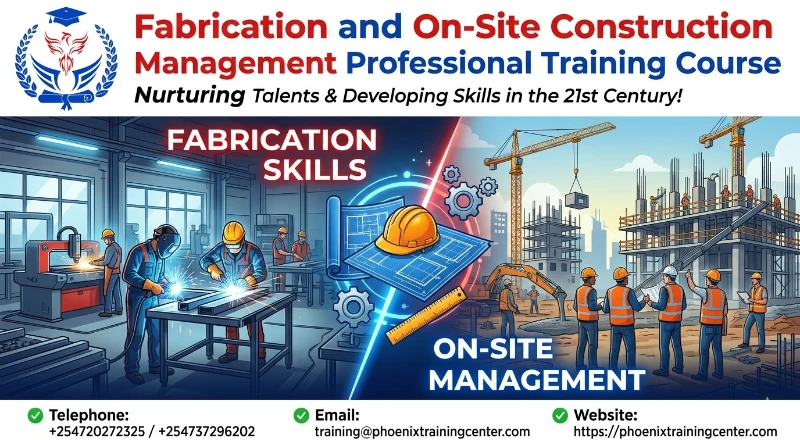
This Fabrication and construction management training, supervising on-site construction & Shop fabrication workflows, Quality inspections, Safety protocols to ensure structural, mechanical and piping works are delivered to specification and schedule training course delivers the essential competencies required to manage complex engineering projects from design to commissioning. Managing industrial fabrication and construction demands a precise balance between factory precision and field adaptability. This course bridges the gap by providing rigorous workflows for handling structural steel, mechanical installations, and industrial piping networks under demanding timelines and strict regulatory environments.
Participants will master the synchronization of workshop processes and site activities by diving deeply into production tracking, material traceability, and modern erection methodologies. The curriculum emphasizes advanced quality inspections, non-destructive testing (NDT) interpretation, and the implementation of uncompromising safety protocols to ensure structural, mechanical and piping works are delivered to specification and schedule. Through interactive case studies and practical simulations, attendees will gain the practical strategies needed to prevent costly reworks, optimize resource allocation, eliminate schedule overruns, and maintain zero-harm project sites.
Upon the successful completion of this Fabrication and On-Site Construction Management Professional Training Course, participants will be able to:
ü Master the principles of fabrication and construction management training across diverse project scales.
ü Streamline supervising on-site construction & shop fabrication workflows to optimize material routing and assembly.
ü Deploy rigid quality inspections and non-destructive testing protocols aligned with international codes.
ü Execute comprehensive safety protocols to ensure structural, mechanical and piping works are delivered to specification and schedule.
ü Minimize schedule slippage and cost overruns using advanced project tracking and resource leveling techniques.
ü Mitigate technical risks during the installation and lifting of heavy structural and mechanical components.
Training Methodology
The course is designed to be highly interactive, challenging and stimulating. It will be an instructor led training and will be delivered using a blended learning approach comprising of:
ü Interactive presentations and conceptual framework lectures.
ü Heavy industry case studies to guarantee immediate workplace applicability.
ü Peer-to-peer technical deep dives.
ü Blueprint and weld map analysis exercises.
ü Root-cause analysis simulations for fabrication failures.
ü Hands-on workshops to build execution checklists, map workflows, and draft inspection test plans (ITPs).
Our facilitators are seasoned industry professionals with years of expertise in their chosen fields. All facilitation and course materials will be offered in English.
Who Should Attend?
This Fabrication and On-Site Construction Management Professional Training Course would be suitable for, but not limited to:
ü Construction Managers
ü Fabrication Shop Supervisors
ü Mechanical and Piping Engineers
ü Quality Assurance/Quality Control (QA/QC) Inspectors
ü Structural Engineers
ü HSE (Health, Safety, and Environment) Officers
ü Project Engineers and Project Managers in oil & gas, energy, and infrastructure sectors
Personal Benefits
ü Enhance professional authority in managing integrated fabrication and construction workflows.
ü Develop advanced technical proficiency in interpreting international quality standards (AWS, ASME, API, ISO).
ü Improve problem-solving capabilities to quickly resolve conflicts between shop fabrication and field execution.
ü Build leadership confidence in driving zero-incident safety cultures across high-risk industrial sites.
Organizational Benefits
ü Ensure all structural, mechanical, and piping works strictly adhere to engineering specifications and contractual deadlines.
ü Reduce total project lifecycle costs by eliminating scrap, rework, and field fit-up modifications.
ü Maximize resource efficiency through optimized production planning and material tracking.
ü Elevate compliance metrics and lower corporate risk profiles by implementing standardized quality and safety governance.
ü Course Duration: 5 Days
ü Training Fee:
o Physical Training: USD 1,500
o Online / Virtual Training: USD 1,000
Module 1: Principles of Integrated Fabrication and Construction Management
ü Project lifecycle integration: Bridging the gap between engineering design, procurement, and execution
ü Standardizing specifications: Interpreting contract documents, codes (ASME, AWS, API, ISO), and standards
ü Strategic resource management: Balancing workforce, equipment, and material allocations across multiple sites
ü Risk identification and mitigation planning in large-scale structural and piping projects
ü Practical Session: Developing an Integrated Project Execution Strategy and Risk Register for an Industrial Plant expansion
Module 2: Optimizing Shop Fabrication Workflows and Material Logistics
ü Material traceability protocols: Heat numbers, material test reports (MTRs), and color-coding management
ü Streamlining raw material processing: Cutting, nesting optimization, beveling, and forming operations
ü Layout and assembly procedures: Jigs, fixtures, and dimensional control during shop fitting
ü Production bottleneck identification: Maximizing throughput via Lean manufacturing and Theory of Constraints
ü Practical Session: Workflow Mapping and Layout Optimization Exercise for a Structural Steel Shop floor layout
Module 3: Supervising On-Site Construction and Field Assembly Workflows
ü Site readiness assessment: Foundations, anchor bolts alignment verification, and battery limits definition
ü Managing field fit-up challenges: Handling tolerances, weld gaps, and mismatch rectification in piping and steel
ü Sequencing site installations: Coordinating parallel structural erection and mechanical equipment positioning
ü Interface management between civil work, structural steel erection, and piping integration
ü Practical Session: Field Coordination Simulation: Developing a Step-by-Step Erection Sequence Plan for a Multi-Tier Structure
Module 4: Quality Inspections for Structural Steelwork and Material Integrity
ü Fundamental elements of an Inspection and Test Plan (ITP) for structural fabrication
ü Visual inspection standards for structural steel welds in accordance with AWS D1.1
ü Bolted connection quality checks: Pre-tensioning, snug-tight inspection, and torque verification procedures
ü Dimensional control tolerances: Verticality, alignment, camber, and sweep checks in erected structures
ü Practical Session: Developing a Comprehensive Structural Inspection and Test Plan (ITP) with Acceptance Criteria
Module 5: Quality Assurance and Inspections for Mechanical and Piping Systems
ü Piping isometric drawings and P&ID verification: Walkdowns and punchlist management
ü Welding Quality Management: Reviewing Welding Procedure Specifications (WPS) and Procedure Qualification Records (PQR)
ü Flange management protocols: Gasket selection, bolt torque patterns, and joint integrity tracking
ü Pressure testing execution: Safe handling of Hydrostatic and Pneumatic testing procedures and pressure charts
ü Practical Session: Reviewing Welder Performance Qualifications (WPQ) and Mapping a Flange Tightening Quality Checklist
Module 6: Safety Protocols to Ensure Structural, Mechanical, and Piping Works Integrity
ü Implementing Job Safety Analysis (JSA) and Permit to Work (PTW) systems for high-risk mechanical operations
ü Confined space entry compliance: Atmospheric testing, ventilation, and rescue plans for vessel and large pipe work
ü Working at heights safety: Scaffolding inspections, personal fall arrest systems (PFAS), and dropped object prevention
ü Hazardous energy control: Lockout/Tagout (LOTO) application during modifications and live tie-ins
ü Practical Session: Conducting a Job Safety Analysis (JSA) for a Complex Piping Tie-in inside an Operational Facility
Module 7: Rigging, Heavy Lifting, and Structural Erection Safety Management
ü Critical lift planning fundamentals: Center of gravity calculations, crane capacity configurations, and ground bearing tests
ü Rigging hardware inspection standards: Shackles, slings, spreader beams, and hoist equipment integrity
ü Communication matrices: Standard hand signals, radio protocols, and exclusion zone enforcement during lifts
ü Environmental limitations: Managing wind speed risks, blind lifts, and tandem crane configurations safely
ü Practical Session: Review and Risk Assessment of a Critical Heavy Lift Plan for a 50-Ton Mechanical Vessel
Module 8: Project Scheduling, Progress Measurement, and Delay Mitigation
ü Work Breakdown Structure (WBS) design for integrated structural, mechanical, and piping works
ü Earned Value Management (EVM) for fabrication: Measuring physical progress vs. hours expended
ü Schedule optimization using Critical Path Method (CPM) and resource leveling techniques
ü Dispute resolution and change management: Documenting site variations and scope growth effectively
ü Practical Session: Reworking a Crashed Project Schedule to Recover a 14-Day Overrun Using Resource Optimization
Module 9: Non-Destructive Testing (NDT) Methods and Weld Defect Analysis
ü Application and limitations of NDT methods: Radiographic (RT), Ultrasonic (UT/PAUT), Magnetic Particle (MT), and Dye Penetrant (PT)
ü Interpreting NDT inspection reports and understanding code acceptance thresholds
ü Root cause analysis of common weld defects: Porosity, lack of fusion, slag inclusion, and cracking mechanisms
ü Developing Repair Welding Procedures: Controlling heat inputs and minimizing heat-affected zone (HAZ) degradation
ü Practical Session: Weld Defect Analysis Workshop: Identifying Failure Modes from Radiographic and UT Inspection Data Sheets
Module 10: Pre-Commissioning, Turnover Documentation, and Project Closeout
ü Systems completions frameworks: Defining boundaries, Hydro-testing loops, and mechanical completion criteria
ü Compiling the Quality Dossier: As-built drawings, NDT records, material certs, and pressure test certificates
ü Pre-commissioning flushing, blowing, and chemical cleaning protocols for process piping networks
ü Handover governance: Managing the final punchlist resolution and formal facility transfer protocols
ü Practical Session: Simulating a Final Walkdown, Drafting a Punchlist, and Structuring a Mechanical Completion Handover Dossier
About Our Trainers
Our trainers are seasoned industry leaders with a minimum of 15 years of active field experience in execution, engineering management, and quality assurance. They possess extensive global portfolios across major oil and gas refineries, petrochemical complexes, thermal power stations, and major mining operations. Holding international professional certifications such as AWS-CWI, CSWIP 3.1/3.2, ASNT Level III, API 570, and PMP, our facilitators pair rigorous theoretical knowledge with real-world case experiences. Their background ensures that learners receive deep insights that translate directly into operational excellence on site.
Quality Statement
Phoenix Training Center is committed to providing world-class capacity-building solutions that meet the highest standards of international best practice. Our training courses are built on a framework of continuous improvement, industry relevance, and rigorous pedagogical excellence. We utilize advanced instructional media, highly validated technical frameworks, and contemporary industry case studies to deliver maximum knowledge retention. Every educational intervention undergoes comprehensive internal review processes to ensure it remains aligned with evolving global engineering codes, technical standards, and occupational safety regulations.
Tailor-Made Courses
We understand that every organization has unique challenges and opportunities as well as unique training needs. Phoenix Training Center offers tailor-made courses designed to address specific requirements and challenges faced by your team or organization. Whether you need a customized curriculum, a specific duration, or on-site delivery, we can adapt our expertise to provide a training solution that perfectly aligns with your objectives. We can customize this Course to focus on your industry, specific risk profile, or internal stakeholder dynamics. Contact us to discuss how we can create a bespoke training program that maximizes value and impact for your team. For further inquiries, please contact us on Tel: +254720272325 / +254737296202 or Email training@phoenixtrainingcenter.com.
Admission Criteria
ü Participants should be reasonably proficient in English.
ü Applicants must live up to Phoenix Center for Policy, Research and Training admission criteria.
Terms and Conditions
ü Discounts: Organizations sponsoring Four Participants will have the 5th attend Free
ü What is catered for by the Course Fees: Fees cater for all requirements for the training – Learning materials, Lunches, Teas, Snacks and Certification. All participants will additionally cater for their travel and accommodation expenses, visa application, insurance, and other personal expenses.
ü Certificate Awarded: Participants are awarded Certificates of Participation at the end of the training.
ü Course Improvement: The program content shown here is for guidance purposes only. Our continuous course improvement process may lead to changes in topics and course structure.
ü Approval of Course: Our Programs are NITA Approved. Participating organizations can therefore claim reimbursement on fees paid in accordance with NITA Rules.
Booking for Training
Kindly send an email to the Training Officer on training@phoenixtrainingcenter.com and we will send you a registration form. We advise you to book early to avoid missing a seat to this training. Or call us on +254720272325 / +254737296202
Payment Options
We provide 3 payment options, choose one for your convenience, and kindly make payments a week before the training starts (at least 5 to 7 days before the Training start date) to reserve your seat:
ü Groups of 5 People and Above – Cheque Payments to: Phoenix Center for Policy, Research and Training Limited should be paid in advance, a week before the training starts.
ü Invoice: We can send a bill directly to you or your company.
ü Deposit directly into Bank Account (Account details provided upon request)
Cancellation Policy
ü Payment for all courses includes a registration fee, which is non-refundable, and equals 15% of the total sum of the course fee.
ü Participants may cancel attendance 14 days or more prior to the training commencement date.
ü No refunds will be made 14 days or less before the training commencement date. However, participants who are unable to attend may opt to attend a similar training course at a later date or send a substitute participant provided the participation criteria have been met.
Accommodation and Airport Pick-up
For physical training attendees, we can assist with recommendations for accommodation near the training venue. Airport pick-up services can also be arranged upon request to ensure a smooth arrival. Please inform us of your travel details in advance if you require these services. For reservations contact the Training Officer on Email: training@phoenixtrainingcenter.com or on Tel: +254720272325 / +254737296202.
| Course Dates | Venue | Fees | Enroll |
|---|---|---|---|
| Sep 21 - Sep 25 2026 | Nairobi | $1,500 |
|
| Sep 28 - Oct 02 2026 | Zoom | $1,000 |
|
| Oct 05 - Oct 09 2026 | Nairobi | $1,500 |
|
| Oct 12 - Oct 16 2026 | Nairobi | $1,500 |
|
| Oct 19 - Oct 23 2026 | Nakuru | $1,500 |
|
| Oct 26 - Oct 30 2026 | Naivasha | $1,500 |
|

Phoenix Training Center
Typically replies in minutes