
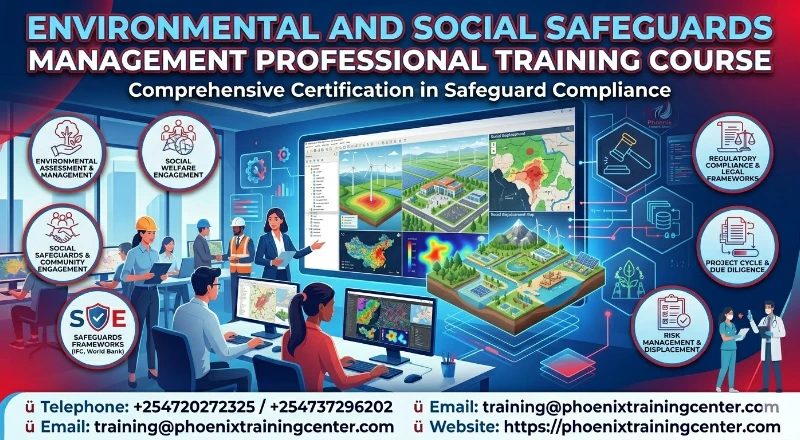
Course Overview
The Environmental and Social Safeguards Management Professional Training Course is a comprehensive program designed to equip professionals with the essential skills to identify, mitigate, and manage environmental and social risks in development projects. In an era where sustainable development is a global mandate, this course provides a deep dive into the frameworks used by international financial institutions and regulatory bodies. Participants will learn how to balance infrastructure and economic growth with ecological preservation and social equity, ensuring that projects achieve "do no harm" objectives while fostering positive community outcomes.
The course covers a broad spectrum of critical topics, beginning with the evolution of safeguard policies and legal frameworks. Participants will explore practical methodologies for Environmental and Social Impact Assessments (ESIA), stakeholder engagement strategies, and grievance redress mechanisms. Advanced modules focus on specific challenges such as involuntary resettlement, labour conditions, biodiversity conservation, and climate change integration. By combining theoretical foundations with hands-on practical sessions, the program ensures that attendees can navigate complex compliance landscapes and implement robust monitoring and reporting systems within their respective organizations.
Upon the successful completion of this Environmental and Social Safeguards Management Professional Training Course, participants will be able to:
ü Interpret and apply international environmental and social safeguard standards effectively.
ü Conduct comprehensive Environmental and Social Risk Classifications for diverse projects.
ü Develop robust Environmental and Social Management Plans (ESMPs).
ü Design and implement inclusive stakeholder engagement and consultation processes.
ü Manage complex social issues including resettlement, indigenous rights, and labour welfare.
ü Establish functional Grievance Redress Mechanisms (GRM) to mitigate project conflicts.
ü Monitor compliance and produce high-quality safeguards performance reports.
Training Methodology
The course is designed to be highly interactive, challenging and stimulating. It will be an instructor led training and will be delivered using a blended learning approach comprising of:
ü Interactive lectures and expert-led presentations
ü Case study analysis of real-world development projects
ü Group discussions and peer-to-peer learning
ü Practical sessions involving toolkit application and document drafting
ü Simulations of stakeholder consultation meetings
Our facilitators are seasoned industry professionals with years of expertise in their chosen fields. All facilitation and course materials will be offered in English.
Who Should Attend?
This Environmental and Social Safeguards Management Professional Training Course would be suitable for, but not limited to:
ü Environmental Consultants and Officers
ü Social Development Specialists
ü Project Managers and Coordinators
ü Government Regulators and Policy Makers
ü NGO Program Managers
ü Sustainability and CSR Managers
ü Investment Officers and Risk Analysts
ü Engineers and Urban Planners
Personal Benefits
ü Enhanced Expertise: Gain a competitive edge by mastering high-demand safeguard compliance skills.
ü Professional Credibility: Earn a recognized certificate that validates your ability to manage complex project risks.
ü Networking: Connect with industry experts and peers to share best practices and global insights.
Organizational Benefits
ü Risk Mitigation: Reduce the likelihood of project delays, legal disputes, and reputational damage.
ü Funding Access: Improve eligibility for international funding by meeting stringent safeguard requirements.
ü Operational Efficiency: Streamline project implementation through proactive social and environmental planning.
ü Course Duration: 5 Days
ü Training Fee
o Physical Training: USD 1,200
o Online / Virtual Training: USD 800
Module 1: Introduction to Environmental and Social Safeguards Frameworks
ü Evolution of international safeguard policies (World Bank, IFC, AfDB)
ü Legal and regulatory frameworks for environmental protection
ü Principles of sustainable development in project cycles
ü Risk categorization: Category A, B, and C projects
ü Practical Session: Screening a sample project to determine its risk category
Module 2: Environmental and Social Impact Assessment (ESIA) Process
ü Scoping and baseline data collection methodologies
ü Identifying cumulative and indirect impacts
ü The mitigation hierarchy: Avoid, Minimize, Restore, Offset
ü Analysis of alternatives in project design
ü Practical Session: Developing an Impact Identification Matrix for a construction project
Module 3: Stakeholder Engagement and Public Consultation Strategies
ü Identifying and mapping project-affected people (PAPs)
ü Techniques for inclusive and meaningful consultation
ü Disclosure of information and transparency requirements
ü Gender-sensitive engagement approaches
ü Practical Session: Role-playing a community consultation meeting for a high-risk project
Module 4: Management of Involuntary Resettlement and Land Acquisition
ü Legal vs. customary land rights
ü Developing a Resettlement Action Plan (RAP)
ü Eligibility criteria and compensation valuation methods
ü Livelihood restoration and improvement programs
ü Practical Session: Drafting a basic census survey for displaced households
Module 5: Biodiversity Conservation and Sustainable Natural Resource Management
ü Assessing impacts on modified, natural, and critical habitats
ü Management of invasive alien species
ü Sustainable management of living natural resources
ü Biodiversity Action Plans (BAP) and offsetting
ü Practical Session: Mapping sensitive ecological zones using a provided case study map
Module 6: Labor and Working Conditions: Standards and Compliance
ü Promoting fair treatment, non-discrimination, and equal opportunity
ü Occupational Health and Safety (OHS) fundamentals
ü Protecting the workforce: Child labour and forced labour prevention
ü Worker grievance mechanisms and collective bargaining
ü Practical Session: Conducting an OHS site inspection simulation
Module 7: Community Health, Safety, and Security Management
ü Managing project-related traffic and road safety risks
ü Mitigating exposure to disease and hazardous materials
ü Emergency preparedness and response planning
ü Security personnel management and human rights
ü Practical Session: Designing a community safety awareness campaign flyer
Module 8: Cultural Heritage Preservation and Indigenous Peoples Safeguards
ü Identifying tangible and intangible cultural heritage
ü "Chance Find" procedures during project implementation
ü Free, Prior, and Informed Consent (FPIC) principles
ü Indigenous Peoples Development Plans (IPDP)
ü Practical Session: Developing a "Chance Find" protocol flowchart
Module 9: Climate Change Resilience and Environmental Management Plans
ü Integrating climate risk screening into safeguards
ü Greenhouse gas emission estimation and reduction
ü Components of a robust Environmental and Social Management Plan (ESMP)
ü Budgeting for safeguard implementation
ü Practical Session: Drafting an ESMP table for an infrastructure project
Module 10: Monitoring, Reporting, and Grievance Redress Mechanisms
ü Establishing Key Performance Indicators (KPIs) for safeguards
ü Internal and external monitoring and auditing
ü Designing an effective Grievance Redress Mechanism (GRM)
ü Reporting formats for stakeholders and lenders
ü Practical Session: Simulating the resolution of a complex community grievance
About Our Trainers
Our trainers are seasoned practitioners with over 20 years of collective experience in environmental law, social development, and international development finance. They have served as lead consultants for major projects funded by the World Bank, International Finance Corporation (IFC), and various African government agencies. Each trainer brings a wealth of field experience, having successfully navigated the complexities of large-scale resettlement, environmental restoration, and community conflict resolution across diverse geographical regions.
Quality Statement
Phoenix Training Center is committed to excellence in professional capacity building. We ensure that our training materials are updated quarterly to reflect the latest changes in international standards and environmental laws. Our focus is on providing high-impact, practical knowledge that transcends theoretical concepts, ensuring every participant leaves with actionable skills they can apply immediately to their professional roles.
Tailor-Made Courses
We understand that every organization has unique challenges and opportunities as well as unique training needs. Phoenix Training Center offers tailor-made courses designed to address specific requirements and challenges faced by your team or organization. Whether you need a customized curriculum, a specific duration, or on-site delivery, we can adapt our expertise to provide a training solution that perfectly aligns with your objectives. We can customize this course to focus on your industry, specific risk profile, or internal stakeholder dynamics. Contact us to discuss how we can create a bespoke training program that maximizes value and impact for your team. For further inquiries, please contact us on Tel: +254720272325 / +254737296202 or Email: training@phoenixtrainingcenter.com.
ü Participants should be reasonably proficient in English.
ü Applicants must live up to Phoenix Center for Policy, Research and Training admission criteria.
Terms and Conditions
ü Discounts: Organizations sponsoring Four Participants will have the 5th attend Free
ü What is catered for by the Course Fees: Fees cater for all requirements for the training – Learning materials, Lunches, Teas, Snacks and Certification. All participants will additionally cater for their travel and accommodation expenses, visa application, insurance, and other personal expenses.
ü Certificate Awarded: Participants are awarded Certificates of Participation at the end of the training.
ü Course Improvement: The program content shown here is for guidance purposes only. Our continuous course improvement process may lead to changes in topics and course structure.
ü Approval of Course: Our Programs are NITA Approved. Participating organizations can therefore claim reimbursement on fees paid in accordance with NITA Rules.
Booking for Training
Simply send an email to the Training Officer on training@phoenixtrainingcenter.com and we will send you a registration form. We advise you to book early to avoid missing a seat to this training. Or call us on +254720272325 / +254737296202
Payment Options
We provide 3 payment options, choose one for your convenience, and kindly make payments at least 5 days before the Training start date to reserve your seat:
ü Groups of 5 People and Above – Cheque Payments to: Phoenix Center for Policy, Research and Training Limited should be paid in advance, 5 days to the training.
ü Invoice: We can send a bill directly to you or your company.
ü Deposit directly into Bank Account (Account details provided upon request)
Cancellation Policy
ü Payment for all courses includes a registration fee, which is non-refundable, and equals 15% of the total sum of the course fee.
ü Participants may cancel attendance 14 days or more prior to the training commencement date.
ü No refunds will be made 14 days or less before the training commencement date. However, participants who are unable to attend may opt to attend a similar training course at a later date or send a substitute participant provided the participation criteria have been met.
Accommodation and Airport Transfer
For physical training attendees, we can assist with recommendations for accommodation near the training venue. Airport pick-up services can also be arranged upon request to ensure a smooth arrival. Please inform us of your travel details in advance if you require these services. For reservations contact the Training Officer on Email: training@phoenixtrainingcenter.com or on Tel: +254720272325 / +254737296202
| Course Dates | Venue | Fees | Enroll |
|---|

Phoenix Training Center
Typically replies in minutes