
Course Overview
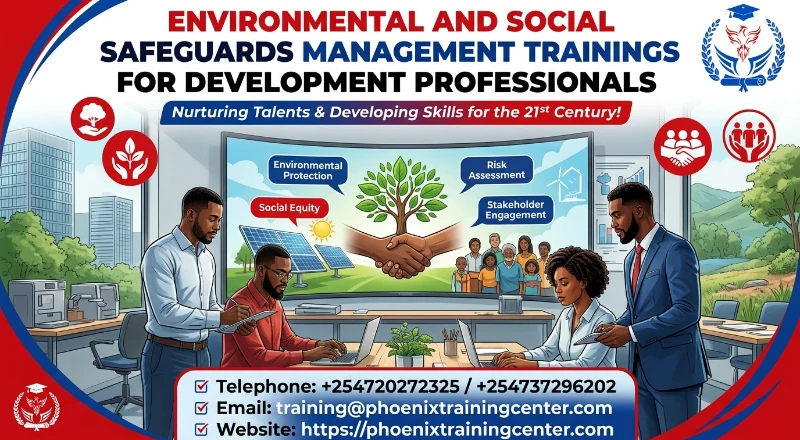
The Environmental and Social Safeguards Management Training Course for Development Professionals provides a comprehensive, hands-on understanding of international risk management standards, including World Bank Environmental and Social Framework (ESF), IFC Performance Standards, and national regulatory compliance. Development projects increasingly demand rigorous oversight to mitigate environmental degradation, ensure social inclusion, and prevent adverse community impacts. This course equips project teams with actionable tools for screening, scoping, impact assessment, stakeholder engagement, and continuous environmental and social monitoring throughout the project life cycle.
Participants will gain deep insights into critical compliance topics, including Climate Risk Assessment, Biodiversity Conservation, Resettlement Action Plans (RAP), Free, Prior, and Informed Consent (FPIC), Labor and Working Conditions, and Gender-Based Violence (GBV) risk mitigation. Through practical exercises and real-world case studies, attendees will learn how to design robust Environmental and Social Management Plans (ESMP), establish functioning Grievance Redress Mechanisms (GRM), and manage institutional risk. By bridging theory and field implementation, this course ensures project activities meet compliance requirements while fostering sustainable development outcomes.
Upon the successful completion of this Environmental and Social Safeguards Management Training Course for Development Professionals, participants will be able to:
ü Apply international safeguard standards, including World Bank ESF and IFC Performance Standards, to project design and implementation.
ü Conduct comprehensive Environmental and Social Impact Assessments (ESIAs) and draft actionable Environmental and Social Management Plans (ESMPs).
ü Design and implement effective Stakeholder Engagement Plans (SEPs) and accessible Grievance Redress Mechanisms (GRMs).
ü Identify, assess, and manage risks related to involuntary resettlement, land acquisition, and indigenous populations.
ü Integrate climate vulnerability, biodiversity conservation, and occupational health and safety (OHS) measures into project monitoring systems.
Training Methodology
The training employs a participant-centered, practical methodology designed to promote active learning and immediate skill application. The course is designed to be highly interactive, challenging and stimulating. It will be an instructor led training and will be delivered using a blended learning approach comprising of:
ü Interactive lectures and multimedia presentations delivered by experienced safeguard specialists
ü Real-world case study analysis of development projects across diverse sectors
ü Guided practical sessions and group exercises focused on toolkit application
ü Plenary discussions, peer review exercises, and expert-led Q&A sessions
ü Simulation of safeguard audits, stakeholder consultations, and field-level risk screenings
Our facilitators are seasoned industry professionals with years of expertise in their chosen fields. All facilitation and course materials will be offered in English.
Who Should Attend?
This Environmental and Social Safeguards Management Training Course for Development Professionals would be suitable for, but not limited to:
ü Environmental and Social Safeguards Specialists
ü Project Managers and Project Implementation Unit (PIU) Staff
ü Development Practitioners and Program Officers
ü Civil Engineers and Infrastructure Project Consultants
ü Sustainability and Corporate Social Responsibility (CSR) Managers
ü Government Officials in Regulatory, Environmental, and Social Agencies
ü NGO Representatives and Monitoring & Evaluation Specialists
Benefits of the Training
Personal Benefits
ü Advanced technical competency in international environmental and social safeguard frameworks
ü Hands-on skills in drafting ESIA, ESMP, RAP, and Stakeholder Engagement documents
ü Enhanced problem-solving capabilities for managing complex community dynamics and project risks
ü Recognized professional advancement as a certified safeguards management practitioner
Organizational Benefits
ü Improved institutional compliance with international donor and partner safeguard mandates
ü Reduced operational, legal, and reputational risks through proactive screening and mitigation
ü Strengthened stakeholder trust through structured community consultation and transparent grievance handling
ü Enhanced project design and execution efficiency, preventing costly project delays or suspensions
ü Course Duration: 5 Days
ü Training Fee:
o Physical Training: USD 1,500
o Online / Virtual Training: USD 1,000
Module 1: Introduction to Environmental and Social Safeguards Frameworks
ü Evolution of environmental and social safeguards in international development
ü Comparative analysis: World Bank ESF, IFC Performance Standards, and AfDB Safeguards
ü National legal regulatory frameworks versus donor safeguard standards
ü Integrating environmental and social considerations into the project cycle
ü Practical Session: Comparative review of safeguard frameworks on selected infrastructure projects
Module 2: Environmental and Social Screening and Risk Categorization
ü Principles of environmental and social risk classification (High, Substantial, Moderate, Low)
ü Screening tools and checklists for early risk identification
ü Assessing cumulative, transboundary, and indirect project impacts
ü Climate risk screening and vulnerability mapping
ü Practical Session: Conducting initial environmental and social screening for a donor-funded development project
Module 3: Environmental and Social Impact Assessment (ESIA) and ESMP Formulation
ü Scoping and defining terms of reference for ESIA studies
ü Baseline data collection methods for environmental and socio-economic parameters
ü Developing the Environmental and Social Management Plan (ESMP)
ü Institutional roles, responsibilities, and mitigation budgeting
ü Practical Session: Drafting an actionable ESMP matrix with specific mitigation measures and monitoring indicators
Module 4: Stakeholder Engagement and Grievance Redress Mechanisms (GRM)
ü Mapping and analyzing stakeholders across public and private sectors
ü Designing effective Stakeholder Engagement Plans (SEPs)
ü Principles of Free, Prior, and Informed Consent (FPIC) for indigenous communities
ü Establishing accessible, transparent, and multi-tier Grievance Redress Mechanisms
ü Practical Session: Simulating a public consultation meeting and setting up a project-level GRM log
Module 5: Land Acquisition, Involuntary Resettlement, and Resettlement Action Plans (RAP)
ü Principles governing involuntary resettlement and land acquisition
ü Socio-economic baseline surveys and asset valuation methodologies
ü Developing Resettlement Action Plans (RAP) and Livelihood Restoration Plans (LRP)
ü Managing compensation processes and legal entitlements
ü Practical Session: Preparing a baseline survey matrix and RAP timeline for a displaced community scenario
Module 6: Labor, Working Conditions, and Occupational Health and Safety (OHS)
ü Donor standards on labor and working conditions (ESRS 2 / IFC PS2)
ü Developing Labor Management Procedures (LMP) and worker grievance channels
ü Identification and mitigation of occupational health and safety hazards on site
ü Managing supply chain labor risks and contractor compliance
ü Practical Session: Conducting an OHS hazard identification and risk assessment (HIRA) for a construction site
Module 7: Biodiversity Conservation and Sustainable Management of Natural Resources
ü Standard requirements for natural habitats, modified habitats, and critical habitats
ü Implementing the mitigation hierarchy: Avoid, Minimize, Restore, Offset
ü Ecosystem service assessments in project areas
ü Managing alien invasive species and sustainable resource harvesting
ü Practical Session: Applying the mitigation hierarchy to a project affecting protected or sensitive habitats
Module 8: Social Inclusion, Vulnerable Groups, and Gender-Based Violence (GBV) Mitigation
ü Identifying vulnerable and marginalized groups in project impact zones
ü Integrating gender dynamics and social inclusion into project safeguards
ü Assessing risks of Gender-Based Violence (GBV), Sexual Exploitation and Abuse (SEA), and Sexual Harassment (SH)
ü Designing SEA/SH prevention plans and survivor-centered referral pathways
ü Practical Session: Designing a GBV/SEA risk mitigation action plan for a large-scale public works project
Module 9: Environmental and Social Safeguards Monitoring, Reporting, and Auditing
ü Designing environmental and social monitoring frameworks and key performance indicators (KPIs)
ü Supervision, inspection, and field monitoring procedures for project units
ü Preparing high-quality periodic safeguard monitoring reports for funding agencies
ü Third-party monitoring and independent compliance auditing
ü Practical Session: Developing a quarterly safeguards monitoring report template using real project data
Module 10: Crisis Communication, Institutional Governance, and Continuous Safeguard Compliance
ü Institutional capacity building and institutionalizing safeguards management
ü Managing emergency responses, incidents, and severe safeguard non-compliance
ü Strategic crisis communication and media relations during safeguard failures
ü Lessons learned and continuous improvement in institutional safeguard systems
ü Practical Session: Conducting a table-top crisis simulation for a major environmental spill or social conflict incident
About Our Trainers
Our trainers are seasoned environmental and social safeguard practitioners, regulatory experts, and international development consultants with extensive field experience across Africa, Asia, and Europe. They hold advanced degrees in Environmental Science, Social Development, Civil Engineering, and Public Policy, combined with over 15 years of hands-on experience implementing safeguards for major funding organizations, including the World Bank, International Finance Corporation (IFC), African Development Bank (AfDB), and national governments. They bring rich, practical perspectives to the classroom, translating donor policies into practical field solutions.
Quality Statement
Phoenix Training Center is committed to delivering world-class, practical professional development solutions that adhere to international educational and industry standards. Our course materials, practical exercises, and instructional methodologies undergo rigorous, ongoing review by sector experts to ensure alignment with global best practices, emerging regulatory standards, and donor requirements. We prioritize high-impact learning experiences that translate immediately into enhanced operational performance for our participants and their sponsoring organizations.
Tailor-Made Courses
We understand that every organization has unique challenges and opportunities as well as unique training needs. Phoenix Training Center offers tailor-made courses designed to address specific requirements and challenges faced by your team or organization. Whether you need a customized curriculum, a specific duration, or on-site delivery, we can adapt our expertise to provide a training solution that perfectly aligns with your objectives. We can customize this Course to focus on your industry, specific risk profile, or internal stakeholder dynamics. Contact us to discuss how we can create a bespoke training program that maximizes value and impact for your team. For further inquiries, please contact us on Tel: +254720272325 / +254737296202 or Email: training@phoenixtrainingcenter.com.
Admission Criteria
ü Participants should be reasonably proficient in English.
ü Applicants must live up to Phoenix Center for Policy, Research and Training admission criteria.
Terms and Conditions
ü Discounts: Organizations sponsoring Four Participants will have the 5th attend Free.
ü What is catered for by the Course Fees: Fees cater for all requirements for the training – Learning materials, Lunches, Teas, Snacks and Certification. All participants will additionally cater for their travel and accommodation expenses, visa application, insurance, and other personal expenses.
ü Certificate Awarded: Participants are awarded a Certificate of Completion at the end of the training.
ü Course Improvement: The program content shown here is for guidance purposes only. Our continuous course improvement process may lead to changes in topics and course structure.
ü Approval of Course: Our Programs are NITA Approved. Participating organizations can therefore claim reimbursement on fees paid in accordance with NITA Rules.
Booking for Training
Kindly send an email to the Training Officer on training@phoenixtrainingcenter.com and we will send you a registration form. We advise you to book early to avoid missing a seat to this training. Or call us on +254720272325 / +254737296202.
Payment Options
We provide 3 payment options, choose one for your convenience, and kindly make payments at least 10 days before the Training start date to reserve your seat:
ü Groups of 5 People and Above: Cheque Payments to: Phoenix Center for Policy, Research and Training Limited should be paid in advance, 10 days to the training.
ü Invoice: We can send a bill directly to you or your company.
ü Deposit directly into Bank Account: (Account details provided upon request)
Cancellation Policy
ü Payment for all courses includes a registration fee, which is non-refundable, and equals 15% of the total sum of the course fee.
ü Participants may cancel attendance 14 days or more prior to the training commencement date.
ü No refunds will be made 14 days or less before the training commencement date. However, participants who are unable to attend may opt to attend a similar training course at a later date or send a substitute participant provided the participation criteria have been met.
Accommodation and Airport Pick-Up
For physical training attendees, we can assist with recommendations for accommodation near the training venue. Airport pick-up services can also be arranged upon request to ensure a smooth arrival. Please inform us of your travel details in advance if you require these services. For reservations contact the Training Officer on Email: training@phoenixtrainingcenter.com or on Tel: +254720272325 / +254737296202.
| Course Dates | Venue | Fees | Enroll |
|---|

Phoenix Training Center
Typically replies in minutes