
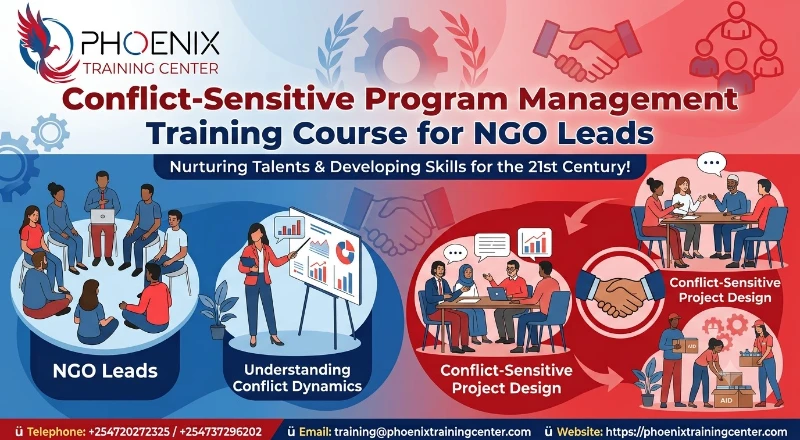
Course Overview
In complex and fragile environments, development and humanitarian interventions are never neutral; they inevitably become part of the local conflict dynamic. This Conflict-Sensitive Program Management Training Course for NGO Leads is specifically designed to equip humanitarian, development, and peacebuilding professionals with critical skills to navigate volatile contexts. Through the integration of robust conflict sensitivity and peacebuilding techniques for effective local engagement, this course ensures that organizational programs "Do No Harm" while actively maximizing positive impacts on social cohesion and peace. Participants will learn to systematically analyze conflict drivers, adapt project lifecycles to shifting dynamics, and cultivate meaningful local relationships that promote community ownership and resilience.
The comprehensive curriculum is structured to guide participants through key modules starting with the core concepts of conflict sensitivity, moving into practical context analysis and stakeholder mapping tools. It covers peacebuilding techniques for effective local engagement, strategic risk mitigation, adaptive program monitoring, and crisis communication. NGO leads will also delve into institutionalizing conflict sensitivity within their organizations, managing staff security, and designing exit strategies that preserve long-term peace gains.
Upon the successful completion of this Conflict-Sensitive Program Management Training Course for NGO Leads, participants will be able to:
ü Deconstruct complex conflict dynamics and identify latent drivers using standardized local context analysis tools.
ü Implement practical conflict sensitivity and peacebuilding techniques for effective local engagement and community ownership.
ü Redesign program monitoring, evaluation, accountability, and learning (MEAL) systems to capture unintended conflict impacts.
ü Formulate operational risk mitigation plans that balance program objectives with community safety and "Do No Harm" principles.
ü Lead strategic organizational change to institutionalize conflict-sensitive policies, staff recruitment practices, and security protocols.
Training Methodology
The course is designed to be highly interactive, challenging and stimulating. It will be an instructor led training and will be delivered using a blended learning approach comprising of:
ü Interactive lectures: Expert-led sessions unpacking theoretical frameworks and practical case studies.
ü Group exercises and role-plays: Simulated community dialogues and multi-stakeholder negotiation scenarios.
ü Case study analysis: Critical reviews of real-world NGO interventions in active and post-conflict zones.
ü Hands-on tool application: Practical mapping, risk analysis, and program design exercises using context-specific templates.
ü Daily peer reflection: Collaborative sessions to exchange field experiences and adapt strategies.
Our facilitators are seasoned industry professionals with years of expertise in their chosen fields. All facilitation and course materials will be offered in English.
Who Should Attend?
This Conflict-Sensitive Program Management Training Course for NGO Leads would be suitable for, but not limited to:
ü NGO Directors, Country Directors, and Program Managers
ü Field Coordinators and Project Officers
ü MEAL (Monitoring, Evaluation, Accountability, and Learning) Specialists
ü Peacebuilding and Humanitarian Practitioners
ü Community Liaison Officers and Public Relations Leads
ü Donors and Government Partners overseeing community interventions
Expected Benefits of the Training
Personal Benefits
ü Enhanced Analytical Skills: Master sophisticated conflict analysis frameworks to confidently navigate highly volatile operating environments.
ü Strategic Leadership: Position yourself as an expert in conflict sensitivity and peacebuilding techniques for effective local engagement, boosting career advancement.
ü Conflict Resolution Mastery: Acquire advanced dialogue facilitation and mediation techniques to resolve project-level friction with local stakeholders.
Organizational Benefits
ü Risk Minimization: Protect organizational reputation, assets, and staff by anticipating and preventing negative program impacts on local conflict dynamics.
ü Enhanced Program Quality: Improve the efficiency and long-term sustainability of interventions through deep local alignment and community-backed initiatives.
ü Funding Attractiveness: Align programs with international donor standards (such as Sida, USAID, FCDO) which increasingly mandate rigorous conflict sensitivity compliance.
ü Course Duration: 5 Days
ü Training Fee:
o Physical Training: USD 1,500
o Virtual Training: USD 1,000
Module 1: Foundations of Conflict Sensitivity and Do No Harm
ü Core theories of conflict, violence, and peacebuilding
ü Historical progression of the "Do No Harm" framework in humanitarian aid
ü Differentiating between conflict-sensitive programming and direct peacebuilding interventions
ü Analyzing the bidirectional relationship between program resources and conflict dividers/connectors
ü Practical Session: Group simulation identifying resource transfer effects on a historical field scenario.
Module 2: Analytical Tools for Local Conflict Contexts
ü Conducting rapid local conflict assessments in active crisis areas
ü Utilizing the Conflict Tree, Pillars, and Timeline analysis methodologies
ü Identifying systemic, proximate, and triggering conflict drivers
ü Triangulating sources of qualitative data to minimize analysis bias
ü Practical Session: Interactive workshop constructing a Conflict Tree for a regional case study.
Module 3: Stakeholder Mapping and Local Dynamics
ü Mapping primary, secondary, and tertiary stakeholders in local conflict ecosystems
ü Analyzing stakeholder positions, interests, needs, and power dynamics
ü Recognizing marginalized groups, spoilers, and peace champions within communities
ü Understanding intra-communal versus inter-communal power struggles
ü Practical Session: Mapping session using actor-linkage matrices for a mock community intervention.
Module 4: Peacebuilding Techniques for Effective Local Engagement
ü Principles of community-led development and deep local ownership
ü Facilitating inclusive, safe community dialogues in divided territories
ü Strengthening existing local peace infrastructures and customary conflict resolution bodies
ü Balancing traditional leadership hierarchies with modern human rights and gender equity
ü Practical Session: Role-play simulation of facilitating a tense multi-clan dialogue regarding water access.
Module 5: Integrating Conflict Sensitivity into Project Design
ü Adapting the logical framework and theory of change to reflect conflict dynamics
ü Formulating conflict-sensitive project indicators (both quantitative and qualitative)
ü Designing transparent, non-discriminatory beneficiary selection criteria
ü Budgeting adequately for conflict assessment, local adaptation, and community liaison roles
ü Practical Session: Revamping a standard development project proposal to incorporate conflict-sensitive safeguards.
Module 6: Monitoring, Evaluation, and Adaptive Management
ü Designing conflict-sensitive feedback, complaints, and response mechanisms (FCRM)
ü Tracking negative unintended side-effects of project activities in real-time
ü Implementing agile management processes to pivot programs when context triggers occur
ü Participatory evaluation techniques with high-risk or divided communities
ü Practical Session: Designing a context-sensitive complaints mechanism for a distributed aid program.
Module 7: Risk Mitigation and Program Safety Planning
ü Identifying and assessing security risks to staff, beneficiaries, and assets
ü Developing programmatic standard operating procedures (SOPs) for conflict escalations
ü Balancing high visibility vs. low-profile operational footprints in volatile zones
ü Integrating Duty of Care and psychological support into team security protocols
ü Practical Session: Drafting an emergency response and program suspension protocol for a simulated security breach.
Module 8: Crisis Communication and Relationship Management
ü Managing expectations and rumors in rumor-rich and high-distrust environments
ü Designing targeted communication strategies to counter community misinformation
ü Negotiating humanitarian access with armed actors while preserving neutrality
ü Strategic advocacy and lobbying without compromising field team safety
ü Practical Session: Crisis simulation resolving a viral local media rumor accusing the NGO of favoritism.
Module 9: Institutionalizing Conflict Sensitivity in NGO Operations
ü Conducting internal organizational self-assessments on conflict sensitivity
ü Conflict-sensitive recruitment practices: ensuring diversity and avoiding localized bias in hiring
ü Procurement policies that prevent inadvertently funding parties to a conflict
ü Capacity-building strategies for local implementing partners and sub-grantees
ü Practical Session: Auditing and restructuring a sample NGO procurement policy to eliminate conflict risks.
Module 10: Sustainability, Transitions, and Ethical Exit Strategies
ü Planning responsible, conflict-sensitive phase-out and exit plans
ü Transferring program assets to community committees without triggering resource conflicts
ü Sustaining peace benefits and social cohesion initiatives beyond project funding
ü Documenting lessons learned and sharing findings with the wider development community
ü Practical Session: Designing an asset-handover strategy for a closing community infrastructure program.
About Our Trainers
Phoenix Training Center works with highly accomplished practitioners, peacebuilding researchers, and development experts who bring decades of combined field experience in active conflict zones across Africa, the Middle East, and Asia. Our trainers have worked extensively with major international NGOs, United Nations agencies, and regional bodies, designing and evaluating complex humanitarian and development interventions. Their deep understanding of localized power dynamics, combined with advanced certifications in conflict mediation and program management, guarantees a practical, real-world educational experience.
Quality Statement
At Phoenix Training Center, we are dedicated to providing the highest standards of professional training. Our courses are structured in accordance with global best practices in adult learning and instructional design. We continuously update our curriculum to reflect the latest paradigm shifts, research findings, and international standards in conflict-sensitive program management and humanitarian operations. Our commitment to excellence guarantees that our training modules are immediately applicable, highly impactful, and tailored to empower participants for professional leadership in complex settings.
Tailor-Made Courses
We understand that every organization has unique challenges and opportunities as well as unique training needs. Phoenix Training Center offers tailor-made courses designed to address specific requirements and challenges faced by your team or organization. Whether you need a customized curriculum, a specific duration, or on-site delivery, we can adapt our expertise to provide a training solution that perfectly aligns with your objectives. We can customize this Course to focus on your industry, specific risk profile, or internal stakeholder dynamics. Contact us to discuss how we can create a bespoke training program that maximizes value and impact for your team. For further inquiries, please contact us on Tel: +254720272325 / +254737296202 or Email training@phoenixtrainingcenter.com.
Admission Criteria
ü Participants should be reasonably proficient in English.
ü Applicants must live up to Phoenix Center for Policy, Research and Training admission criteria.
Terms and Conditions
ü Discounts: Organizations sponsoring Four Participants will have the 5th attend Free
ü What is catered for by the Course Fees: Fees cater for all requirements for the training – Learning materials, Lunches, Teas, Snacks and Certification. All participants will additionally cater for their travel and accommodation expenses, visa application, insurance, and other personal expenses.
ü Certificate Awarded: Participants are awarded Certificates of Participation at the end of the training.
ü Course Improvement: The program content shown here is for guidance purposes only. Our continuous course improvement process may lead to changes in topics and course structure.
ü Approval of Course: Our Programs are NITA Approved. Participating organizations can therefore claim reimbursement on fees paid in accordance with NITA Rules.
Booking for Training
Kindly send an email to the Training Officer on training@phoenixtrainingcenter.com and we will send you a registration form. We advise you to book early to avoid missing a seat to this training. Or call us on +254720272325 / +254737296202
Payment Options
We provide 3 payment options, choose one for your convenience, and kindly make payments a week before the training starts (at least 5 to 7 days before the Training start date) to reserve your seat:
ü Groups of 5 People and Above – Cheque Payments to: Phoenix Center for Policy, Research and Training Limited should be paid in advance, a week before the training starts.
ü Invoice: We can send a bill directly to you or your company.
ü Deposit directly into Bank Account (Account details provided upon request)
Cancellation Policy
ü Payment for all courses includes a registration fee, which is non-refundable, and equals 15% of the total sum of the course fee.
ü Participants may cancel attendance 14 days or more prior to the training commencement date.
ü No refunds will be made 14 days or less before the training commencement date. However, participants who are unable to attend may opt to attend a similar training course at a later date or send a substitute participant provided the participation criteria have been met.
Accommodation and Airport Pick-up
For physical training attendees, we can assist with recommendations for accommodation near the training venue. Airport pick-up services can also be arranged upon request to ensure a smooth arrival. Please inform us of your travel details in advance if you require these services. For reservations contact the Training Officer on Email: training@phoenixtrainingcenter.com or on Tel: +254720272325 / +254737296202.
| Course Dates | Venue | Fees | Enroll |
|---|

Phoenix Training Center
Typically replies in minutes