
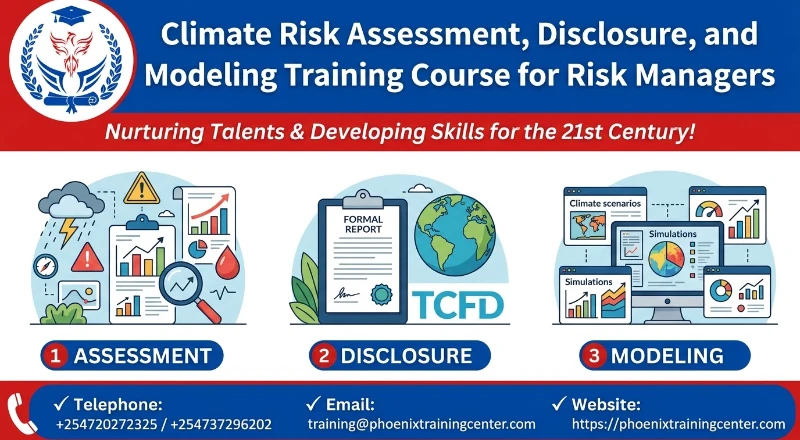
Course Overview
The Climate Risk Assessment, Disclosure, and Modeling Training Course for Risk Managers is an elite masterclass structured to empower financial, corporate, and public-sector risk professionals with actionable methodologies for navigating macro-climate exposures. As modern regulatory frameworks increasingly mandate transparent environmental reporting, organizations face the dual challenge of quantifying physical hazards—such as extreme weather disruptions—and transition vulnerabilities, including regulatory changes and shifting market dynamics. This training program integrates complex quantitative modeling with statutory compliance guidelines, bridging the gap between raw environmental data and boardroom risk architecture.
During this intensive 5-day curriculum, participants will systematically work through the building blocks of a professional climate risk and vulnerability analysis. The syllabus features deep dives into predictive data frameworks as part of a specialized climate risk modeling course, training participants to manipulate forward-looking emission paths and macroeconomic variables. Furthermore, the course demystifies the complex global landscape of sustainability disclosure mandates, ensuring that risk managers can build cohesive frameworks that satisfy international audit standards, protect corporate assets, and identify sustainable commercial opportunities.
Upon the successful completion of this Climate Risk Assessment, Disclosure, and Modeling Training Course for Risk Managers, participants will be able to:
ü Architect and implement an integrated framework for comprehensive climate risk and vulnerability analysis across diverse business units.
ü Deploy advanced statistical techniques and methodologies learned from this specialized climate risk modeling course to predict long-term capital risks.
ü Synthesize raw climate data and scenario projections into regulatory-compliant disclosures that align with international reporting structures.
ü Distinguish, quantify, and manage the strategic interactions between physical climate assets and transition-related macroeconomic shifts.
ü Leverage climate stress-testing metrics to build long-term institutional resilience and secure green market advantages.
Training Methodology
The course is designed to be highly interactive, challenging and stimulating. It will be an instructor led training and will be delivered using a blended learning approach comprising of:
ü Interactive technical lectures paired with real-world institutional diagnostic studies
ü Hands-on laboratory sessions utilizing standard analytical toolkits and predictive modules
ü Guided collaborative workshops focusing on corporate disclosure stress-testing and auditing
ü Group peer-to-peer strategic modeling assignments and interactive case simulations
ü Structured roundtables addressing multi-sector compliance demands and policy variations
Our facilitators are seasoned industry professionals with years of expertise in their chosen fields. All facilitation and course materials will be offered in English.
Who Should Attend?
This Climate Risk Assessment, Disclosure, and Modeling Training Course for Risk Managers would be suitable for, but not limited to:
ü Chief Risk Officers and Corporate Risk Managers
ü Financial Analysts, Portfolio Managers, and Investment Officers
ü Sustainability Directors and Corporate Governance Compliance Managers
ü Government Regulatory Auditors and Public Sector Infrastructure Planners
ü Insurance Underwriters and Actuarial Professionals
ü Environmental Consultants specializing in corporate ESG asset valuation
Benefits of the Training
Personal Benefits
ü Master the advanced quantitative techniques of a comprehensive climate risk modelling course to accelerate professional authority.
ü Gain definitive fluency in complex international disclosure rules, making yourself indispensable to executive leadership boards.
ü Cultivate the critical data skills required to translate abstract environmental shifts into precise financial risk metrics.
ü Enhance your global career trajectory by earning a specialized certification at the intersection of quantitative finance and climate science.
Organizational Benefits
ü Safeguard corporate infrastructure and capital assets through proactive, predictive climate risk and vulnerability analysis.
ü Ensure flawless institutional alignment with evolving statutory mandates, eliminating the threat of non-compliance penalties.
ü Fortify investor confidence by publishing highly transparent, technically sound financial risk disclosures.
ü Elevate strategic planning capacities by incorporating data-driven, long-term environmental stress testing into capital allocation models.
ü Course Duration: 5 Days
ü Training Fee:
o Physical Training: USD 1,500
o Online / Virtual Training: USD 1,000
Module 1: Foundations of Corporate Climate Risk Architecture and Governance
ü Deconstructing climate risk into distinct categories: Physical, transition, and systemic litigation vectors
ü Understanding the financial transmission channels through which climate disruptions impact corporate liquidity
ü Historical evolution of environmental risk accounting and modern corporate governance responsibilities
ü Translating public science data from the IPCC into corporate risk registers and appetite statements
ü Practical Session: Building a preliminary corporate climate risk register by mapping unique environmental vulnerabilities to standard asset classes.
Module 2: Methodologies for Climate Risk and Vulnerability Analysis
ü Conceptual frameworks for isolating asset sensitivity, hazard exposure, and localized adaptive capacities
ü Qualitative versus quantitative assessment frameworks for corporate asset networks
ü Establishing baseline environmental metrics and defining operational risk tolerances across supply lines
ü Integrating traditional enterprise risk management (ERM) matrix tools with climate uncertainty timelines
ü Practical Session: Executing a detailed climate risk and vulnerability analysis on a multinational supply chain case study.
Module 3: Macroeconomic Principles in a Climate Risk Modeling Course Framework
ü Introduction to the structural mechanics of global Network for Greening the Financial System (NGFS) scenarios
ü Core fundamentals of a comprehensive climate risk modeling course focusing on deterministic versus stochastic projections
ü Utilizing integrated assessment models (IAMs) to link greenhouse gas trends to real-world capital market conditions
ü Navigating data limitations, multi-decade time horizons, and structural uncertainty in mathematical models
ü Practical Session: Simulating long-term corporate asset valuation changes across contrasting economic pathways using standard spreadsheet modeling templates.
Module 4: Quantifying Physical Risks and Asset Level Vulnerability Modeling
ü Modeling acute environmental hazards: Tropical cyclones, convective storms, and systemic flash flooding events
ü Assessing chronic climate risks: Structural sea-level rise, persistent heat stress, and baseline water scarcity
ü Geospatial data integration and asset-level mapping for localized risk analysis
ü Calculating probabilistic financial metrics including Expected Annual Loss (EAL) and Value at Risk (VaR)
ü Practical Session: Running an automated hazard analysis using geospatial data coordinates to quantify potential physical damage on a diverse real estate asset portfolio.
Module 5: Modeling Transition Risks, Regulatory Shifts, and Market Decarbonization
ü Quantifying policy risks: Carbon pricing mechanics, border adjustments, and evolving cap-and-trade networks
ü Assessing technology transition risks, stranded asset dynamics, and premature capital equipment obsolescence
ü Tracking shifting consumer behavioral patterns and competitive market repositioning across industries
ü Advanced techniques from a specialized climate risk modelling course to simulate alternative energy adoption curves
ü Practical Session: Projecting the financial impact of a rising carbon tax rate on the operating margins of an industrial manufacturing firm.
Module 6: Global Disclosure Standards and Regulatory Compliance Structures
ü Detailed deep dive into the International Sustainability Standards Board (ISSB) IFRS S2 climate requirements
ü Comparative analysis of European CSRD standards and evolving regional regulatory compliance targets
ü Core disclosure pillars: Documenting institutional governance, strategy, risk management, and quantitative metrics
ü Managing liability risks linked to greenwashing allegations and technical misstatements in public filings
ü Practical Session: Evaluating a corporate annual disclosure report against standard IFRS S2 compliance checklists to identify latent auditing gaps.
Module 7: Applied Scenario Analysis and Stress Testing for Balance Sheets
ü Structuring rigorous climate stress-testing models for corporate balance sheets and asset books
ü Designing custom corporate climate scenarios matching an organization's unique operating footprint
ü Tracing the propagation of climate shocks from operational cash flows to corporate credit profiles
ü Evaluating systemic impacts on collateral valuations, debt service capacities, and insurance premiums
ü Practical Session: Stress-testing a mid-sized corporate balance sheet against an aggressive, uncoordinated transition pathway scenario.
Module 8: Corporate Strategy, Capital Allocation, and Climate Opportunity Capture
ü Integrating climate risk limits directly into corporate capital expenditure allocation frameworks
ü Evaluating the economics of climate adaptation investments versus passive risk acceptance strategies
ü Identifying commercial climate opportunities: Green bonds, sustainability-linked loans, and new market demands
ü Transitioning from defensive risk reduction models to active sustainable value generation architectures
ü Practical Session: Formulating an investment business case comparing upfront climate resilience expenditure against long-term operational loss reductions.
Module 9: Advanced Data Integration and Technical Platforms for Risk Managers
ü Navigating the specialized vendor landscape for commercial climate data and modeling software
ü Overcoming data gaps through proxy variables, sector averages, and machine learning estimations
ü Implementing automated data pipelines to track operational emission metrics and physical asset flags
ü Standardizing data ingestion across fragmented business units for unified enterprise risk reporting
ü Practical Session: Evaluating and selecting specialized climate modeling software profiles based on specific sector risk cases.
Module 10: Executive Reporting, Internal Auditing, and Governance Integration
ü Translating complex outputs from a climate risk modeling course into non-technical executive board briefings
ü Establishing rigorous internal controls and independent audit tracks for climate disclosure validation
ü Embedding climate-related performance targets directly into executive compensation and incentive systems
ü Fostering cross-departmental collaboration between risk management, finance, and sustainability divisions
ü Practical Session: Simulating an executive board presentation defending strategic risk recommendations based on a climate stress-test.
About Our Trainers
Our instructional team consists of veteran risk professionals, quantitative financial analysts, and certified ESG sustainability auditors with over 15 years of industry experience. They have actively built risk management frameworks and directed predictive analysis models for major commercial banks, international investment houses, and regulatory compliance agencies. Combining specialized academic achievements in financial engineering with deep knowledge of environmental science, our trainers offer an educational experience that matches real-world boardroom dynamics and data demands.
Quality Statement
Phoenix Training Center is dedicated to delivering professional training programs that meet the highest international educational standards. Our courses are systematically updated to incorporate the newest shifts in global reporting regulations, risk management protocols, and quantitative modeling tools. Through strict quality assurance checks, continuous curriculum refinement, and direct tracking of attendee learning outcomes, we guarantee that this training program delivers immediate practical utility, building professional expertise and reinforcing organizational resilience.
Tailor-Made Courses
We understand that every organization has unique challenges and opportunities as well as unique training needs. Phoenix Training Center offers tailor-made courses designed to address specific requirements and challenges faced by your team or organization. Whether you need a customized curriculum, a specific duration, or on-site delivery, we can adapt our expertise to provide a training solution that perfectly aligns with your objectives. We can customize this Course to focus on your industry, specific risk profile, or internal stakeholder dynamics. Contact us to discuss how we can create a bespoke training program that maximizes value and impact for your team. For further inquiries, please contact us on Tel: +254720272325 / +254737296202 or Email: training@phoenixtrainingcenter.com.
Admission Criteria
ü Participants should be reasonably proficient in English.
ü Applicants must live up to Phoenix Center for Policy, Research and Training admission criteria.
Terms and Conditions
ü Discounts: Organizations sponsoring Four Participants will have the 5th attend Free
ü What is catered for by the Course Fees: Fees cater for all requirements for the training – Learning materials, Lunches, Teas, Snacks and Certification. All participants will additionally cater for their travel and accommodation expenses, visa application, insurance, and other personal expenses.
ü Certificate Awarded: Participants are awarded Certificate of Completion at the end of the training.
ü Course Improvement: The program content shown here is for guidance purposes only. Our continuous course improvement process may lead to changes in topics and course structure.
ü Approval of Course: Our Programs are NITA Approved. Participating organizations can therefore claim reimbursement on fees paid in accordance with NITA Rules.
Booking for Training
Kindly send an email to the Training Officer on training@phoenixtrainingcenter.com and we will send you a registration form. We advise you to book early to avoid missing a seat to this training. Or call us on +254720272325 / +254737296202
Payment Options
We provide 3 payment options, choose one for your convenience, and kindly make payments a week before the training starts (at least 5 to 7 days before the Training start date) to reserve your seat:
ü Groups of 5 People and Above – Cheque Payments to: Phoenix Center for Policy, Research and Training Limited should be paid in advance, a week before the training starts.
ü Invoice: We can send a bill directly to you or your company.
ü Deposit directly into Bank Account (Account details provided upon request)
Cancellation Policy
ü Payment for all courses includes a registration fee, which is non-refundable, and equals 15% of the total sum of the course fee.
ü Participants may cancel attendance 14 days or more prior to the training commencement date.
ü No refunds will be made 14 days or less before the training commencement date. However, participants who are unable to attend may opt to attend a similar training course at a later date or send a substitute participant provided the participation criteria have been met.
Accommodation and Airport Pick-up
For physical training attendees, we can assist with recommendations for accommodation near the training venue. Airport pick-up services can also be arranged upon request to ensure a smooth arrival. Please inform us of your travel details in advance if you require these services. For reservations contact the Training Officer on Email: training@phoenixtrainingcenter.com or on Tel: +254720272325 / +254737296202.
| Course Dates | Venue | Fees | Enroll |
|---|

Phoenix Training Center
Typically replies in minutes