
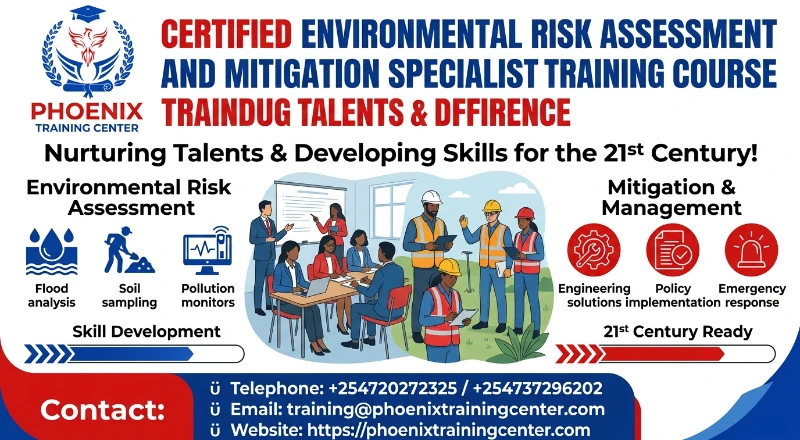
Course Overview
The Certified Environmental Risk Assessment and Mitigation Specialist Training Course is designed to equip professionals with cutting-edge competencies in identifying, evaluating, and neutralizing environmental hazards across diverse industrial and municipal settings. As regulatory pressures intensify and ecological challenges escalate, organizations require specialized experts capable of balancing operational efficiency with rigorous environmental protection. This comprehensive program bridges theoretical frameworks with practical applications, empowering participants to safeguard ecosystems, ensure legal compliance, and drive sustainable corporate practices.
Participants will explore a robust curriculum covering fundamental environmental hazard identification, advanced exposure modeling, human health and ecological risk assessment, and cutting-edge remediation technologies. The course also delves deep into climate change adaptation, environmental impact assessment (EIA) protocols, regulatory frameworks, and comprehensive risk auditing. Through interactive case studies, simulation exercises, and expert-led sessions, attendees will gain actionable insights into designing resilient mitigation strategies tailored to modern industrial challenges.
Upon the successful completion of this Certified Environmental Risk Assessment and Mitigation Specialist Training Course, participants will be able to:
ü Identify, evaluate, and quantify potential environmental hazards across industrial and municipal projects.
ü Master advanced environmental risk assessment methodologies and quantitative modeling tools.
ü Design and implement robust mitigation strategies, remediation plans, and emergency response frameworks.
ü Navigate complex local and international environmental regulatory compliance standards with confidence.
ü Conduct thorough environmental impact assessments (EIA) and audits to ensure long-term corporate sustainability.
Training Methodology
The training employs a practical, interactive adult-learning methodology designed for maximum knowledge transfer. The course is designed to be highly interactive, challenging and stimulating. It will be an instructor led training and will be delivered using a blended learning approach comprising of:
ü Interactive lectures delivered by seasoned industry experts
ü Real-world case studies and contextualized scenarios
ü Hands-on modeling and practical software simulations
ü Guided group discussions and collaborative peer workshops
ü Field-based risk evaluation and practical problem-solving exercises
Our facilitators are seasoned industry professionals with years of expertise in their chosen fields. All facilitation and course materials will be offered in English.
Who Should Attend?
This Certified Environmental Risk Assessment and Mitigation Specialist Training Course would be suitable for, but not limited to:
ü Environmental Engineers
ü Risk Management Professionals
ü Health Safety and Environment EHS Officers
ü Sustainability Managers
ü Industrial Plant Operators
ü Regulatory Compliance Officers
ü Project Managers
Expected Outcomes and Benefits
Personal Benefits
ü Enhance professional credibility with a specialized certification in environmental risk assessment.
ü Master advanced assessment tools and mitigation techniques for immediate career advancement.
ü Gain practical expertise applicable across diverse industrial, corporate, and governmental sectors.
ü Expand professional networks with industry peers and leading environmental protection experts.
Organizational Benefits
ü Minimize legal, financial, and operational liabilities through proactive risk identification and mitigation.
ü Ensure full compliance with regional and international environmental regulations and standards.
ü Improve corporate sustainability performance, stakeholder confidence, and public relations.
ü Protect workforce health, surrounding communities, and fragile ecosystems from industrial hazards.
ü Course Duration: 5 Days
ü Training Fee:
o Physical Training: USD 1,500
o Online / Virtual Training: USD 1,000
Module 1: Introduction to Environmental Risk Management and Regulatory Frameworks
ü Overview of environmental risk paradigms and core concepts
ü National and international environmental compliance standards
ü The role of risk assessment in corporate decision-making
ü Stakeholder engagement and public perception in environmental management
ü Practical Session: Reviewing and mapping an organization's existing regulatory compliance matrix.
Module 2: Environmental Hazard Identification and Source Characterization
ü Methodology for identifying chemical, physical, and biological hazards
ü Point source versus non-point source pollution analysis
ü Industrial process mapping for environmental footprints
ü Data collection techniques and baseline environmental sampling
ü Practical Session: Conducting a simulated preliminary hazard identification walkthrough for a manufacturing facility.
Module 3: Exposure Assessment and Environmental Pathway Analysis
ü Fate and transport of contaminants in air, water, and soil
ü Pathways of human and ecological exposure
ü Mathematical modeling of pollutant dispersion
ü Evaluating receptor populations and exposure duration
ü Practical Session: Using screening-level air dispersion tools to model pollutant migration.
Module 4: Toxicity Assessment and Ecological Impact Modeling
ü Principles of environmental toxicology and dose-response relationships
ü Acute versus chronic toxicity thresholds
ü Assessing impacts on aquatic and terrestrial ecosystems
ü Bioaccumulation and biomagnification in food webs
ü Practical Session: Analyzing toxicity report data to determine ecological risk indices.
Module 5: Human Health Risk Assessment (HHRA) in Industrial Settings
ü Step-by-step framework for conducting HHRAs
ü Carcinogenic and non-carcinogenic risk characterization
ü Inhalation, ingestion, and dermal absorption calculations
ü Managing uncertainty and conservative assumptions in health risk analysis
ü Practical Session: Calculating excess lifetime cancer risk using hypothetical contaminant concentration datasets.
Module 6: Quantitative and Qualitative Risk Evaluation Techniques
ü Matrix-based qualitative risk assessment methodologies
ü Probabilistic risk assessment (PRA) and Monte Carlo simulations
ü Risk ranking and prioritization frameworks
ü Cost-benefit analysis of risk reduction measures
ü Practical Session: Building a quantitative risk matrix for a multi-hazard industrial plant.
Module 7: Advanced Environmental Mitigation and Remediation Strategies
ü Hierarchy of hazard controls in environmental management
ü In-situ and ex-situ soil and groundwater remediation technologies
ü Air pollution control systems and wastewater treatment engineering
ü Designing fail-safe engineering controls and containment systems
ü Practical Session: Designing a remediation action plan for a contaminated industrial site.
Module 8: Environmental Impact Assessment (EIA) and Strategic Environmental Assessment (SEA)
ü The EIA process: scoping, baseline studies, and impact prediction
ü Mitigation measures and environmental management plans (EMP)
ü Differences and applications of SEA in regional planning
ü Reviewing EIA reports for quality and regulatory approval
ü Practical Session: Drafting an environmental impact mitigation framework for a large-scale infrastructure project.
Module 9: Climate Change Adaptation and Resilience Planning
ü Assessing climate-related vulnerabilities and physical risks
ü Integrating climate risk into corporate risk management systems
ü Business continuity planning for extreme weather events
ü Sustainable infrastructure design and nature-based solutions
ü Practical Session: Conducting a climate vulnerability assessment workshop for a coastal industrial asset.
Module 10: Environmental Risk Auditing, Reporting, and Continuous Monitoring
ü Principles and protocols of environmental auditing (ISO 14001 alignment)
ü Designing environmental monitoring programs and key performance indicators (KPIs)
ü Communicating risk data to executive boards and external stakeholders
ü Establishing continuous improvement and adaptive management loops
ü Practical Session: Developing an internal environmental audit checklist and reporting template.
About Our Trainers
Our training team comprises elite environmental scientists, senior risk management consultants, certified EHS directors, and regulatory compliance experts with decades of combined international experience. They bring deep practical insights from working across manufacturing, energy, mining, and governmental sectors, ensuring that participants receive actionable, industry-tested guidance throughout the program.
Quality Statement
Phoenix Training Center is committed to delivering world-class professional education that meets the highest standards of quality, relevance, and practical applicability. We continuously review and update our curriculum, materials, and delivery methods to reflect evolving industry best practices, technological advancements, and regulatory updates, ensuring our participants achieve maximum professional impact.
Tailor-Made Courses
We understand that every organization has unique challenges and opportunities as well as unique training needs. Phoenix Training Center offers tailor-made courses designed to address specific requirements and challenges faced by your team or organization. Whether you need a customized curriculum, a specific duration, or on-site delivery, we can adapt our expertise to provide a training solution that perfectly aligns with your objectives. We can customize this Course to focus on your industry, specific risk profile, or internal stakeholder dynamics. Contact us to discuss how we can create a bespoke training program that maximizes value and impact for your team. For further inquiries, please contact us on Tel: +254720272325 / +254737296202 or Email training@phoenixtrainingcenter.com.
Admission Criteria
ü Participants should be reasonably proficient in English.
ü Applicants must live up to Phoenix Center for Policy, Research and Training admission criteria.
Terms and Conditions
ü Discounts: Organizations sponsoring Four Participants will have the 5th attend Free
ü What is catered for by the Course Fees: Fees cater for all requirements for the training – Learning materials, Lunches, Teas, Snacks and Certification. All participants will additionally cater for their travel and accommodation expenses, visa application, insurance, and other personal expenses.
ü Certificate Awarded: Participants are awarded Certificates of Participation at the end of the training.
ü Course Improvement: The program content shown here is for guidance purposes only. Our continuous course improvement process may lead to changes in topics and course structure.
ü Approval of Course: Our Programs are NITA Approved. Participating organizations can therefore claim reimbursement on fees paid in accordance with NITA Rules.
Booking for Training
Kindly send an email to the Training Officer on training@phoenixtrainingcenter.com and we will send you a registration form. We advise you to book early to avoid missing a seat to this training. Or call us on +254720272325 / +254737296202
Payment Options
We provide 3 payment options, choose one for your convenience, and kindly make payments a week before the training starts (at least 5 to 7 days before the Training start date) to reserve your seat:
ü Groups of 5 People and Above – Cheque Payments to: Phoenix Center for Policy, Research and Training Limited should be paid in advance, a week before the training starts.
ü Invoice: We can send a bill directly to you or your company.
ü Deposit directly into Bank Account (Account details provided upon request)
Cancellation Policy
ü Payment for all courses includes a registration fee, which is non-refundable, and equals 15% of the total sum of the course fee.
ü Participants may cancel attendance 14 days or more prior to the training commencement date.
ü No refunds will be made 14 days or less before the training commencement date. However, participants who are unable to attend may opt to attend a similar training course at a later date or send a substitute participant provided the participation criteria have been met.
Accommodation and Airport Pick-up
For physical training attendees, we can assist with recommendations for accommodation near the training venue. Airport pick-up services can also be arranged upon request to ensure a smooth arrival. Please inform us of your travel details in advance if you require these services. For reservations contact the Training Officer on Email: training@phoenixtrainingcenter.com or on Tel: +254720272325 / +254737296202.
| Course Dates | Venue | Fees | Enroll |
|---|---|---|---|
| Nov 02 - Nov 06 2026 | Nairobi | $1,500 |
|
| Nov 09 - Nov 13 2026 | Nairobi | $1,500 |
|
| Nov 16 - Nov 20 2026 | Mombasa | $1,500 |
|
| Nov 23 - Nov 27 2026 | Naivasha | $1,500 |
|
| Nov 23 - Nov 27 2026 | Zoom | $1,000 |
|
| Nov 30 - Dec 04 2026 | Nairobi | $1,000 |
|
| Dec 07 - Dec 11 2026 | Nairobi | $1,500 |
|
| Nov 30 - Dec 04 2026 | Zoom | $1,000 |
|
| Dec 14 - Dec 18 2026 | Nairobi | $1,500 |
|
| Dec 28 - Jan 01 2027 | Zoom | $1,000 |
|

Phoenix Training Center
Typically replies in minutes