
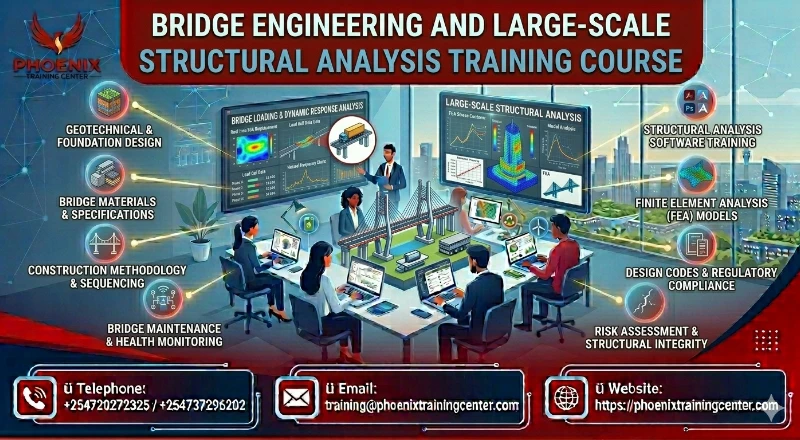
Course Overview
The Bridge Engineering and Large-Scale Structural Analysis Training Course is an intensive professional development program designed to bridge the gap between advanced structural theory and practical civil engineering application. In an era of rapid urbanization and aging infrastructure, the ability to design, analyze, and maintain resilient large-scale structures is a critical competency for modern engineers. This course provides an exhaustive look at the technical requirements for modern bridges, utilizing state-of-the-art computational methods to solve complex engineering challenges and ensure public safety and structural longevity.
The curriculum transitions from fundamental bridge deck mechanics to the sophisticated world of non-linear finite element analysis and seismic retrofitting. Participants will explore diverse bridge types—from reinforced concrete to cable-stayed systems—and delve into the intricacies of load distribution, environmental stressors, and material fatigue. By integrating real-world case studies with high-level structural modeling software, this program ensures that attendees can navigate the entire lifecycle of a bridge project, from initial conceptual design to rigorous safety inspections and structural health monitoring.
Upon the successful completion of this Bridge Engineering and Large-Scale Structural Analysis Training Course participants will be able to:
ü Apply advanced structural analysis techniques to large-scale bridge projects.
ü Interpret and implement international bridge design codes and standards.
ü Model complex loading scenarios including seismic, wind, and hydrodynamic forces.
ü Evaluate the structural integrity of existing bridges using modern diagnostic tools.
ü Design effective maintenance and rehabilitation strategies for aging infrastructure.
Training Methodology
The course is designed to be highly interactive, challenging and stimulating. It will be an instructor led training and will be delivered using a blended learning approach comprising of:
ü Expert-led technical lectures and interactive workshops.
ü Hands-on computational modeling sessions using industry-standard software.
ü In-depth analysis of global bridge failure and success case studies.
ü Collaborative design projects and peer-review simulations.
ü Virtual or physical site visit simulations for structural inspection training.
Our facilitators are seasoned industry professionals with years of expertise in their chosen fields. All facilitation and course materials will be offered in English.
Who Should Attend?
This Bridge Engineering and Large-Scale Structural Analysis Training Course would be suitable for, but not limited to:
ü Civil and Structural Engineers
ü Bridge Design Consultants
ü Infrastructure Project Managers
ü Transportation Authority Engineers
ü Geotechnical Engineers
ü Public Works Maintenance Supervisors
ü Graduate Students specializing in Structural Engineering
Personal Benefits
Participants will gain a competitive edge by mastering high-demand skills in finite element modeling and large-scale structural assessment. This course provides the technical confidence required to lead complex engineering teams, sign off on critical design phases, and contribute to significant national infrastructure projects.
Organizational Benefits
Organizations will benefit from enhanced design accuracy and reduced project risks. By training staff in the latest structural analysis methodologies, firms can minimize material waste through optimized design, ensure compliance with stringent safety regulations, and extend the service life of the assets they manage, ultimately improving their reputation for engineering excellence.
ü Course Duration: 5 Days
ü Training Fee
o Physical Training: USD 1,200
o Online / Virtual Training: USD 800
Module 1: Fundamentals of Bridge Engineering and Aesthetics
ü History and evolution of bridge archetypes
ü Selection of bridge types based on span and site constraints
ü Aesthetic considerations in urban infrastructure
ü Conceptual design and preliminary sizing
ü Practical Session: Developing a bridge conceptual design for a 100m span river crossing
Module 2: Bridge Hydraulics and Geotechnical Considerations
ü Hydraulic modeling of river crossings and scour analysis
ü Subsurface investigation and soil-structure interaction
ü Abutment and pier foundation design (Piles vs. Spread footings)
ü Earth pressure and retaining wall mechanics
ü Practical Session: Calculating local scour depth for a multi-span bridge pier
Module 3: Structural Mechanics of Bridge Decks and Girders
ü Influence lines and moving load analysis
ü Transverse and longitudinal load distribution
ü Grillage analysis and plate theory applications
ü Expansion joints and bearing systems
ü Practical Session: Manual grillage analysis for a multi-girder deck system
Module 4: Advanced Analysis of Reinforced and Prestressed Concrete Bridges
ü Time-dependent properties of concrete (Creep and Shrinkage)
ü Prestressing losses and anchorage zone mechanics
ü Segmental construction techniques
ü Serviceability and ultimate limit state checks
ü Practical Session: Modeling a post-tensioned box girder in a structural software environment
Module 5: Steel and Composite Bridge Design and Fatigue Analysis
ü Properties of high-strength structural steel
ü Shear connectors and composite action mechanics
ü Plate girder stability and buckling analysis
ü Fatigue life estimation and fracture mechanics
ü Practical Session: Designing a composite steel-concrete beam section for AASHTO/Eurocode compliance
Module 6: Large-Scale Structural Analysis: Finite Element Method (FEM)
ü Principles of 2D and 3D finite element modeling
ü Meshing strategies and convergence criteria
ü Non-linear material modeling and geometric non-linearity
ü Interpreting stress contours and deformation results
ü Practical Session: Building a 3D FE model of a truss bridge and performing a stress check
Module 7: Dynamic Loading: Seismic and Wind Engineering for Bridges
ü Response spectrum analysis and time-history methods
ü Damping and energy dissipation systems (Base isolation)
ü Aerodynamic stability and aeroelasticity in long-span bridges
ü Vibration control under traffic and pedestrian loads
ü Practical Session: Dynamic modal analysis to determine bridge natural frequencies
Module 8: Cable-Stayed and Suspension Bridge Systems
ü Global behavior of cable-supported structures
ü Pylon design and cable-stay tensioning sequences
ü Stiffness and stability of suspension systems
ü Construction stage analysis for long-span structures
ü Practical Session: Simulation of a cable-stayed bridge stay-replacement sequence
Module 9: Structural Health Monitoring and Non-Destructive Testing
ü Sensor technologies (Strain gauges, Accelerometers, Fiber optics)
ü Interpretation of data for structural integrity assessment
ü Visual inspection protocols and rating systems
ü Non-destructive testing (NDT) methods: Ultrasonic and Radiography
ü Practical Session: Designing a sensor placement map for a major highway bridge
Module 10: Rehabilitation, Retrofitting, and Bridge Management Systems
ü Common degradation mechanisms (Corrosion and Alkali-Silica Reaction)
ü Strengthening techniques: Carbon Fiber Reinforced Polymers (CFRP)
ü Life-cycle cost analysis and maintenance prioritization
ü Bridge Management Software (BMS) integration
ü Practical Session: Drafting a rehabilitation plan for a 50-year-old reinforced concrete bridge
About Our Trainers
Our trainers are distinguished Structural Engineers and Lead Bridge Designers with over 20 years of international experience. They have spearheaded major infrastructure projects across Africa, Europe, and Asia, specializing in large-span structures and seismic design. Their deep industry knowledge ensures that the Bridge Engineering and Large-Scale Structural Analysis Training Course is delivered with a focus on practical problem-solving and technical precision.
Quality Statement
Phoenix Center for Policy, Research and Training is committed to delivering the highest caliber of technical education. We ensure that our training materials are rigorously vetted and aligned with current international engineering standards (AASHTO, Eurocodes, and BS). Our focus is on providing actionable, evidence-based knowledge that empowers engineers to build a safer and more resilient world.
Tailor-Made Courses
We understand that every organization has unique challenges and opportunities as well as unique training needs. Phoenix Training Center offers tailor-made courses designed to address specific requirements and challenges faced by your team or organization. Whether you need a customized curriculum, a specific duration, or on-site delivery, we can adapt our expertise to provide a training solution that perfectly aligns with your objectives. We can customize this course to focus on your specific local codes, industry-specific risk profiles, or internal stakeholder dynamics. Contact us to discuss how we can create a bespoke training program that maximizes value and impact for your team. For further inquiries, please contact us on Tel: +254720272325 / +254737296202 or Email training@phoenixtrainingcenter.com
ü Participants should be reasonably proficient in English.
ü Applicants must live up to Phoenix Center for Policy, Research and Training admission criteria.
Terms and Conditions
ü Discounts: Organizations sponsoring Four Participants will have the 5th attend Free
ü What is catered for by the Course Fees: Fees cater for all requirements for the training – Learning materials, Lunches, Teas, Snacks and Certification. All participants will additionally cater for their travel and accommodation expenses, visa application, insurance, and other personal expenses.
ü Certificate Awarded: Participants are awarded Certificates of Participation at the end of the training.
ü The program content shown here is for guidance purposes only. Our continuous course improvement process may lead to changes in topics and course structure.
ü Approval of Course: Our Programs are NITA Approved. Participating organizations can therefore claim reimbursement on fees paid in accordance with NITA Rules.
Booking for Training
Simply send an email to the Training Officer on training@phoenixtrainingcenter.com and we will send you a registration form. We advise you to book early to avoid missing a seat to this training. Or call us on +254720272325 / +254737296202
Payment Options
We provide 3 payment options, choose one for your convenience, and kindly make payments at least 5 days before the Training start date to reserve your seat:
ü Groups of 5 People and Above – Cheque Payments to: Phoenix Center for Policy, Research and Training Limited should be paid in advance, 5 days to the training.
ü Invoice: We can send a bill directly to you or your company.
ü Deposit directly into Bank Account (Account details provided upon request)
Cancellation Policy
ü Payment for all courses includes a registration fee, which is non-refundable, and equals 15% of the total sum of the course fee.
ü Participants may cancel attendance 14 days or more prior to the training commencement date.
ü No refunds will be made 14 days or less before the training commencement date. However, participants who are unable to attend may opt to attend a similar training course at a later date or send a substitute participant provided the participation criteria have been met.
Accommodation and Airport Transfer
For physical training attendees, we can assist with recommendations for accommodation near the training venue. Airport pick-up services can also be arranged upon request to ensure a smooth arrival. Please inform us of your travel details in advance if you require these services. For reservations contact the Training Officer on Email: training@phoenixtrainingcenter.com or on Tel: +254720272325 / +254737296202
| Course Dates | Venue | Fees | Enroll |
|---|

Phoenix Training Center
Typically replies in minutes