
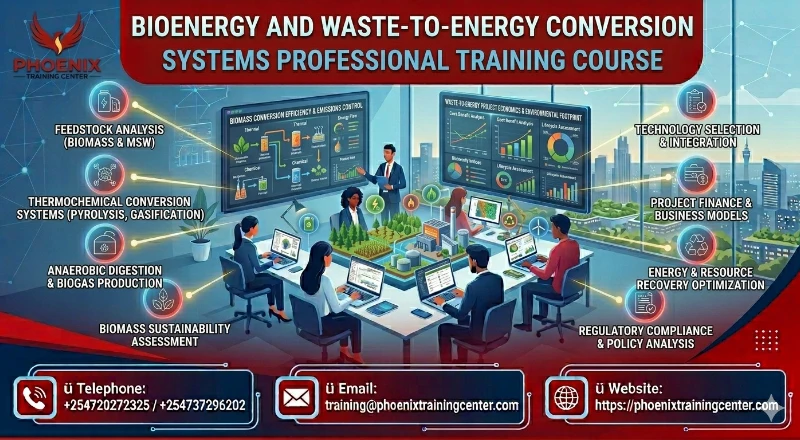
Course Overview
This comprehensive Bioenergy and Waste-to-Energy Conversion Systems Training Course, Biomass and Biofuels Technology: Sustainable Sourcing and Energy Conversion is designed for professionals seeking to lead the transition toward a circular economy and carbon-neutral energy production. As global energy demands increase alongside rising waste management challenges, the integration of bioenergy solutions has become a critical strategic priority. This course provides a high-level technical and economic framework for transforming organic waste and biomass into high-value electricity, heat, and transport fuels, ensuring participants can navigate the complexities of modern energy systems.
The program offers an in-depth exploration of Biomass and Biofuels Technology: Sustainable Sourcing and Energy Conversion, covering the entire value chain from feedstock logistics to advanced thermochemical and biochemical conversion processes. Participants will gain specialized knowledge in anaerobic digestion, gasification, and the production of next-generation biofuels. By attending this Bioenergy and Waste-to-Energy Conversion Systems Training Course, Biomass and Biofuels Technology: Sustainable Sourcing and Energy Conversion, attendees will be equipped with the tools to design, evaluate, and manage sustainable energy projects that align with international environmental standards and renewable energy mandates.
Upon the successful completion of this Bioenergy and Waste-to-Energy Conversion Systems Professional Training Course participants will be able to:
ü Evaluate the technical viability of various bioenergy and waste-to-energy (WtE) technologies.
ü Understand the principles of Biomass and Biofuels Technology: Sustainable Sourcing and Energy Conversion.
ü Perform life-cycle assessments (LCA) for bioenergy systems to ensure true sustainability.
ü Navigate the regulatory frameworks and financial incentives for bioenergy projects.
ü Design efficient feedstock collection and preprocessing supply chains for energy plants.
Training Methodology
The course is designed to be highly interactive, challenging and stimulating. It will be an instructor led training and will be delivered using a blended learning approach comprising of:
ü Interactive technical lectures and multimedia presentations.
ü Case studies of successful commercial-scale Waste-to-Energy plants.
ü Mathematical modeling of energy yields and conversion efficiencies.
ü Group workshops focused on project feasibility and financial modeling.
ü Practical simulation of feedstock sourcing and logistics planning.
Our facilitators are seasoned industry professionals with years of expertise in their chosen fields. All facilitation and course materials will be offered in English.
Who Should Attend?
This Bioenergy and Waste-to-Energy Conversion Systems Professional Training Course
would be suitable for, but not limited to:
ü Renewable Energy Engineers and Project Developers
ü Waste Management Consultants and Municipal Officers
ü Environmental Policy Makers and Regulators
ü Agricultural Scientists and Biofuel Plant Managers
ü Sustainability Officers and Corporate ESG Leads
ü Chemical and Mechanical Engineers in the Energy Sector
ü Investment Analysts focusing on Green Technology
Personal Benefits
Participants will position themselves at the forefront of the global energy transition, acquiring high-demand technical skills that bridge environmental engineering and power generation. This course enhances professional credibility and provides the expertise required to lead innovative waste-to-value projects in both public and private sectors.
Organizational Benefits
Organizations will gain the internal capacity to reduce waste disposal costs while generating onsite renewable energy. By implementing Biomass and Biofuels Technology: Sustainable Sourcing and Energy Conversion strategies, companies can significantly lower their carbon footprint, achieve sustainability targets, and tap into new revenue streams from the circular economy.
ü Course Duration: 5 Days
ü Training Fee
o Physical Training: USD 1,200
o Online / Virtual Training: USD 800
Module 1: Global Bioenergy Landscape and Circular Economy Principles
ü Current status of bioenergy in the global energy mix
ü Concepts of Waste-to-Value and the circular economy
ü Carbon neutrality vs. Carbon negativity (BECCS)
ü Bioenergy’s role in achieving Net-Zero targets
ü Practical Session: Mapping local waste streams to potential energy outputs
Module 2: Biomass and Biofuels Technology: Sustainable Sourcing and Energy Conversion
ü Types of biomass: Forestry, agricultural, and aquatic residues
ü Sustainable sourcing criteria and land-use change (ILUC)
ü Energy density and fuel quality standards
ü The chemistry of biofuels: From 1st to 4th generation
ü Practical Session: Evaluating feedstock sustainability using international certification templates
Module 3: Characterization and Preprocessing of Waste and Biomass Feedstocks
ü Proximate and ultimate analysis of feedstocks
ü Moisture content, heating value (HHV/LHV), and bulk density
ü Mechanical preprocessing: Shredding, pelletizing, and torrefaction
ü Sorting and recovery of recyclables from MSW
ü Practical Session: Calculating the energy potential of different organic waste samples
Module 4: Thermochemical Conversion: Combustion and Gasification
ü Direct combustion and steam turbine cycles
ü Physics of gasification: Syngas production and cleaning
ü Pyrolysis for bio-oil and biochar production
ü Plasma arc gasification for hazardous waste
ü Practical Session: Designing a mass-energy balance for a small-scale gasifier
Module 5: Advanced Biochemical Conversion and Anaerobic Digestion
ü Microbiology of anaerobic digestion (AD)
ü Biogas composition, upgrading, and biomethane production
ü Small-scale vs. Industrial-scale digester designs
ü Digestate management and nutrient recovery
ü Practical Session: Simulating a biogas yield based on varying organic loading rates
Module 6: Liquid Biofuels: Biodiesel, Bioethanol, and Sustainable Aviation Fuel (SAF)
ü Transesterification processes for biodiesel
ü Fermentation and distillation of bioethanol
ü Hydrotreated Vegetable Oil (HVO) and SAF pathways
ü Bio-refinery concepts: Co-production of chemicals and energy
ü Practical Session: Comparative cost-benefit analysis of liquid biofuel pathways
Module 7: Municipal Solid Waste (MSW) to Energy Systems
ü Incineration technologies and grate-fired furnaces
ü Refuse-Derived Fuel (RDF) and Solid Recovered Fuel (SRF)
ü Landfill gas (LFG) collection and utilization
ü Managing the "energy from waste" hierarchy
ü Practical Session: Site selection exercise for a municipal WtE facility
Module 8: Environmental Impact, Emission Control, and Carbon Sequestration
ü Flue gas cleaning: Dioxins, NOx, SOx, and particulate matter
ü Ash management and hazardous waste disposal
ü Life-Cycle Assessment (LCA) of waste-to-energy pathways
ü Integration of Carbon Capture and Storage (CCS)
ü Practical Session: Performing a simplified LCA for a biomass power plant
Module 9: Economic Feasibility and Project Finance for Bioenergy
ü Capital Expenditure (CAPEX) and Operational Expenditure (OPEX)
ü Levelized Cost of Energy (LCOE) for bioenergy
ü Revenue streams: Gate fees, power purchase agreements (PPAs), and carbon credits
ü Risk assessment in feedstock supply and energy off-take
ü Practical Session: Developing a 10-year financial projection for a bioenergy project
Module 10: Policy, Standards, and Future Trends in Waste-to-Energy
ü International renewable energy policies and subsidies
ü Grid integration and decentralised bioenergy systems
ü Hydrogen production from biomass (Green Hydrogen)
ü Digitalization and IoT in energy plant management
ü Practical Session: Final project: Designing a comprehensive waste-to-energy roadmap for a specific region
About Our Trainers
Our training facilitators are seasoned energy consultants and chemical engineers with over 15 years of practical experience in the design and operation of bioenergy plants. They have led major waste-to-energy feasibility studies for international developmental agencies and private energy firms across Africa and Europe, ensuring the Bioenergy and Waste-to-Energy Conversion Systems Training Course is delivered with unmatched technical depth and industry relevance.
Quality Statement
Phoenix Center for Policy, Research and Training is committed to delivering world-class educational excellence. We ensure that our Biomass and Biofuels Technology: Sustainable Sourcing and Energy Conversion training content is updated quarterly to reflect the latest technological breakthroughs and evolving environmental regulations.
Tailor-Made Courses
We understand that every organization has unique challenges and opportunities as well as unique training needs. Phoenix Training Center offers tailor-made courses designed to address specific requirements and challenges faced by your team or organization. Whether you need a customized curriculum, a specific duration, or on-site delivery, we can adapt our expertise to provide a training solution that perfectly aligns with your objectives. We can customize this Course to focus on your industry, specific risk profile, or internal stakeholder dynamics. Contact us to discuss how we can create a bespoke training program that maximizes value and impact for your team. For further inquiries, please contact us on Tel: +254720272325 / +254737296202 or Email training@phoenixtrainingcenter.com
ü Participants should be reasonably proficient in English.
ü Applicants must live up to Phoenix Center for Policy, Research and Training admission criteria.
Terms and Conditions
ü Discounts: Organizations sponsoring Four Participants will have the 5th attend Free
ü What is catered for by the Course Fees: Fees cater for all requirements for the training – Learning materials, Lunches, Teas, Snacks and Certification. All participants will additionally cater for their travel and accommodation expenses, visa application, insurance, and other personal expenses.
ü Certificate Awarded: Participants are awarded Certificates of Participation at the end of the training.
ü The program content shown here is for guidance purposes only. Our continuous course improvement process may lead to changes in topics and course structure.
ü Approval of Course: Our Programs are NITA Approved. Participating organizations can therefore claim reimbursement on fees paid in accordance with NITA Rules.
Booking for Training
Simply send an email to the Training Officer on training@phoenixtrainingcenter.com and we will send you a registration form. We advise you to book early to avoid missing a seat to this training. Or call us on +254720272325 / +254737296202
Payment Options
We provide 3 payment options, choose one for your convenience, and kindly make payments at least 5 days before the Training start date to reserve your seat:
ü Groups of 5 People and Above – Cheque Payments to: Phoenix Center for Policy, Research and Training Limited should be paid in advance, 5 days to the training.
ü Invoice: We can send a bill directly to you or your company.
ü Deposit directly into Bank Account (Account details provided upon request)
Cancellation Policy
ü Payment for all courses includes a registration fee, which is non-refundable, and equals 15% of the total sum of the course fee.
ü Participants may cancel attendance 14 days or more prior to the training commencement date.
ü No refunds will be made 14 days or less before the training commencement date. However, participants who are unable to attend may opt to attend a similar training course at a later date or send a substitute participant provided the participation criteria have been met.
Accommodation and Airport Transfer
For physical training attendees, we can assist with recommendations for accommodation near the training venue. Airport pick-up services can also be arranged upon request to ensure a smooth arrival. Please inform us of your travel details in advance if you require these services. For reservations contact the Training Officer on Email: training@phoenixtrainingcenter.com or on Tel: +254720272325 / +254737296202
| Course Dates | Venue | Fees | Enroll |
|---|

Phoenix Training Center
Typically replies in minutes