
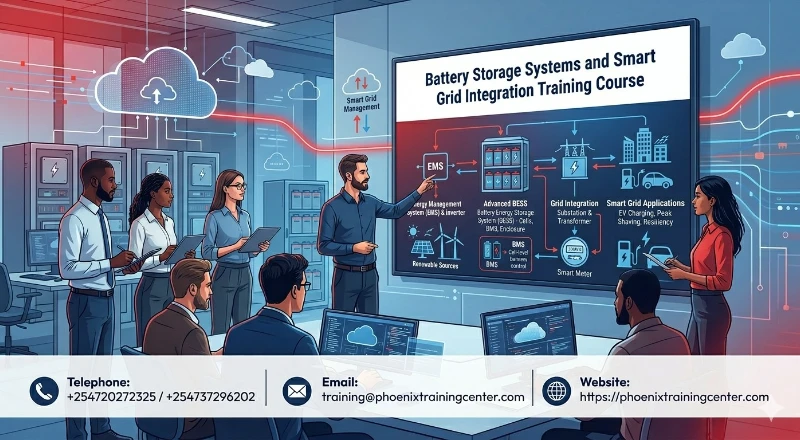
Course Overview
This comprehensive Battery Storage and Smart Grid Technologies Training Course is designed to address the urgent need for flexible power solutions in the transition to renewable energy. As modern grids face increasing volatility from wind and solar inputs, the deployment of Battery Storage Systems (BESS) & Smart Grid Integration for Modern Power Systems has become a critical competency for energy professionals. This course provides a deep dive into the engineering, economic, and operational aspects of large-scale storage and the digital infrastructure required to manage 21st-century electricity networks.
The program explores the technical synergy between energy storage and smart grid components, focusing on the deployment of Battery Storage Systems (BESS) & Smart Grid Integration for Modern Power Systems. Participants will examine battery chemistries, power conversion systems, and the sophisticated control algorithms that allow BESS to provide ancillary services like frequency regulation and peak shaving. By attending this Battery Storage and Smart Grid Technologies Training Course, professionals will gain the expertise needed to design resilient, efficient, and decarbonized power infrastructures.
Upon the successful completion of this Battery Storage Systems and Smart Grid Integration Training Course participants will be able to:
ü Evaluate different battery technologies and their suitability for specific grid applications.
ü Design and size Battery Storage Systems (BESS) & Smart Grid Integration for Modern Power Systems.
ü Understand the communication protocols and control architectures of smart grids.
ü Analyze the economic viability and business models for energy storage arbitrage.
ü Implement safety standards and thermal management protocols for large-scale battery installations.
Training Methodology
The course is designed to be highly interactive, challenging and stimulating. It will be an instructor led training and will be delivered using a blended learning approach comprising of:
ü In-depth technical lectures supported by real-world case studies.
ü Interactive simulation exercises using grid modeling software.
ü Group design projects focusing on BESS sizing and placement.
ü Comparative analysis of international smart grid standards.
ü Hands-on practical sessions with battery management system (BMS) interfaces.
Our facilitators are seasoned industry professionals with years of expertise in their chosen fields. All facilitation and course materials will be offered in English.
Who Should Attend?
This Battery Storage Systems and Smart Grid Integration Training Course would be suitable for, but not limited to:
ü Power Systems Engineers and Grid Planners
ü Renewable Energy Project Developers
ü Utility Managers and Operations Personnel
ü Energy Policy Makers and Regulators
ü Electrical Engineers and Consultants
ü Sustainability Officers and Energy Analysts
ü Technical Managers overseeing BESS procurement
Personal Benefits
Participants will position themselves at the forefront of the energy transition, mastering high-demand technical skills in energy storage and grid modernization. This course empowers professionals to lead innovative projects, bridging the gap between traditional electrical engineering and advanced digital power systems.
Organizational Benefits
Organizations will gain the internal capacity to implement cost-saving storage solutions that enhance grid stability and reduce reliance on fossil-fuel peaking plants. By training staff in Battery Storage Systems (BESS) & Smart Grid Integration for Modern Power Systems, utilities and developers can minimize technical risks and optimize the ROI of renewable energy assets.
ü Course Duration: 5 Days
ü Training Fee
o Physical Training: USD 1,200
o Online / Virtual Training: USD 800
Module 1: Fundamentals of Energy Storage and Smart Grid Evolution
ü Historical context of power grids vs. modern decentralized networks
ü The role of storage in variable renewable energy (VRE) integration
ü Key components of a smart grid ecosystem
ü Regulatory drivers for storage deployment
ü Practical Session: Mapping a local grid's transition to a smart architecture
Module 2: Battery Chemistries and BESS Technical Characteristics
ü Comparison of Li-ion, Flow, Lead-Acid, and Solid-State batteries
ü Understanding Depth of Discharge (DoD) and Cycle Life
ü Energy density vs. Power density requirements
ü Degradation mechanisms and State of Health (SoH) monitoring
ü Practical Session: Technical selection exercise based on a specific use-case
Module 3: Power Conversion Systems (PCS) and Interconnection
ü Inverter technologies: Grid-following vs. Grid-forming
ü DC/DC converters and AC/DC rectification
ü Interconnection requirements and Grid Codes
ü Harmonics and power quality management
ü Practical Session: Simulating an inverter synchronization with a utility grid
Module 4: Smart Grid Communication and IoT Infrastructure
ü Communication protocols: IEC 61850, DNP3, and Modbus
ü The role of Advanced Metering Infrastructure (AMI)
ü Cybersecurity for critical energy infrastructure
ü Cloud-based energy management systems (EMS)
ü Practical Session: Configuring a basic DNP3 data point map for a BESS
Module 5: Grid Applications: Frequency Regulation and Peak Shaving
ü Primary, secondary, and tertiary frequency control
ü Demand response and load shifting strategies
ü Voltage support and reactive power compensation
ü Black start capabilities using BESS
ü Practical Session: Calculating the required BESS capacity for a peak-shaving application
Module 6: Microgrids and Distributed Energy Resources (DERs)
ü Islanded vs. Grid-tied operation modes
ü Integrating solar PV, wind, and storage in microgrids
ü Virtual Power Plants (VPPs) and community energy storage
ü Transitioning between operation modes (seamless transfer)
ü Practical Session: Designing a hybrid solar-plus-storage microgrid layout
Module 7: BESS Safety, Thermal Management, and Fire Suppression
ü Thermal runaway: Causes, detection, and prevention
ü HVAC and liquid cooling systems for containerized BESS
ü Fire suppression standards (NFPA 855)
ü Container design and spatial separation requirements
ü Practical Session: Conducting a safety hazard and operability (HAZOP) study
Module 8: Economic Modeling and Revenue Streams for Storage
ü Levelized Cost of Storage (LCOS) vs. Levelized Cost of Energy (LCOE)
ü Revenue stacking: Combining multiple grid services
ü Merchant market participation and energy arbitrage
ü Policy incentives and tax credits for storage
ü Practical Session: Building a 10-year financial model for a BESS project
Module 9: Control Systems and Battery Management Systems (BMS)
ü Cell balancing techniques (Passive vs. Active)
ü Algorithms for State of Charge (SoC) estimation
ü The hierarchy of control: Cell, String, and Plant levels
ü Edge computing in smart grid devices
ü Practical Session: Hands-on BMS software dashboard navigation and fault diagnosis
Module 10: Future Trends in Modern Power Systems and Grid Decarbonization
ü Second-life batteries: Using EV batteries for grid storage
ü The role of Hydrogen and Long-Duration Energy Storage (LDES)
ü AI and Machine Learning in predictive grid maintenance
ü Global case studies of successful 100% renewable grids
ü Practical Session: Developing a 5-year roadmap for an organization's grid modernization
About Our Trainers
Our training team consists of PhD-level electrical engineers and industry consultants with extensive experience in the deployment of Battery Storage Systems (BESS) & Smart Grid Integration for Modern Power Systems. They have worked on utility-scale projects across Europe, Africa, and the Middle East, bringing practical insights into the technical and regulatory challenges of the energy transition.
Quality Statement
The Phoenix Center for Policy, Research and Training is committed to delivering high-impact educational content. Our Battery Storage and Smart Grid Technologies Training Course is continuously updated to reflect the latest technological breakthroughs and international safety standards, ensuring that our participants receive world-class technical education.
Tailor-Made Courses
We understand that every organization has unique challenges and opportunities as well as unique training needs. Phoenix Training Center offers tailor-made courses designed to address specific requirements and challenges faced by your team or organization. Whether you need a customized curriculum, a specific duration, or on-site delivery, we can adapt our expertise to provide a training solution that perfectly aligns with your objectives. We can customize this Course to focus on your industry, specific risk profile, or internal stakeholder dynamics. Contact us to discuss how we can create a bespoke training program that maximizes value and impact for your team. For further inquiries, please contact us on Tel: +254720272325 / +254737296202 or Email training@phoenixtrainingcenter.com
ü Participants should be reasonably proficient in English.
ü Applicants must live up to Phoenix Center for Policy, Research and Training admission criteria.
Terms and Conditions
ü Discounts: Organizations sponsoring Four Participants will have the 5th attend Free
ü What is catered for by the Course Fees: Fees cater for all requirements for the training – Learning materials, Lunches, Teas, Snacks and Certification. All participants will additionally cater for their travel and accommodation expenses, visa application, insurance, and other personal expenses.
ü Certificate Awarded: Participants are awarded Certificates of Participation at the end of the training.
ü The program content shown here is for guidance purposes only. Our continuous course improvement process may lead to changes in topics and course structure.
ü Approval of Course: Our Programs are NITA Approved. Participating organizations can therefore claim reimbursement on fees paid in accordance with NITA Rules.
Booking for Training
Simply send an email to the Training Officer on training@phoenixtrainingcenter.com and we will send you a registration form. We advise you to book early to avoid missing a seat to this training. Or call us on +254720272325 / +254737296202
Payment Options
We provide 3 payment options, choose one for your convenience, and kindly make payments at least 5 days before the Training start date to reserve your seat:
ü Groups of 5 People and Above – Cheque Payments to: Phoenix Center for Policy, Research and Training Limited should be paid in advance, 5 days to the training.
ü Invoice: We can send a bill directly to you or your company.
ü Deposit directly into Bank Account (Account details provided upon request)
Cancellation Policy
ü Payment for all courses includes a registration fee, which is non-refundable, and equals 15% of the total sum of the course fee.
ü Participants may cancel attendance 14 days or more prior to the training commencement date.
ü No refunds will be made 14 days or less before the training commencement date. However, participants who are unable to attend may opt to attend a similar training course at a later date or send a substitute participant provided the participation criteria have been met.
Accommodation and Airport Transfer
For physical training attendees, we can assist with recommendations for accommodation near the training venue. Airport pick-up services can also be arranged upon request to ensure a smooth arrival. Please inform us of your travel details in advance if you require these services. For reservations contact the Training Officer on Email: training@phoenixtrainingcenter.com or on Tel: +254720272325 / +254737296202
| Course Dates | Venue | Fees | Enroll |
|---|

Phoenix Training Center
Typically replies in minutes