
Course Overview
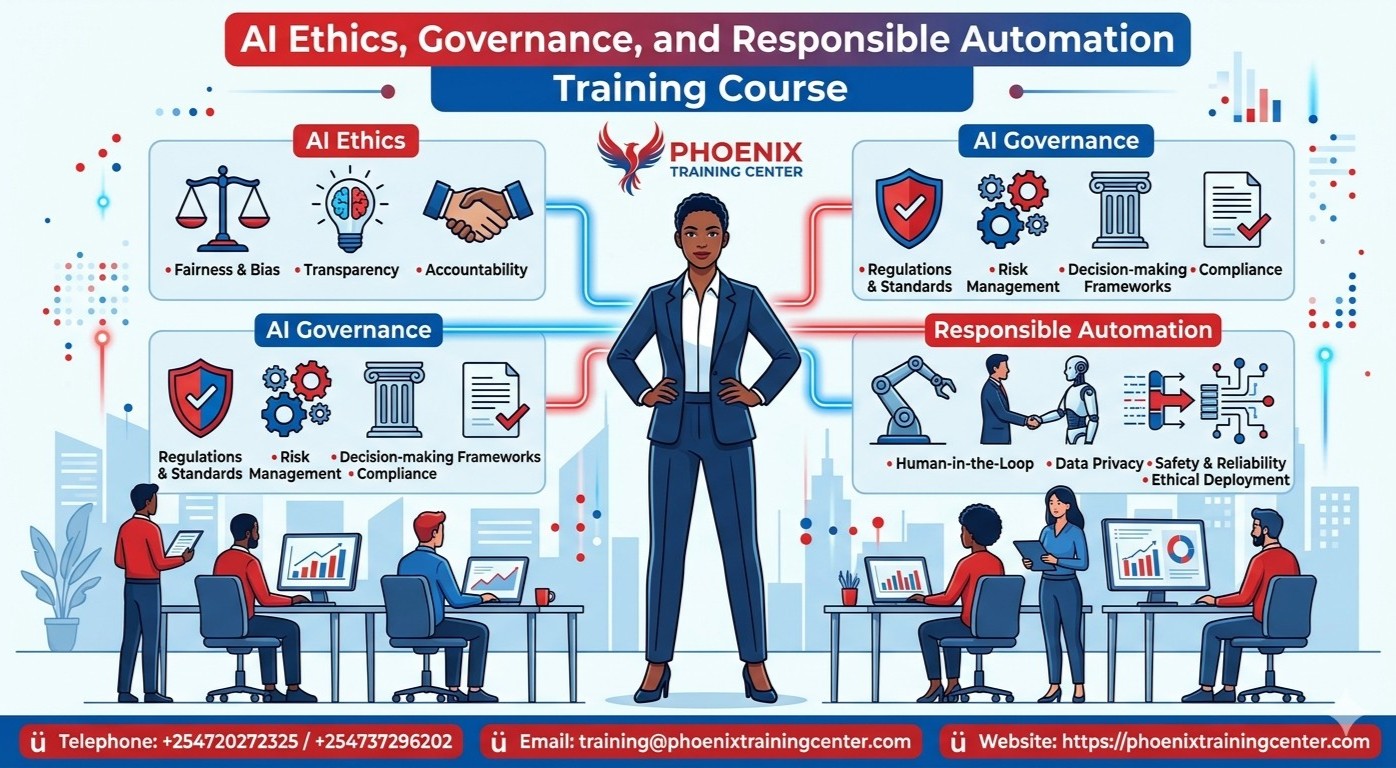
The AI Ethics, Governance, and Responsible Automation Training Course is a high-level program designed to help leaders navigate the complex moral and regulatory landscape of Artificial Intelligence. As AI integration becomes standard across industries, the need for robust governance frameworks and ethical guardrails has never been more urgent. This course provides a comprehensive deep dive into the socio-technical challenges of AI, focusing on how to align automated systems with human values, legal requirements, and organizational integrity.
The curriculum covers a wide spectrum of critical topics, ranging from bias detection and algorithmic transparency to global AI regulatory compliance and corporate accountability. Participants will explore the practical implementation of "Ethics by Design" and learn how to manage the risks associated with large-scale automation. By bridging the gap between technical capability and moral responsibility, this training equips professionals to lead digital transformations that are not only efficient but also trustworthy and sustainable.
Upon the successful completion of this AI Ethics, Governance, and Responsible Automation Training Course participants will be able to:
ü Identify and mitigate ethical risks such as algorithmic bias and data privacy breaches.
ü Develop and implement a robust AI Governance framework within their organization.
ü Navigate global AI regulations including the EU AI Act and international standards.
ü Conduct comprehensive AI Impact Assessments for new automated systems.
ü Foster a corporate culture of responsible innovation and automation transparency.
Training Methodology
The course is designed to be highly interactive, challenging and stimulating. It will be an instructor led training and will be delivered using a blended learning approach comprising of:
ü Interactive PowerPoint presentations and expert-led lectures
ü Real-world case studies of AI failures and governance successes
ü Group debates on ethical dilemmas in automation
ü Hands-on workshops using AI fairness and bias-detection tools
ü Practical Sessions involving the design of governance templates and audit checklists
Our facilitators are seasoned industry professionals with years of expertise in their chosen fields. All facilitation and course materials will be offered in English.
Who Should Attend?
This AI Ethics, Governance, and Responsible Automation Training Course would be suitable for, but not limited to:
ü Chief Technology Officers and IT Directors
ü Data Scientists and AI Engineers
ü Compliance and Risk Managers
ü Legal Professionals and Policy Makers
ü HR Managers overseeing automated recruitment
ü Corporate Ethics Officers
ü Digital Transformation Leads
ü Management Consultants specializing in AI
Personal Benefits
ü Master the technical and legal vocabulary of AI ethics to lead high-level strategy sessions.
ü Enhance professional credibility as a certified leader in responsible AI implementation.
ü Develop the critical thinking skills needed to solve complex socio-technical dilemmas.
ü Gain a competitive edge in the job market by specializing in the "human side" of technology.
Organizational Benefits
ü Protect the organization from reputational damage and legal liabilities related to AI failure.
ü Improve stakeholder trust and customer loyalty through transparent automation practices.
ü Future-proof the organization against evolving international AI regulations.
ü Ensure that automation projects deliver fair and non-discriminatory outcomes.
ü Course Duration: 5 Days
ü Training Fee
o Physical Training: USD 1,200
o Online / Virtual Training: USD 800
Module 1: Foundations of AI Ethics and Moral Philosophy
ü The evolution of AI and why ethics matters now
ü Core ethical theories applied to automated decision-making
ü Human rights in the digital age
ü The concept of "Ethics by Design"
ü Practical Session: Evaluating a company's current AI mission statement against ethical pillars
Module 2: Understanding Algorithmic Bias and Fairness
ü Types of bias: Data bias, societal bias, and algorithmic loops
ü Measuring fairness: Demographic parity vs. equal opportunity
ü The impact of biased AI on marginalized communities
ü Techniques for debiasing datasets
ü Practical Session: Using an open-source tool to detect bias in a sample recruitment algorithm
Module 3: Data Privacy and Security in the Age of AI
ü Data sovereignty and the ethics of data scraping
ü Anonymization and de-identification challenges
ü Surveillance capitalism and facial recognition ethics
ü Generative AI and intellectual property rights
ü Practical Session: Drafting a data consent form for a new AI-driven customer service bot
Module 4: The AI Governance Framework: Policy and Oversight
ü Defining internal AI policies and standards
ü Roles and responsibilities: Who is accountable for AI?
ü Integrating ethics into the Software Development Life Cycle (SDLC)
ü Monitoring and continuous auditing of live models
ü Practical Session: Creating a stakeholder map for an AI governance oversight board
Module 5: Global AI Regulations and Legal Compliance
ü Deep dive into the EU AI Act and its global influence
ü AI policy landscapes in the US, China, and Africa
ü Liability and the "personhood" of AI systems
ü Industry-specific regulations (Finance, Healthcare, Defense)
ü Practical Session: Mapping an organization’s AI tools to the EU AI Act risk categories
Module 6: Responsible Automation and the Future of Work
ü Ethical considerations of AI-driven job displacement
ü The ethics of human-in-the-loop vs. fully autonomous systems
ü Workplace surveillance and worker autonomy
ü Upskilling and the moral responsibility of employers
ü Practical Session: Designing a transition plan for a department facing partial automation
Module 7: Transparency, Explainability, and "Black Box" Challenges
ü The trade-off between model accuracy and explainability (XAI)
ü Techniques for making AI outcomes interpretable to non-experts
ü Right to Explanation: What do users deserve to know?
ü Counterfactual explanations and user trust
ü Practical Session: Explaining a complex AI loan denial to a hypothetical customer in plain language
Module 8: AI Risk Management and Impact Assessments
ü Identifying high-risk AI use cases
ü Performing an Algorithmic Impact Assessment (AIA)
ü Red-teaming and adversarial testing for AI safety
ü Incident response: What to do when AI fails
ü Practical Session: Completing a risk-scoring matrix for a proposed AI deployment
Module 9: Corporate Accountability and Ethical Leadership
ü Building a culture of ethical tech stewardship
ü Whistleblowing mechanisms for AI engineers
ü Public perception and branding through ethical AI
ü Environmental ethics: The carbon footprint of large language models
ü Practical Session: Role-playing an executive meeting deciding whether to kill a profitable but unethical AI project
Module 10: Building an AI Ethics Committee and Audit Process
ü Composition of an AI Ethics Committee: Diverse perspectives
ü Internal vs. external AI auditing
ü Reporting frameworks for transparency
ü Creating a roadmap for long-term responsible AI
ü Practical Session: Developing an AI Audit Checklist for the upcoming fiscal year
About Our Trainers
Our trainers are internationally recognized experts in digital ethics, law, and computer science. With decades of combined experience advising Fortune 500 companies and government agencies, they bring a unique blend of technical expertise and policy insight. They have published extensive research on AI governance and have been instrumental in drafting internal AI ethics guidelines for global tech leaders.
Quality Statement
Phoenix Center for Policy, Research and Training is committed to delivering excellence. Our curriculum is continuously updated to reflect the rapid shifts in AI technology and the emerging regulatory landscape, ensuring our participants receive the most current and actionable intelligence available in the field of AI governance.
Tailor-Made Courses
We understand that every organization has unique challenges and opportunities as well as unique training needs. Phoenix Training Center offers tailor-made courses designed to address specific requirements and challenges faced by your team or organization. Whether you need a customized curriculum, a specific duration, or on-site delivery, we can adapt our expertise to provide a training solution that perfectly aligns with your objectives.We can customize this Course to focus on your industry, specific risk profile, or internal stakeholder dynamics. Contact us to discuss how we can create a bespoke training program that maximizes value and impact for your team. For further inquiries, please contact us on Tel: +254720272325 / +254737296202 or Email training@phoenixtrainingcenter.com
ü Participants should be reasonably proficient in English.
ü Applicants must live up to Phoenix Center for Policy, Research and Training admission criteria.
Terms and Conditions
ü Discounts: Organizations sponsoring Four Participants will have the 5th attend Free
ü What is catered for by the Course Fees: Fees cater for all requirements for the training – Learning materials, Lunches, Teas, Snacks and Certification. All participants will additionally cater for their travel and accommodation expenses, visa application, insurance, and other personal expenses.
ü Certificate Awarded: Participants are awarded Certificates of Participation at the end of the training.
ü The program content shown here is for guidance purposes only. Our continuous course improvement process may lead to changes in topics and course structure.
ü Approval of Course: Our Programs are NITA Approved. Participating organizations can therefore claim reimbursement on fees paid in accordance with NITA Rules.
Booking for Training
Simply send an email to the Training Officer on training@phoenixtrainingcenter.com and we will send you a registration form. We advise you to book early to avoid missing a seat to this training. Or call us on +254720272325 / +254737296202
Payment Options
We provide 3 payment options, choose one for your convenience, and kindly make payments at least 5 days before the Training start date to reserve your seat:
ü Groups of 5 People and Above – Cheque Payments to: Phoenix Center for Policy, Research and Training Limited should be paid in advance, 5 days to the training.
ü Invoice: We can send a bill directly to you or your company.
ü Deposit directly into Bank Account (Account details provided upon request)
Cancellation Policy
ü Payment for all courses includes a registration fee, which is non-refundable, and equals 15% of the total sum of the course fee.
ü Participants may cancel attendance 14 days or more prior to the training commencement date.
ü No refunds will be made 14 days or less before the training commencement date. However, participants who are unable to attend may opt to attend a similar training course at a later date or send a substitute participant provided the participation criteria have been met.
Accommodation and Airport Transfer
For physical training attendees, we can assist with recommendations for accommodation near the training venue. Airport pick-up services can also be arranged upon request to ensure a smooth arrival. Please inform us of your travel details in advance if you require these services. For reservations contact the Training Officer on Email: training@phoenixtrainingcenter.com or on Tel: +254720272325 / +254737296202
| Course Dates | Venue | Fees | Enroll |
|---|

Phoenix Training Center
Typically replies in minutes