
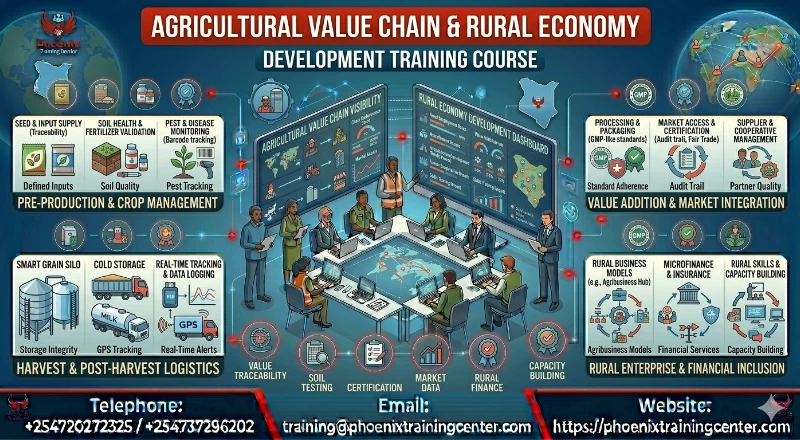
Course Overview
The Agricultural Value Chain and Rural Economy Development Training Course is designed to provide a comprehensive understanding of the systems that move food from farm to table. This course explores the intricate linkages between producers, processors, and consumers, emphasizing how optimized value chains can act as a primary engine for rural economic growth. Participants will analyze the roles of various stakeholders and the impact of policy, infrastructure, and technology on market efficiency and poverty reduction in rural areas.
The curriculum covers a wide spectrum of essential topics including value chain mapping, post-harvest management, and agribusiness financing. Participants will delve into market-linkage strategies, the integration of smallholder farmers into global markets, and the role of digital innovation in modernizing agriculture. The course also addresses sustainable rural development frameworks and the critical importance of gender inclusivity and environmental stewardship in building resilient rural economies.
Upon the successful completion of this Agricultural Value Chain and Rural Economy Development Training Course, participants will be able to:
ü Map and analyze complex agricultural value chains to identify bottlenecks and opportunities.
ü Design strategies to enhance the competitiveness of rural agribusinesses.
ü Implement post-harvest loss reduction techniques to improve value addition.
ü Facilitate effective market linkages between smallholder farmers and large-scale buyers.
ü Develop sustainable rural economic development plans aligned with global standards.
ü Assess the impact of climate change and digital technology on the agricultural sector.
Training Methodology
The course is designed to be highly interactive, challenging and stimulating. It will be an instructor led training and will be delivered using a blended learning approach comprising of:
ü Interactive lectures and expert-led presentations
ü Case studies of successful global agricultural value chains
ü Group discussions and peer-to-peer learning
ü Field visits or virtual tours of agribusiness hubs
ü Practical Sessions involving value chain mapping and financial modelling exercises
Our facilitators are seasoned industry professionals with years of expertise in their chosen fields. All facilitation and course materials will be offered in English.
Who Should Attend?
This Agricultural Value Chain and Rural Economy Development Training Course would be suitable for, but not limited to:
ü Agricultural Extension Officers
ü Agribusiness Managers and Entrepreneurs
ü Rural Development Practitioners
ü Policy Makers in Ministry of Agriculture
ü NGO Program Managers in Food Security
ü Value Chain Analysts
ü Project Coordinators for Rural Development
ü Microfinance and Agricultural Credit Officers
ü Supply Chain Professionals in the Food Industry
Personal Benefits
ü Gain specialized expertise in a high-demand sector of the global economy.
ü Develop strategic thinking skills to solve complex logistical and economic problems.
ü Enhance professional networking opportunities with key industry stakeholders.
ü Improve capacity to design and lead successful rural development projects.
Organizational Benefits
ü Increased efficiency in agricultural supply chain management.
ü Improved ability to secure funding and investment for rural projects.
ü Enhanced organizational reputation for implementing sustainable and inclusive practices.
ü Better alignment of organizational goals with national and international development targets.
ü Course Duration: 5 Days
ü Training Fee
o Physical Training: USD 1,200
o Online / Virtual Training: USD 800
Module 1: Introduction to Agricultural Value Chain Concepts
ü Defining the value chain vs. the supply chain
ü Stages of the agricultural value chain: From input to consumer
ü The role of agriculture in rural economic transformation
ü Global trends impacting agricultural markets
ü Practical Session: Identifying and diagramming local agricultural stakeholders
Module 2: Value Chain Analysis and Mapping Techniques
ü Tools for mapping value chain flows
ü Identifying "pain points" and value-added opportunities
ü Analyzing cost structures and profit margins across the chain
ü Competitiveness benchmarking for rural products
ü Practical Session: Conducting a comprehensive SWOT analysis on a selected crop value chain
Module 3: Agribusiness Value Addition and Post-Harvest Management
ü Strategies for primary and secondary processing
ü Reducing post-harvest losses through technology
ü Quality standards, certification, and food safety (HACCP)
ü Packaging and branding for rural agribusinesses
ü Practical Session: Quality control simulation and shelf-life assessment exercise
Module 4: Market Linkages and Market Information Systems
ü Contract farming models and out-grower schemes
ü The role of producer organizations and cooperatives
ü B2B and B2C marketing strategies for rural produce
ü Utilizing Market Information Systems (MIS) for price transparency
ü Practical Session: Developing a mock marketing plan for a rural cooperative
Module 5: Financing the Agricultural Value Chain
ü Understanding value chain finance instruments
ü Warehouse receipt systems and trade finance
ü Micro-insurance and crop insurance for smallholders
ü Investment readiness for agribusinesses
ü Practical Session: Designing a loan application or pitch deck for an agribusiness venture
Module 6: Digital Innovation and ICT in Agriculture
ü E-extension services and digital advisory tools
ü Precision agriculture and IoT for smallholders
ü Blockchain for traceability in the food chain
ü Mobile payment systems in rural transactions
ü Practical Session: Demonstration of mobile-based market access platforms
Module 7: Sustainable Rural Economic Development Strategies
ü Diversification of rural income sources
ü Infrastructure development: Roads, energy, and irrigation
ü The Circular Economy in agriculture
ü Measuring the impact of rural development projects
ü Practical Session: Creating a Logic Model for a rural development intervention
Module 8: Gender Integration and Inclusivity in Rural Economies
ü The role of women and youth in the agricultural value chain
ü Addressing barriers to land and resource ownership
ü Inclusive business models for marginalized groups
ü Promoting youth entrepreneurship in agribusiness
ü Practical Session: Developing a gender-inclusive action plan for a project
Module 9: Risk Management and Climate Resilience in Agriculture
ü Identifying climate risks in value chains
ü Climate-smart agriculture (CSA) practices
ü Building resilient supply chains against global shocks
ü Disaster risk reduction in rural communities
ü Practical Session: Risk assessment and mitigation planning workshop
Module 10: Policy Frameworks and Governance in the Rural Sector
ü The impact of trade policies and tariffs on agriculture
ü Public-Private Partnerships (PPPs) in rural development
ü Enabling environments for agribusiness growth
ü Course wrap-up and action planning
ü Practical Session: Formulating a policy brief for local government engagement
About Our Trainers
Our trainers are seasoned industry experts with over 15 years of experience in agricultural economics, international trade, and rural development. They have worked extensively with international organizations such as the FAO, World Bank, and various regional development banks. Each trainer brings a wealth of practical knowledge from implementing field-level projects across Africa, Asia, and Latin America, ensuring that the training is grounded in real-world application.
Quality Statement
At Phoenix Training Center, we are committed to delivering excellence. Our courses are developed through rigorous research and are updated annually to reflect the latest industry trends and technological advancements. We maintain a high standard of instructional design to ensure that our learning outcomes are measurable, impactful, and directly transferable to the workplace.
Tailor-Made Courses
We understand that every organization has unique challenges and opportunities as well as unique training needs. Phoenix Training Center offers tailor-made courses designed to address specific requirements and challenges faced by your team or organization. Whether you need a customized curriculum, a specific duration, or on-site delivery, we can adapt our expertise to provide a training solution that perfectly aligns with your objectives. We can customize this Course to focus on your industry, specific risk profile, or internal stakeholder dynamics. Contact us to discuss how we can create a bespoke training program that maximizes value and impact for your team. For further inquiries, please contact us on Tel: +254720272325 / +254737296202 or Email: training@phoenixtrainingcenter.com.
Admission Criteria
ü Participants should be reasonably proficient in English.
ü Applicants must live up to Phoenix Center for Policy, Research and Training admission criteria.
Terms and Conditions
ü Discounts: Organizations sponsoring Four Participants will have the 5th attend Free.
ü What is catered for by the Course Fees: Fees cater for all requirements for the training – Learning materials, Lunches, Teas, Snacks and Certification. All participants will additionally cater for their travel and accommodation expenses, visa application, insurance, and other personal expenses.
ü Certificate Awarded: Participants are awarded a Certificate of Completion at the end of the training.
ü Course Improvement: The program content shown here is for guidance purposes only. Our continuous course improvement process may lead to changes in topics and course structure.
ü Approval of Course: Our Programs are NITA Approved. Participating organizations can therefore claim reimbursement on fees paid in accordance with NITA Rules.
Booking for Training
Kindly send an email to the Training Officer on training@phoenixtrainingcenter.com and we will send you a registration form. We advise you to book early to avoid missing a seat to this training. Or call us on +254720272325 / +254737296202
Payment Options
We provide 3 payment options, choose one for your convenience, and kindly make payments at least 5 days before the Training start date to reserve your seat:
ü Groups of 5 People and Above: Cheque Payments to: Phoenix Center for Policy, Research and Training Limited should be paid in advance, 5 days to the training.
ü Invoice: We can send a bill directly to you or your company.
ü Deposit directly into Bank Account: (Account details provided upon request).
Cancellation Policy
ü Payment for all courses includes a registration fee, which is non-refundable, and equals 15% of the total sum of the course fee.
ü Participants may cancel attendance 14 days or more prior to the training commencement date.
ü No refunds will be made 14 days or less before the training commencement date. However, participants who are unable to attend may opt to attend a similar training course at a later date or send a substitute participant provided the participation criteria have been met.
Accommodation and Airport Transfer
For physical training attendees, we can assist with recommendations for accommodation near the training venue. Airport pick-up services can also be arranged upon request to ensure a smooth arrival. Please inform us of your travel details in advance if you require these services. For reservations contact the Training Officer on Email: training@phoenixtrainingcenter.com or on Tel: +254720272325 / +254737296202
| Course Dates | Venue | Fees | Enroll |
|---|---|---|---|
| Sep 21 - Sep 25 2026 | Naivasha | $1,200 |
|
| Sep 28 - Oct 02 2026 | Zoom | $800 |
|
| Oct 05 - Oct 09 2026 | Nairobi | $1,200 |
|
| Oct 12 - Oct 16 2026 | Mombasa | $1,200 |
|
| Oct 19 - Oct 23 2026 | Naivasha | $1,200 |
|
| Oct 26 - Oct 30 2026 | Nairobi | $1,200 |
|
| Nov 02 - Nov 06 2026 | Eldoret | $1,200 |
|
| Nov 09 - Nov 13 2026 | Nanyuki | $1,200 |
|
| Nov 16 - Nov 20 2026 | Nairobi | $1,200 |
|
| Nov 23 - Nov 27 2026 | Nairobi | $1,200 |
|
| Nov 30 - Dec 04 2026 | Zoom | $800 |
|
| Dec 07 - Dec 11 2026 | Nakuru | $1,200 |
|
| Dec 14 - Dec 18 2026 | Naivasha | $1,200 |
|
| Dec 28 - Jan 01 2027 | Zoom | $800 |
|

Phoenix Training Center
Typically replies in minutes