
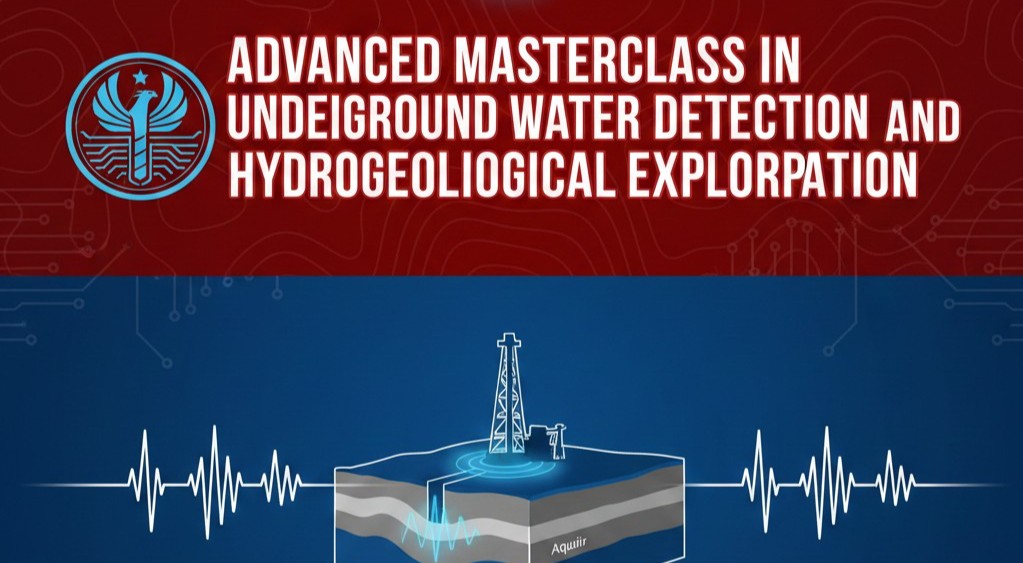
Course Overview
This comprehensive 10-day training program is designed to equip professionals with the advanced technical skills required for successful underground water detection and sustainable groundwater management. As water scarcity becomes a global challenge, mastering the scientific methods of locating and quantifying subterranean aquifers is critical. This course bridges the gap between traditional geological surveying and modern geophysical technologies, ensuring that participants can accurately identify water sources with high precision and minimal environmental impact.
The curriculum covers a broad spectrum of topics, starting from the fundamentals of hydrogeology and fluid dynamics to the practical application of Resistivity, Electromagnetic (EM), and Seismic methods. Participants will explore the integration of Remote Sensing and GIS in groundwater mapping, borehole drilling supervision, and water quality assessment. The course also delves into modern software tools for 3D aquifer modelling and the legal frameworks governing groundwater extraction, providing a holistic approach to water resource development.
Upon the successful completion of this Advanced Masterclass in Underground Water Detection and Hydrogeological Exploration, participants will be able to:
ü Apply advanced geophysical methods for accurate underground water detection
ü Interpret complex hydrogeological maps and satellite imagery
ü Operate modern water detection equipment including Terrameters and VLF detectors
ü Supervise borehole drilling and well construction projects to international standards
ü Evaluate aquifer yield and water quality for safe consumption and industrial use
ü Develop sustainable groundwater management and recharge strategies
Training Methodology
The course is designed to be highly interactive, challenging and stimulating. It will be an instructor led training and will be delivered using a blended learning approach comprising of:
ü Interactive classroom-based lectures and theoretical presentations
ü Case study analysis of successful and failed groundwater projects
ü Hands-on software demonstrations for data modelling
ü Field-based practical sessions using geophysical equipment
ü Group discussions and peer-to-peer knowledge sharing
ü Daily assessments and a final project simulation
Our facilitators are seasoned industry professionals with years of expertise in their chosen fields. All facilitation and course materials will be offered in English.
Who Should Attend?
This Advanced Masterclass in Underground Water Detection and Hydrogeological Exploration would be suitable for, but not limited to:
ü Hydrogeologists and Geologists
ü Water Resource Engineers
ü Civil and Environmental Engineers
ü Borehole Drilling Contractors
ü Environmental Consultants
ü Project Managers in WASH (Water, Sanitation, and Hygiene)
ü Government Agricultural and Irrigation Officers
ü Sustainability Officers in the Mining and Construction sectors
Personal benefits
ü Enhance your technical expertise in a high-demand specialized field.
ü Gain hands-on experience with industry-standard geophysical tools.
ü Improve project success rates by reducing "dry borehole" incidents.
ü Expand your professional network within the water and energy sectors.
Organizational benefits
ü Reduce operational costs by optimizing site selection for water points.
ü Ensure long-term water security through scientific aquifer management.
ü Comply with environmental regulations and sustainable extraction limits.
ü Increase the technical capacity of the workforce in modern hydrogeological techniques.
ü Course Duration: 10 Days
ü Training Fee:
o Physical Training: USD 3,000
o Online / Virtual Training: USD 2,500
Module 1: Fundamentals of Hydrogeology and the Hydrologic Cycle
ü Principles of groundwater flow and storage
ü Classification of aquifers: Confined vs. Unconfined
ü Porosity, permeability, and hydraulic conductivity
ü Understanding the water balance equation
ü Practical Session: Calculations of hydraulic gradient and flow direction
Module 2: Geological Indicators for Underground Water Detection
ü Identifying water-bearing rock formations
ü Role of faults, fractures, and lineaments in water storage
ü Stratigraphy and sedimentation in hydrogeology
ü Weathering profiles and their impact on water yield
ü Practical Session: Identification of water-bearing structures on geological maps
Module 3: Remote Sensing and GIS in Groundwater Mapping
ü Utilizing Landsat and Sentinel data for water prospecting
ü Lineament extraction and analysis using GIS software
ü Creating groundwater potential zone (GWPZ) maps
ü Integration of topography and drainage patterns
ü Practical Session: GIS exercise in overlaying thematic layers for siting
Module 4: Electrical Resistivity Methods (VES and ERT)
ü Physics of electrical resistivity in the subsurface
ü Schlumberger and Wenner array configurations
ü Vertical Electrical Sounding (VES) data collection
ü Electrical Resistivity Tomography (ERT) for 2D imaging
ü Practical Session: Setting up a Terrameter and performing a VES survey
Module 5: Electromagnetic (EM) and Very Low Frequency (VLF) Methods
ü Principles of induction and secondary magnetic fields
ü Frequency domain vs. Time domain EM
ü Mapping conductive zones and fractured aquifers
ü Data filtering and noise reduction in EM surveys
ü Practical Session: Field demonstration of VLF equipment for fracture detection
Module 6: Seismic and Magnetic Methods in Hydrogeology
ü Seismic refraction for determining depth to bedrock
ü Magnetic surveys for identifying intrusive dikes
ü Correlation between seismic velocity and water saturation
ü Instrumentation and field layouts
ü Practical Session: Interpretation of seismic refraction profiles
Module 7: Ground Penetrating Radar (GPR) for Shallow Aquifers
ü Application of high-frequency radio waves
ü Mapping the water table in sandy or gravelly environments
ü Detection of shallow karst features and voids
ü GPR data processing and radargram interpretation
ü Practical Session: Operating a GPR unit over a known shallow aquifer
Module 8: Integrated Geophysical Surveying Techniques
ü The multi-method approach: Combining Resistivity and EM
ü Reducing ambiguity in data interpretation
ü Cost-benefit analysis of different survey types
ü Case studies of integrated surveys in complex terrains
ü Practical Session: Designing a survey plan for a challenging geological site
Module 9: Borehole Site Selection and Siting Protocols
ü Criteria for selecting the optimal drilling point
ü Stakeholder engagement and social considerations in siting
ü Site accessibility and drilling rig logistics
ü Documenting the siting report and GPS coordinates
ü Practical Session: Field exercise in pegging and documenting a site
Module 10: Borehole Drilling Technology and Supervision
ü Rotary, Percussion, and Mud-Rotary drilling methods
ü Borehole design: Casing, screens, and gravel packing
ü Monitoring drilling progress and lithological logging
ü Common drilling challenges and troubleshooting
ü Practical Session: Simulation of a drilling supervision log and material tally
Module 11: Well Logging and Aquifer Testing
ü Downhole geophysical logging (Gamma, Caliper, Resistivity)
ü Step-drawdown tests and Constant Rate tests
ü Calculating Transmissivity and Storativity
ü Determining the "Safe Yield" of a borehole
ü Practical Session: Analysis of a 24-hour pumping test data set
Module 12: Groundwater Chemistry and Quality Analysis
ü Physical, chemical, and biological parameters of water
ü Sampling protocols for laboratory analysis
ü Interpreting Piper and Stiff diagrams
ü Health implications of Fluoride, Arsenic, and Nitrate
ü Practical Session: On-site water quality testing using portable kits
Module 13: 3D Aquifer Modelling and Data Interpretation
ü Introduction to MODFLOW and groundwater modelling software
ü Inputting geophysical and borehole data into 3D environments
ü Visualizing plume migration and drawdown cones
ü Predictive modelling for long-term water availability
ü Practical Session: Basic 3D visualization exercise using specialized software
Module 14: Sustainable Groundwater Management and Artificial Recharge
ü The concept of Integrated Water Resources Management (IWRM)
ü Managed Aquifer Recharge (MAR) techniques
ü Monitoring groundwater levels using piezometers
ü Community-based water management models
ü Practical Session: Designing a simple rainwater harvesting recharge system
Module 15: Environmental Impact Assessment (EIA) for Water Projects
ü Regulatory requirements for groundwater development
ü Potential impacts on ecosystems and surface water
ü Mitigation strategies for drilling-related pollution
ü Social impact assessment and water rights
ü Practical Session: Drafting an environmental management plan (EMP)
Module 16: Legal Frameworks and Water Extraction Permits
ü National and international water laws
ü The process of applying for drilling and abstraction permits
ü Compliance with Water Resources Authority (WRA) guidelines
ü Ethical considerations in the water sector
ü Practical Session: Mock application for a water abstraction license
Module 17: Project Management in Groundwater Exploration
ü Budgeting and financial management for water projects
ü Contract management for drilling services
ü Risk assessment and mitigation in the field
ü Reporting and communication with donors/clients
ü Practical Session: Developing a project timeline and budget for a 5-borehole project
Module 18: Emerging Technologies in Underground Water Detection
ü Drone-borne geophysics and magnetic surveys
ü The role of Artificial Intelligence (AI) in data interpretation
ü IoT-enabled remote monitoring of borehole levels
ü Advanced sensors for real-time water quality monitoring
ü Practical Session: Review of a case study featuring AI-driven water detection
About Our Trainers
Our trainers are seasoned Hydrogeologists and Geophysical Engineers with over 15 years of field experience in underground water detection across diverse geological terrains. They have led major water infrastructure projects for international NGOs, government agencies, and private developers. Each trainer holds advanced degrees in Earth Sciences and is a registered professional with relevant engineering and geological boards.
Quality Statement
Phoenix Training Center is committed to delivering excellence. Our courses are developed through rigorous research and are continuously updated to reflect the latest technological advancements and industry standards. We ensure a high-quality learning environment with state-of-the-art equipment and a focus on practical, actionable knowledge.
Tailor-Made Courses
We understand that every organization has unique challenges and opportunities as well as unique training needs. Phoenix Training Center offers tailor-made courses designed to address specific requirements and challenges faced by your team or organization. Whether you need a customized curriculum, a specific duration, or on-site delivery, we can adapt our expertise to provide a training solution that perfectly aligns with your objectives. We can customize this Course to focus on your industry, specific risk profile, or internal stakeholder dynamics. Contact us to discuss how we can create a bespoke training program that maximizes value and impact for your team. For further inquiries, please contact us on Tel: +254720272325 / +254737296202 or Email training@phoenixtrainingcenter.com
Admission Criteria
ü Participants should be reasonably proficient in English.
ü Applicants must live up to Phoenix Center for Policy, Research and Training admission criteria.
Terms and Conditions
ü Discounts: Organizations sponsoring Four Participants will have the 5th attend Free.
ü What is catered for by the Course Fees: Fees cater for all requirements for the training – Learning materials, Lunches, Teas, Snacks and Certification. All participants will additionally cater for their travel and accommodation expenses, visa application, insurance, and other personal expenses.
ü Certificate Awarded: Participants are awarded Certificate of Completion at the end of the training.
ü Course Improvement: The program content shown here is for guidance purposes only. Our continuous course improvement process may lead to changes in topics and course structure.
ü Approval of Course: Our Programs are NITA Approved. Participating organizations can therefore claim reimbursement on fees paid in accordance with NITA Rules.
Booking for Training
Kindly send an email to the Training Officer on training@phoenixtrainingcenter.com and we will send you a registration form. We advise you to book early to avoid missing a seat to this training. Or call us on +254720272325 / +254737296202
Payment Options
We provide 3 payment options, choose one for your convenience, and kindly make payments at least 5 days before the Training start date to reserve your seat:
ü Groups of 5 People and Above: Cheque Payments to: Phoenix Center for Policy, Research and Training Limited should be paid in advance, 5 days to the training.
ü Invoice: We can send a bill directly to you or your company.
ü Deposit: Directly into Bank Account (Account details provided upon request).
Cancellation Policy
ü Payment for all courses includes a registration fee, which is non-refundable, and equals 15% of the total sum of the course fee.
ü Participants may cancel attendance 14 days or more prior to the training commencement date.
ü No refunds will be made 14 days or less before the training commencement date. However, participants who are unable to attend may opt to attend a similar training course at a later date or send a substitute participant provided the participation criteria have been met.
Accommodation and Airport Transfer
For physical training attendees, we can assist with recommendations for accommodation near the training venue. Airport pick-up services can also be arranged upon request to ensure a smooth arrival. Please inform us of your travel details in advance if you require these services. For reservations contact the Training Officer on Email: training@phoenixtrainingcenter.com or on Tel: +254720272325 / +254737296202
| Course Dates | Venue | Fees | Enroll |
|---|

Phoenix Training Center
Typically replies in minutes