
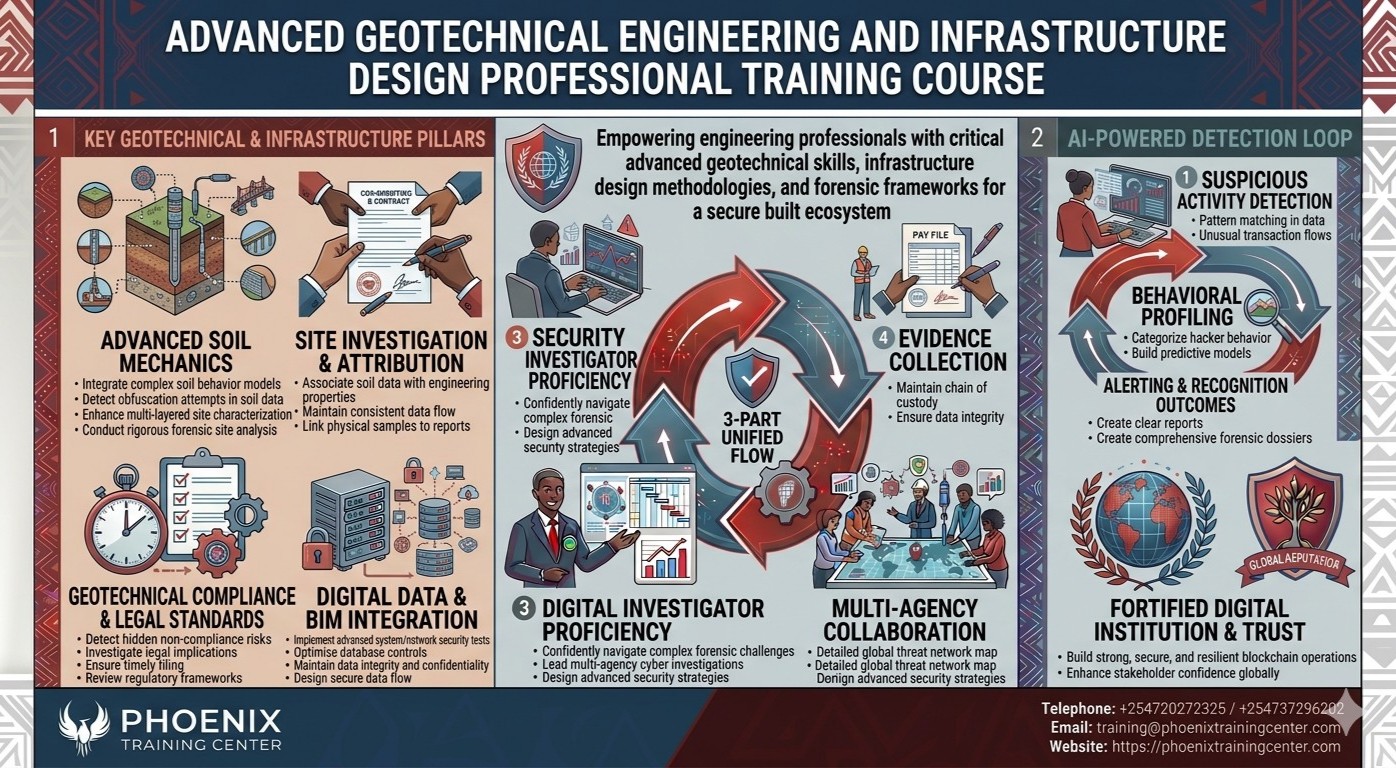
Course Overview
The Advanced Geotechnical Engineering and Infrastructure Design Professional Training Course is an intensive program designed to provide engineers and construction professionals with advanced insights into soil mechanics and foundation engineering. As global infrastructure becomes more complex, the ability to accurately assess subsurface conditions and design resilient structures is critical. This course bridges the gap between theoretical soil physics and practical engineering applications, focusing on the stability of large-scale civil works such as highways, bridges, and high-rise buildings.
The curriculum provides a comprehensive deep dive into modern geotechnical investigative techniques, seismic design, and ground improvement technologies. Participants will explore the latest software modelling tools, slope stability analysis, and the behaviour of deep foundations under diverse loading conditions. By the end of the program, attendees will be equipped to manage geotechnical risks effectively, ensuring the safety, longevity, and cost-effectiveness of major infrastructure projects.
Upon the successful completion of this Advanced Geotechnical Engineering and Infrastructure Design Professional Training Course participants will be able to:
ü Execute advanced site investigations and interpret complex geotechnical reports.
ü Design robust shallow and deep foundation systems for diverse soil profiles.
ü Perform detailed slope stability analysis and design effective retention systems.
ü Implement modern ground improvement techniques to mitigate problematic soil conditions.
ü Integrate seismic and environmental considerations into geotechnical design.
ü Utilize specialized software for geotechnical modeling and infrastructure simulation.
Training Methodology
The course is designed to be highly interactive, challenging and stimulating. It will be an instructor led training and will be delivered using a blended learning approach comprising of:
ü Interactive technical lectures and multimedia presentations
ü Hands-on data analysis and soil modeling workshops
ü Case study reviews of landmark geotechnical projects
ü Group design exercises and problem-solving clinics
ü Software simulation and virtual laboratory demonstrations
Our facilitators are seasoned industry professionals with years of expertise in their chosen fields. All facilitation and course materials will be offered in English.
Who Should Attend?
This Advanced Geotechnical Engineering and Infrastructure Design Professional Training Course would be suitable for, but not limited to:
ü Civil and Structural Engineers
ü Geotechnical Engineers and Geologists
ü Infrastructure Project Managers
ü Construction Site Supervisors
ü Foundation Design Specialists
ü Mining and Tunneling Engineers
ü Public Works and Transport Authority Officials
Personal Benefits
Participants will enhance their technical authority in the field of civil engineering, gaining specialized skills that are in high demand for international infrastructure projects. This training fosters a high level of confidence in decision-making regarding subsurface risks, leading to career advancement and professional recognition.
Organizational Benefits
Organizations will benefit from improved project reliability and a significant reduction in foundation-related failures or cost overruns. By applying advanced geotechnical principles, firms can optimize design costs, ensure compliance with international building codes, and enhance their reputation for delivering high-quality, resilient infrastructure.
ü Course Duration: 5 Days
ü Training Fee
o Physical Training: USD 1,200
o Online / Virtual Training: USD 800
Module 1: Advanced Soil Mechanics and Constitutive Modeling
ü Effective stress principles in saturated and unsaturated soils
ü Shear strength parameters and stress-strain behavior
ü Consolidation theory and settlement predictions
ü Critical state soil mechanics
ü Practical Session: Interpreting triaxial and direct shear test data for design input
Module 2: Subsurface Investigation and In-Situ Testing Technologies
ü Advanced drilling and sampling techniques
ü Standard Penetration Test (SPT) and Cone Penetration Test (CPTu)
ü Pressuremeter and Dilatometer testing
ü Geophysical methods in geotechnical site characterization
ü Practical Session: Developing a site investigation plan for a high-rise structure
Module 3: Advanced Design of Deep Foundation Systems
ü Axial and lateral load capacity of driven and bored piles
ü Pile group effects and settlement analysis
ü Static and dynamic pile load testing
ü Drilled shafts and micro-piling applications
ü Practical Session: Designing a pile foundation layout using load-transfer (t-z) methods
Module 4: Slope Stability Analysis and Landslide Mitigation
ü Factor of safety and limit equilibrium methods
ü Finite element analysis of slopes
ü Design of soil nails and rock bolts
ü Drainage systems for slope stabilization
ü Practical Session: Using software tools to model a critical slope failure scenario
Module 5: Earth Retaining Structures and Deep Excavations
ü Lateral earth pressure theories (Rankine vs. Coulomb)
ü Design of cantilever and anchored sheet pile walls
ü Diaphragm walls and secant pile walls for urban excavations
ü Dewatering and groundwater control strategies
ü Practical Session: Designing a multi-level shoring system for a deep basement
Module 6: Ground Improvement and Soil Stabilization Techniques
ü Dynamic compaction and vibro-flotation
ü Stone columns and lime/cement deep mixing
ü Preloading with vertical wick drains
ü Grouting techniques and applications
ü Practical Session: Selecting the optimal ground improvement method for soft clay deposits
Module 7: Geotechnical Earthquake Engineering and Seismic Design
ü Site response analysis and seismic hazard assessment
ü Soil liquefaction potential and mitigation
ü Seismic design of retaining walls and foundations
ü Ground motion parameters and response spectra
ü Practical Session: Evaluating liquefaction risk using CPT data
Module 8: Rock Mechanics and Tunneling in Civil Infrastructure
ü Rock mass classification systems (RMR, Q-system)
ü Mechanical properties of intact rock and joints
ü Tunneling methods: TBM vs. New Austrian Tunneling Method (NATM)
ü Support systems in underground construction
ü Practical Session: Calculating rock support requirements for a road tunnel
Module 9: Geosynthetics in Infrastructure Design and Construction
ü Functions of geotextiles, geogrids, and geomembranes
ü Reinforcement of embankments over soft soils
ü Filtration, drainage, and erosion control applications
ü Design of geosynthetic reinforced soil (GRS) walls
ü Practical Session: Designing a reinforced earth wall using geogrids
Module 10: Digital Geotechnics: Modeling and Risk Management
ü Introduction to Geotechnical BIM (Building Information Modeling)
ü 2D and 3D Finite Element Modeling (FEM)
ü Geotechnical risk assessment and mitigation strategies
ü Observational method and instrumentation monitoring
ü Practical Session: Final project presentation: Integrated geotechnical design for a bridge abutment
About Our Trainers
Our trainers are distinguished Geotechnical Engineers and Project Consultants with decades of experience in large-scale infrastructure projects across Africa, Europe, and the Middle East. They possess advanced degrees (MSc/PhD) in Civil Engineering and are active members of international geotechnical societies. Each trainer brings a wealth of practical "field-to-desk" knowledge, ensuring that participants learn from real-world successes and challenges.
Quality Statement
Phoenix Center for Policy, Research and Training is committed to delivering world-class educational excellence. Our geotechnical programs are meticulously reviewed by industry experts to ensure alignment with current Eurocodes, ASTM standards, and NITA requirements. We guarantee a high-impact learning environment supported by the latest technical data and industry best practices.
Tailor-Made Courses
We understand that every organization has unique challenges and opportunities as well as unique training needs. Phoenix Training Center offers tailor-made courses designed to address specific requirements and challenges faced by your team or organization. Whether you need a customized curriculum, a specific duration, or on-site delivery, we can adapt our expertise to provide a training solution that perfectly aligns with your objectives. We can customize this Course to focus on your industry, specific risk profile, or internal stakeholder dynamics. Contact us to discuss how we can create a bespoke training program that maximizes value and impact for your team. For further inquiries, please contact us on Tel: +254720272325 / +254737296202 or Email training@phoenixtrainingcenter.com
ü Participants should be reasonably proficient in English.
ü Applicants must live up to Phoenix Center for Policy, Research and Training admission criteria.
Terms and Conditions
ü Discounts: Organizations sponsoring Four Participants will have the 5th attend Free
ü What is catered for by the Course Fees: Fees cater for all requirements for the training – Learning materials, Lunches, Teas, Snacks and Certification. All participants will additionally cater for their travel and accommodation expenses, visa application, insurance, and other personal expenses.
ü Certificate Awarded: Participants are awarded Certificates of Participation at the end of the training.
ü The program content shown here is for guidance purposes only. Our continuous course improvement process may lead to changes in topics and course structure.
ü Approval of Course: Our Programs are NITA Approved. Participating organizations can therefore claim reimbursement on fees paid in accordance with NITA Rules.
Booking for Training
Simply send an email to the Training Officer on training@phoenixtrainingcenter.com and we will send you a registration form. We advise you to book early to avoid missing a seat to this training. Or call us on +254720272325 / +254737296202
Payment Options
We provide 3 payment options, choose one for your convenience, and kindly make payments at least 5 days before the Training start date to reserve your seat:
ü Groups of 5 People and Above – Cheque Payments to: Phoenix Center for Policy, Research and Training Limited should be paid in advance, 5 days to the training.
ü Invoice: We can send a bill directly to you or your company.
ü Deposit directly into Bank Account (Account details provided upon request)
Cancellation Policy
ü Payment for all courses includes a registration fee, which is non-refundable, and equals 15% of the total sum of the course fee.
ü Participants may cancel attendance 14 days or more prior to the training commencement date.
ü No refunds will be made 14 days or less before the training commencement date. However, participants who are unable to attend may opt to attend a similar training course at a later date or send a substitute participant provided the participation criteria have been met.
Accommodation and Airport Transfer
For physical training attendees, we can assist with recommendations for accommodation near the training venue. Airport pick-up services can also be arranged upon request to ensure a smooth arrival. Please inform us of your travel details in advance if you require these services. For reservations contact the Training Officer on Email: training@phoenixtrainingcenter.com or on Tel: +254720272325 / +254737296202
| Course Dates | Venue | Fees | Enroll |
|---|

Phoenix Training Center
Typically replies in minutes