
Course Overview
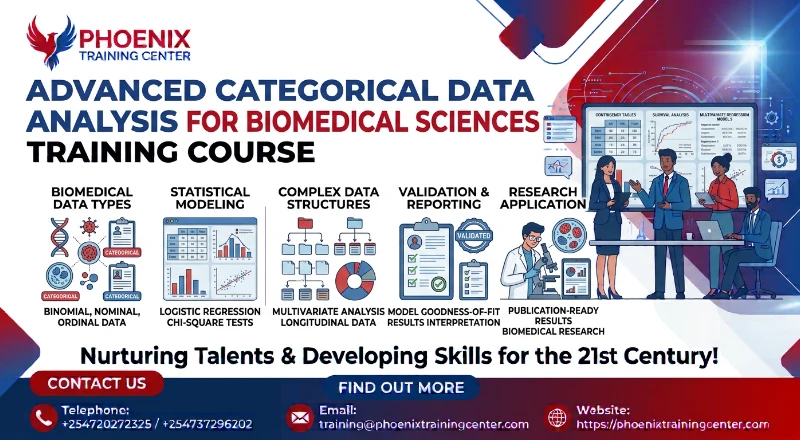
Categorical Data Analysis for Biomedical Sciences: Expert-Level Training Course provides an in-depth, rigorous exploration of statistical methodologies tailored specifically for handling categorical variables in statistics within clinical, epidemiological, and medical research contexts. As biomedical research increasingly relies on non-continuous outcomes—such as disease status, treatment response, and patient survival stages—mastering advanced analytical techniques for categorical data analysis is essential for producing robust, reproducible, and publication-ready evidence. This program bridges theoretical statistical foundations with practical execution using real-world clinical datasets.
Throughout this comprehensive curriculum, participants will delve into binary, nominal, and ordinal logistic regression models, contingency table analysis, log-linear models, exact test procedures, and longitudinal generalized estimating equations (GEE). Special emphasis is placed on addressing complex data structures commonly encountered in medical trials, such as sparse matrices, overdispersion, missing observations, and clustered patient outcomes. By blending conceptual rigor with hands-on computer lab exercises, researchers will gain the confidence to select appropriate models, execute computational workflows, interpret odds ratios and relative risks accurately, and communicate statistical findings to scientific audiences.
Upon the successful completion of this Advanced Categorical Data Analysis for Biomedical Sciences Training Course, participants will be able to:
ü Identify, classify, and appropriately structure categorical variables in statistics for complex biomedical research studies.
ü Perform rigorous contingency table analyses, calculating and interpreting odds ratios, risk ratios, and measures of association while accounting for confounding via Mantel-Haenszel methods.
ü Fit, evaluate, and diagnose binary, ordinal, and multinomial logistic regression models to evaluate clinical outcomes.
ü Implement generalized linear models (GLM) and log-linear approaches to analyze multi-dimensional categorical data and interactions.
ü Utilize generalized estimating equations (GEE) and random-effects models for longitudinal and correlated categorical clinical data.
ü Execute exact methods and power calculations for small-sample clinical datasets and sparse table structures.
Training Methodology
The training methodology employs a blended, dynamic approach to maximize learning retention and practical application. The course is designed to be highly interactive, challenging and stimulating. It will be an instructor led training and will be delivered using a blended learning approach comprising of:
ü Interactive lectures explaining statistical theory and mathematical foundation
ü Hands-on computational lab sessions using statistical software (R/Stata/SAS)
ü Group case study reviews analyzing published biomedical research papers
ü Guided troubleshooting sessions for participant-provided research datasets
ü Daily practical exercises focusing on real-world clinical trial data analysis
Our facilitators are seasoned industry professionals with years of expertise in their chosen fields. All facilitation and course materials will be offered in English.
Who Should Attend?
This Advanced Categorical Data Analysis for Biomedical Sciences Training Course would be suitable for, but not limited to:
ü Biostatisticians and Medical Statisticians
ü Clinical Epidemiologists and Public Health Researchers
ü Biomedical Investigators and Clinical Trial Managers
ü Data Scientists working in Pharmaceutical and Biotechnology Industries
ü Academic Researchers and Healthcare Analysts
Benefits of the Training
Personal Benefits
ü Master advanced statistical techniques specifically tailored for non-continuous biomedical outcomes.
ü Enhance research output quality and increase the likelihood of publication in high-impact medical journals.
ü Gain confidence in executing, diagnosing, and troubleshooting complex categorical data regression models.
ü Expand professional capability in modern statistical software for advanced data manipulation and reporting.
Organizational Benefits
ü Improve the methodological rigor and validity of institutional clinical trials and epidemiological studies.
ü Accelerate data analysis pipelines and reduce time-to-publication for biomedical research projects.
ü Ensure compliance with international statistical standards for drug development and regulatory submissions.
ü Strengthen internal quantitative capacity, reducing reliance on external statistical consultancy.
ü Course Duration: 5 Days
ü Training Fee
o Physical Training: USD 1,500
o Online / Virtual Training: USD 1,000
Module 1: Foundations of Categorical Data in Biomedical Research
ü Classification of categorical variables in statistics (nominal, ordinal, binary)
ü Probability distributions for categorical data: Binomial, Multinomial, and Poisson
ü Sampling schemes in clinical studies: cross-sectional, case-control, and cohort designs
ü Principles of maximum likelihood estimation for categorical parameters
ü Practical Session: Importing, cleaning, and structuring categorical biomedical datasets in statistical software
Module 2: Contingency Tables and Measures of Association
ü Analysis of $2 \times 2$ and $I \times J$ contingency tables in clinical studies
ü Calculating and interpreting Risk Ratios, Odds Ratios, and Difference in Proportions
ü Pearson Chi-Square test of independence and Likelihood Ratio Chi-Square test
ü Stratified categorical data analysis and the Mantel-Haenszel test for confounding and interaction
ü Practical Session: Analyzing treatment efficacy across stratified patient cohorts using contingency tables
Module 3: Binary Logistic Regression Modeling
ü Formulation of the generalized linear model framework for binary responses
ü Interpreting log-odds, odds ratios, and intercept terms in biomedical models
ü Incorporating continuous and categorical covariates in binary logistic models
ü Model building strategies: forward, backward, and stepwise selection methods
ü Practical Session: Fitting a binary logistic regression model to predict disease presence based on clinical biomarkers
Module 4: Model Diagnostics and Goodness-of-Fit for Logistic Regression
ü Goodness-of-fit assessments: Hosmer-Lemeshow test, Deviance, and Pearson residuals
ü Evaluating predictive power: Receiver Operating Characteristic (ROC) curves and Area Under the Curve (AUC)
ü Detecting influential observations, leverage points, and multicollinearity in clinical models
ü Handling sparse data, separation, and Firth's penalized likelihood approach
ü Practical Session: Performing full model diagnostics and ROC analysis on a cardiovascular risk dataset
Module 5: Multinomial and Nominal Logistic Regression
ü Extension of logistic regression to multi-category nominal responses
ü Baseline-category logit models formulation and parameter interpretation
ü Testing global hypotheses across response categories
ü Calculating predicted probabilities for multi-class medical outcomes
ü Practical Session: Modeling disease subtype classification using patient demographic and genetic predictors
Module 6: Ordinal Logistic Regression Models
ü Cumulative logit models and the proportional odds assumption
ü Testing the proportional odds assumption (Score test and Brant test)
ü Alternative models for ordinal data: Adjacent-categories logit and Continuation-ratio models
ü Model selection and interpretation of cumulative odds ratios in disease staging
ü Practical Session: Analyzing cancer stage progression using ordinal logistic regression models
Module 7: Log-Linear Models for Multi-Dimensional Tables
ü Log-linear model structure for three-way and high-dimensional contingency tables
ü Independence, conditional independence, and homogeneous association models
ü Parameter estimation and model selection using deviance differences
ü Equivalence between log-linear models and logistic regression
ü Practical Session: Modeling multi-variable categorical interactions in epidemiological survey data
Module 8: Exact Methods and Small-Sample Analysis
ü Limitations of asymptotic tests in small or unbalanced biomedical datasets
ü Fisher’s Exact test for $2 \times 2$ tables and extensions to $I \times J$ tables
ü Exact logistic regression for rare events and small sample sizes
ü Non-parametric tests for categorical responses (Wilcoxon rank-sum, Kruskal-Wallis)
ü Practical Session: Conducting exact logistic regression on a rare disease clinical trial dataset
Module 9: Correlated and Longitudinal Categorical Data Analysis
ü Challenges of clustered and repeated categorical variables in statistics
ü McNemar test and symmetry models for paired binary data
ü Marginal models: Generalized Estimating Equations (GEE) for longitudinal binary and ordinal data
ü Random effects models: Generalized Linear Mixed Models (GLMM) for subject-specific inferences
ü Practical Session: Analyzing longitudinal patient follow-up data using GEE and GLMM structures
Module 10: Advanced Topics and Reporting Standards in Biomedical Sciences
ü Handling missing categorical data: Multiple Imputation strategies for categorical variables
ü Power analysis and sample size estimation for categorical data study designs
ü Communicating statistical results according to SAMPL and CONSORT guidelines
ü Translating categorical model results into clinical decision support metrics
ü Practical Session: Capstone project analyzing a complex biomedical dataset and drafting a manuscript-ready statistical report
About Our Trainers
Our facilitators are seasoned biostatisticians, senior epidemiologists, and biomedical data scientists with over 15 years of industry and academic experience. Holding PhDs in Biostatistics and Statistics, they have authored numerous peer-reviewed publications in top-tier medical journals and regularly consult for pharmaceutical companies, global health organizations, and clinical research institutions. They bring deep practical expertise in applying complex statistical methodologies to real-world biomedical challenges.
Quality Statement
Phoenix Training Center is committed to delivering world-class, professional capacity-building programs. Our courses are rigorously designed, continuously updated, and benchmarked against global statistical and scientific standards. We ensure high-impact learning experiences through rigorous quality assurance frameworks, peer-reviewed curriculum design, and expert-led practical training.
Tailor-Made Courses
We understand that every organization has unique challenges and opportunities as well as unique training needs. Phoenix Training Center offers tailor-made courses designed to address specific requirements and challenges faced by your team or organization. Whether you need a customized curriculum, a specific duration, or on-site delivery, we can adapt our expertise to provide a training solution that perfectly aligns with your objectives. We can customize this Course to focus on your industry, specific risk profile, or internal stakeholder dynamics. Contact us to discuss how we can create a bespoke training program that maximizes value and impact for your team. For further inquiries, please contact us on Tel: +254720272325 / +254737296202 or Email training@phoenixtrainingcenter.com.
Admission Criteria
ü Participants should be reasonably proficient in English.
ü Applicants must live up to Phoenix Center for Policy, Research and Training admission criteria.
Terms and Conditions
ü Discounts: Organizations sponsoring Four Participants will have the 5th attend Free.
ü What is catered for by the Course Fees: Fees cater for all requirements for the training – Learning materials, Lunches, Teas, Snacks and Certification. All participants will additionally cater for their travel and accommodation expenses, visa application, insurance, and other personal expenses.
ü Certificate Awarded: Participants are awarded a Certificate of Completion at the end of the training.
ü Course Improvement: The program content shown here is for guidance purposes only. Our continuous course improvement process may lead to changes in topics and course structure.
ü Approval of Course: Our Programs are NITA Approved. Participating organizations can therefore claim reimbursement on fees paid in accordance with NITA Rules.
Booking for Training
Kindly send an email to the Training Officer on training@phoenixtrainingcenter.com and we will send you a registration form. We advise you to book early to avoid missing a seat to this training. Or call us on +254720272325 / +254737296202.
Payment Options
We provide 3 payment options, choose one for your convenience, and kindly make payments at least 10 days before the Training start date to reserve your seat:
ü Groups of 5 People and Above: Cheque Payments to: Phoenix Center for Policy, Research and Training Limited should be paid in advance, 10 days to the training.
ü Invoice: We can send a bill directly to you or your company.
ü Deposit directly into Bank Account: (Account details provided upon request)
Cancellation Policy
ü Payment for all courses includes a registration fee, which is non-refundable, and equals 15% of the total sum of the course fee.
ü Participants may cancel attendance 14 days or more prior to the training commencement date.
ü No refunds will be made 14 days or less before the training commencement date. However, participants who are unable to attend may opt to attend a similar training course at a later date or send a substitute participant provided the participation criteria have been met.
Accommodation and Airport Pick-Up
For physical training attendees, we can assist with recommendations for accommodation near the training venue. Airport pick-up services can also be arranged upon request to ensure a smooth arrival. Please inform us of your travel details in advance if you require these services. For reservations contact the Training Officer on Email: training@phoenixtrainingcenter.com or on Tel: +254720272325 / +254737296202.
| Course Dates | Venue | Fees | Enroll |
|---|

Phoenix Training Center
Typically replies in minutes