
Course Overview
This intensive, five-day training course provides agribusiness professionals, investors, and supply chain managers with the essential knowledge and practical tools to effectively integrate Environmental, Social, and Governance (ESG) principles into their operations and investment strategies. Participants will gain a comprehensive understanding of the evolving global regulatory landscape, stakeholder expectations, and the competitive advantages derived from strong ESG performance, specifically tailored for the unique challenges and opportunities within the agriculture sector. The course combines theoretical frameworks with real-world case studies and hands-on exercises to ensure immediate applicability.
The curriculum is structured around a deep dive into ESG risks and opportunities in agriculture, covering topics such as Climate Change adaptation, Sustainable Land Management (SLM), water scarcity, biodiversity protection, social impact assessment, labor practices, supply chain transparency, and robust ESG reporting and disclosure. Key frameworks, including the Task Force on Climate-related Financial Disclosures (TCFD) and Global Reporting Initiative (GRI), will be explored, alongside strategies for attracting sustainable finance and managing reputational risk through effective stakeholder engagement.
Course Objectives
Upon the successful completion of this 🌾 Strategic ESG Integration in Agribusiness: Risk Management, Sustainable Investment & Reporting, participants will be able to:
ü Lead the development and execution of an integrated ESG strategy within their organization
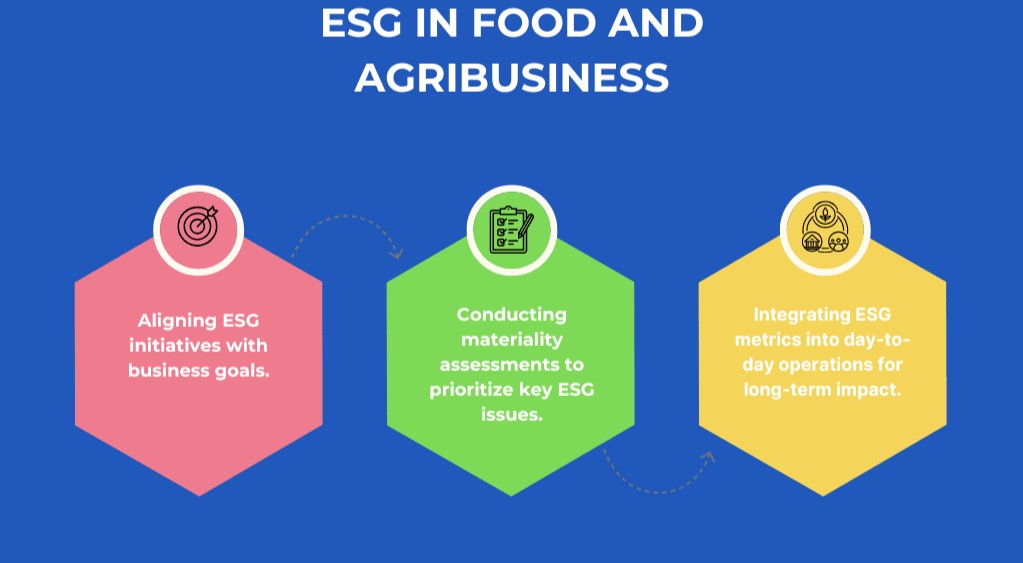
ü Identify and prioritize material ESG risks and opportunities specific to their agricultural value chain
ü Apply global best practices for sustainable resource management and social impact
ü Enhance their professional credentials in the rapidly growing field of sustainable agribusiness
ü Communicate effectively with investors and stakeholders regarding ESG performance
Training Methodology
The course is designed to be highly interactive, challenging and stimulating. It will be an instructor led training and will be delivered using a blended learning approach comprising of presentations, discussions, guided sessions of practical exercise, case study review, web-based tutorials, group work, exploration of relevant issues collaborative strength training, performance measurement, and workshops of participants’ displays, all of which adhere to the highest standards of training. The training technique is built on learning by doing, with lecturers using a learner-centered approach to engage participants and provide tasks that allow them to apply what they’ve learned. Experiential knowledge is also given equal importance within the format of training. Our facilitators are seasoned industry professionals with years of expertise in their chosen fields. All facilitation and course materials will be offered in English.
Who Should Attend?
This 🌾 Strategic ESG Integration in Agribusiness: Risk Management, Sustainable Investment & Reporting would be suitable for, but not limited to:
ü Agribusiness Owners and Executives
ü Sustainability Managers and Directors
ü Agricultural Investment and Finance Professionals
ü Supply Chain and Procurement Managers
ü Risk Management Officers
ü Government and Regulatory Officials focused on Agriculture
ü ESG Analysts and Consultants
Organizational Benefits
ü Improve access to capital by meeting the requirements of sustainable finance and impact investors
ü Reduce operational and reputational risk through proactive governance and ethical labor practices
ü Boost brand value and consumer trust through demonstrable transparency and sustainability commitments
ü Optimize resource efficiency, particularly related to water scarcity and energy use
ü Ensure long-term resilience and compliance with evolving ESG regulations and Climate Change targets
ü Course Duration: 5 Days
ü Training Fee
o Physical Training: USD 1,500
Course Outline
Module 1: Foundations of ESG and Sustainability in the Agriculture Sector
ü The Global Context: Megatrends and the Urgency of Sustainable Agriculture
ü Defining ESG and its Materiality for Agribusiness Value Chains
ü Investor and Stakeholder Expectations for the Agriculture Sector
ü Key Global ESG Frameworks: UN SDGs, PRI, and SASB
ü Practical Session: Mapping Material ESG Issues for a Sample Agricultural Enterprise
Module 2: The Environmental (E) Pillar: Climate Change Adaptation and Resource Management
ü Analyzing and Mitigating Climate Change Risks in Agricultural Operations
ü Strategies for Greenhouse Gas (GHG) Emissions Measurement and Reduction
ü Managing Water Scarcity and Optimizing Irrigation Practices
ü Sustainable Energy Use and Transition to Renewables in Farming
ü Practical Session: Calculating a Farm’s Carbon and Water Footprint
Module 3: Sustainable Land Management (SLM) and Biodiversity in Farming
ü Principles and Techniques of Sustainable Land Management (SLM)
ü Strategies for Soil Health, Conservation Tillage, and Regenerative Agriculture
ü Protecting Biodiversity and Ecosystem Services on Farmland
ü Managing Agricultural Inputs: Pesticides, Fertilizers, and Waste Reduction
ü Practical Session: Developing a Biodiversity Action Plan for an Agricultural Site
Module 4: The Social (S) Pillar: Labor, Communities, and Social Impact
ü Upholding Ethical Labor Practices and Human Rights in the Agricultural Workforce
ü Ensuring Health and Safety Standards for Farm Workers and Communities
ü Assessing and Enhancing Social Impact Assessment and Community Relations
ü Addressing Land Tenure and Displacement Issues in Agribusiness Projects
ü Practical Session: Conducting a Social Risk Screening for a New Sourcing Region
Module 5: Agribusiness Supply Chain Responsibility and Transparency
ü Mapping and Assessing ESG Risks across the Agricultural Supply Chain
ü Implementing Due Diligence and Traceability Systems
ü Leveraging Technology for Transparency and Data Collection (e.g., blockchain)
ü Developing and Monitoring Supplier Codes of Conduct
ü Practical Session: Designing a Supplier Verification Checklist for ESG Compliance
Module 6: The Governance (G) Pillar: Ethical Practices and Risk Management
ü Integrating ESG into Corporate Governance Structures and Board Oversight
ü Implementing Anti-Corruption and Anti-Bribery Policies
ü Risk Management Frameworks for Agricultural ESG Issues
ü Data Privacy and Security in Modern Farming Technology
ü Practical Session: Creating an ESG Governance Structure Chart and Mandates
Module 7: ESG Reporting, Disclosure, and Materiality Assessment
ü The Importance of Materiality Assessment in ESG Reporting
ü Reporting Frameworks: GRI, SASB, and the TCFD
ü Developing Key Performance Indicators (KPIs) for Agricultural ESG Metrics
ü The Role of Assurance and Third-Party Verification of ESG Data
ü Practical Session: Drafting an Initial TCFD-aligned Disclosure Statement
Module 8: Accessing Sustainable Finance and Capital Markets
ü Understanding the Landscape of Sustainable Finance: Green Bonds, Sustainability-Linked Loans
ü Meeting Investor Demands for ESG Data and Performance
ü Valuation and the Impact of ESG on Agricultural Assets
ü Navigating ESG Ratings and Indices
ü Practical Session: Preparing a Pitch Deck Section to Attract ESG Investment
Module 9: Stakeholder Engagement and Reputational Risk Management
ü Identifying and Prioritizing Key Agribusiness Stakeholder Engagement Groups
ü Best Practices for Meaningful Dialogue with Local Communities, NGOs, and Consumers
ü Proactive Management of Reputational Risk and Crisis Communication
ü Addressing Greenwashing and Ensuring Credible Communications
ü Practical Session: Developing a Stakeholder Engagement Plan for a New Farm Project
Module 10: Developing and Implementing a Comprehensive Agribusiness ESG Strategy
ü From Materiality to Strategy: Setting Targets and Defining the ESG Roadmap
ü Integrating ESG into Business Planning and Capital Expenditure Decisions
ü Organizational Change Management for ESG Implementation
ü Monitoring, Review, and Continuous Improvement
ü Practical Session: Creating a 3-Year Strategic Implementation Plan and Scorecard
About Our Trainers
Our training is led by seasoned professionals with extensive, hands-on experience in sustainable agriculture, corporate finance, and ESG consulting. Our trainers typically possess advanced degrees in relevant fields, hold professional certifications (e.g., GRI, FSA Credential), and have over 10 years of experience in roles such as Chief Sustainability Officer, Agribusiness Investment Analyst, or Environmental/Social Compliance Auditor, having worked directly with global agribusiness corporations, financial institutions, and international development agencies. Their expertise ensures the course content is current, practical, and grounded in real-world application.
Quality Statement
We are committed to delivering high-impact, quality-assured training that adheres to international best practices. Our course content is rigorously researched, continuously updated to reflect the latest regulatory changes and market trends, and delivered using proven adult learning methodologies. We ensure that every participant leaves with not just theoretical knowledge, but with actionable tools and a clear framework to drive tangible positive change within their organization.
ü Participants should be reasonably proficient in English.
ü Applicants must live up to Phoenix Center for Policy, Research and Training admission criteria.
Terms and Conditions
Booking for Training
Simply send an email to the Training Officer on training@phoenixtrainingcenter.com and we will send you a registration form. We advise you to book early to avoid missing a seat to this training.
Or call us on +254720272325 / +254737296202
Payment Options
We provide 3 payment options, choose one for your convenience, and kindly make payments at least 5 days before the Training start date to reserve your seat:
Cancellation Policy
Tailor-Made Courses
We understand that every organization has unique challenges and opportunities as well as unique training needs. Phoenix Training Center offers tailor-made courses designed to address specific requirements and challenges faced by your team or organization. Whether you need a customized curriculum, a specific duration, or on-site delivery, we can adapt our expertise to provide a training solution that perfectly aligns with your objectives.
We can customize this Course to focus on your industry, specific risk profile, or internal stakeholder dynamics. Contact us to discuss how we can create a bespoke training program that maximizes value and impact for your team. For further inquiries, please contact us on Tel: +254720272325 / +254737296202 or Email training@phoenixtrainingcenter.com
Accommodation and Airport Pick-up
For physical training attendees, we can assist with recommendations for accommodation near the training venue. Airport pick-up services can also be arranged upon request to ensure a smooth arrival. Please inform us of your travel details in advance if you require these services. For reservations contact the Training Officer on Email: training@phoenixtrainingcenter.com or on Tel: +254720272325 / +254737296202
| Course Dates | Venue | Fees | Enroll |
|---|

Phoenix Training Center
Typically replies in minutes