
Course Overview
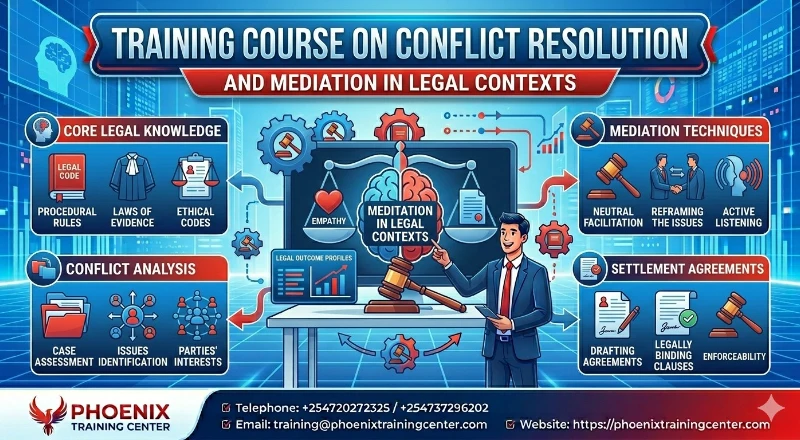
This specialized training program provides legal professionals and those working within the justice system with the essential knowledge and practical skills to effectively utilize conflict resolution and mediation techniques. As courts and legal systems worldwide, including in Kenya, increasingly embrace Alternative Dispute Resolution (ADR), proficiency in mediation and negotiation has become crucial for achieving timely, cost-effective, and mutually agreeable outcomes outside the traditional adversarial litigation process. This course offers an in-depth exploration of mediation principles, processes, and skills tailored specifically for application within various legal contexts, empowering participants to manage disputes constructively and facilitate resolutions efficiently.
The curriculum covers foundational conflict theory, the spectrum of dispute resolution options available within the legal landscape, and a comprehensive examination of the mediation process from initiation to agreement. Participants will develop core mediation and negotiation skills, understand the relevant legal and ethical frameworks governing mediation (with reference to international standards and Kenyan practice), learn techniques for managing complex dynamics such as power imbalances and high emotions, and gain proficiency in drafting robust settlement agreements. The course also touches upon the application of mediation in specific legal fields and explores contemporary developments like Online Dispute Resolution (ODR).
Course Objectives
Upon the successful completion of this Training Course on Conflict Resolution and Mediation in Legal Contexts, participants will be able to:
ü Understand the theoretical underpinnings of conflict and the principles of ADR within the legal system.
ü Master the stages and key components of the mediation process.
ü Apply core mediation communication and process management skills effectively.
ü Utilize various negotiation strategies suitable for legal dispute resolution.
ü Navigate the legal and ethical frameworks governing mediation practice, including relevant Kenyan provisions.
ü Manage complex dynamics, power imbalances, and emotional aspects during mediation.
ü Draft clear, comprehensive, and enforceable mediated settlement agreements.
ü Recognize the nuances of applying mediation in different legal specializations.
ü Understand the basics of Online Dispute Resolution (ODR) in legal contexts.
Training Methodology
The course is designed to be highly interactive, challenging and stimulating. It will be an instructor led training and will be delivered using a blended learning approach comprising of presentations, discussions, guided sessions of practical exercise, case study review, web-based tutorials, group work, exploration of relevant issues collaborative strength training, performance measurement, and workshops of participants’ displays, all of which adhere to the highest standards of training. The training technique is built on learning by doing, with lecturers using a learner-centered approach to engage participants and provide tasks that allow them to apply what they’ve learned. Experiential knowledge is also given equal importance within the format of training. Our facilitators are seasoned industry professionals with years of expertise in their chosen fields. All facilitation and course materials will be offered in English.
Who Should Attend?
This Training Course on Conflict Resolution and Mediation in Legal Contexts would be suitable for, but not limited to:
ü Practicing Lawyers Advocates and Legal Consultants
ü Judges Magistrates and other Judicial Officers
ü Paralegals and Legal Assistants
ü Court Administrators and Registry Staff
ü Government Legal Officers and Policy Makers involved in justice reform
ü In-house Counsel
ü Aspiring or Practicing Mediators seeking legal context specialization
ü Academics and Researchers in Law and Dispute Resolution
ü Members of Tribunals or Adjudicatory Bodies
Personal Benefits
ü Enhanced ability to resolve client disputes efficiently and effectively.
ü Development of valuable negotiation and communication skills applicable across legal practice.
ü Increased competence and confidence in participating in or conducting mediations.
ü Better understanding of client interests beyond legal positions.
ü Potential for career development in the growing field of ADR and mediation.
ü Improved ability to manage conflict constructively in professional interactions.
ü Contribution to faster and more satisfactory justice outcomes.
Organizational Benefits
ü Increased efficiency in resolving disputes, reducing litigation costs and delays for law firms and clients.
ü Enhanced capacity for courts and tribunals to manage caseloads through effective ADR programs.
ü Improved stakeholder satisfaction through collaborative dispute resolution processes.
ü Reduced resource allocation towards protracted litigation for legal departments and government bodies.
ü Development of a more collaborative and resolution-focused legal culture.
ü Enhanced reputation for organizations embracing modern and efficient dispute resolution methods.
ü Course Duration: 5 Days
ü Training Fee
o Physical Training: USD 1,200
o Online / Virtual Training: USD 800
Module 1: Understanding Conflict and Dispute Resolution in Law
ü Theories of Conflict: Causes and Escalation Cycles
ü Spectrum of Dispute Resolution Processes (Litigation Arbitration Mediation Negotiation)
ü Advantages and Disadvantages of ADR vs Litigation
ü The Role of Conflict Resolution in Access to Justice (mentioning Kenyan context e.g. Article 159 Constitution)
ü Practical Session: Analyzing Conflict Dynamics in Legal Case Scenarios
Module 2: Introduction to Mediation: Principles and Process
ü Defining Mediation: Core Principles (Voluntariness Confidentiality Neutrality Self-determination)
ü Different Models of Mediation (Facilitative Evaluative Transformative)
ü Stages of the Mediation Process (Opening Exploration Negotiation Agreement)
ü Role and Function of the Mediator vs Lawyer Judge
ü Practical Session: Observation and Discussion of a Simulated Mediation Opening
Module 3: Core Mediation Skills and Techniques
ü Active Listening and Paraphrasing in Legal Disputes
ü Effective Questioning Techniques (Open Closed Probing Hypothetical)
ü Identifying Interests vs Positions
ü Reframing and Summarizing Techniques
ü Practical Session: Role-Playing Core Skills in Dyads Triads
Module 4: Negotiation Strategies for Legal Professionals
ü Principles of Negotiation (BATNA WATNA ZOPA)
ü Distributive vs Integrative Bargaining Approaches
ü Positional vs Interest-Based Negotiation
ü Preparing for Negotiation in a Legal Context
ü Practical Session: Simulated Negotiation Exercise Based on a Legal Dispute
Module 5: Legal Frameworks for Mediation (International and Kenyan Context)
ü Overview of International Conventions (e.g. Singapore Convention on Mediation)
ü Relevant National Legislation Governing Mediation (Highlighting Kenyan Mediation Act Rules)
ü Court-Annexed Mediation Programs and Procedures (Focus on Kenyan System)
ü Enforceability of Mediated Settlement Agreements under Law
ü Practical Session: Discussion on Applying Legal Frameworks to Mediation Scenarios
Module 6: Ethical Considerations and Mediator Neutrality
ü Mediator Codes of Conduct and Ethical Standards (International and Local)
ü Maintaining Impartiality and Neutrality
ü Managing Conflicts of Interest
ü Confidentiality and its Exceptions in Legal Mediation
ü Practical Session: Analyzing Ethical Dilemmas Faced by Mediators
Module 7: Managing Complexities in Mediation (Power Imbalances, Emotions)
ü Identifying and Addressing Power Imbalances Between Parties
ü Managing High Emotions and Difficult Behaviors
ü Techniques for Breaking Impasse
ü Working Effectively with Legal Representatives in Mediation
ü Practical Session: Role-Playing Scenarios with Complex Dynamics
Module 8: Drafting Effective Settlement Agreements
ü Key Elements of a Legally Sound Settlement Agreement
ü Ensuring Clarity Precision and Enforceability
ü Role of Lawyers in Reviewing and Advising on Agreements
ü Addressing Implementation Enforcement and Potential Future Issues
ü Practical Session: Drafting Clauses for Sample Settlement Agreements
Module 9: Mediation in Specific Legal Areas (Family, Commercial, Employment)
ü Adapting the Mediation Process for Family Law Disputes (Considering Children's Act etc. in Kenya)
ü Key Considerations in Commercial Contractual and Tort Mediation
ü Mediation in Employment and Workplace Conflicts (Referring to Kenyan Labour Laws)
ü Overview of Mediation in other areas (e.g. Land Environment Community Disputes – relevant to Kenya)
ü Practical Session: Case Study Analysis of Mediation in a Specific Legal Field
Module 10: Advanced Mediation Practices and Online Dispute Resolution (ODR)
ü Co-Mediation and Multi-Party Mediation Techniques
ü Introduction to Online Dispute Resolution (ODR) Platforms and Processes
ü Challenges Opportunities and Ethics of ODR in the Legal Sector
ü Continuous Professional Development Pathways for Mediators
ü Practical Session: Simulation or Discussion of an Online Mediation Scenario
About Our Trainers
This course is facilitated by a team of highly qualified trainers comprising experienced legal practitioners, accredited mediators with extensive experience in legal contexts, and respected academics specializing in dispute resolution. They possess deep knowledge of both international best practices and the specific legal and procedural landscape in Kenya.
Quality Assurance
We are committed to delivering a high-quality, practical, and relevant training experience. The course content is continuously updated to reflect current legal developments, ADR trends, and best practices in mediation within the legal profession, ensuring participants receive up-to-date and actionable knowledge.
Tailor-Made Courses
We offer customized versions of this training program tailored to the specific needs of law firms, judicial bodies, government departments, or corporate legal teams. Courses can be adapted to focus on particular areas of law or specific organizational challenges related to dispute resolution. Contact us to discuss tailored solutions. For further inquiries, please contact us on Tel: +254720272325 / +254737296202 or Email training@phoenixtrainingcenter.com
ü Participants should be reasonably proficient in English.
ü Applicants must live up to Phoenix Center for Policy, Research and Training admission criteria.
Terms and Conditions
ü Discounts: Organizations sponsoring Four Participants will have the 5th attend Free
ü What is catered for by the Course Fees: Fees cater for all requirements for the training – Learning materials, Lunches, Teas, Snacks and Certification. All participants will additionally cater for their travel and accommodation expenses, visa application, insurance, and other personal expenses.
ü Certificate Awarded: Participants are awarded Certificates of Participation at the end of the training.
ü The program content shown here is for guidance purposes only. Our continuous course improvement process may lead to changes in topics and course structure.
ü Approval of Course: Our Programs are NITA Approved. Participating organizations can therefore claim reimbursement on fees paid in accordance with NITA Rules.
Booking for Training
Simply send an email to the Training Officer on training@phoenixtrainingcenter.com and we will send you a registration form. We advise you to book early to avoid missing a seat to this training. Or call us on +254720272325 / +254737296202
Payment Options
We provide 3 payment options, choose one for your convenience, and kindly make payments at least 5 days before the Training start date to reserve your seat:
ü Groups of 5 People and Above – Cheque Payments to: Phoenix Center for Policy, Research and Training Limited should be paid in advance, 5 days to the training.
ü Invoice: We can send a bill directly to you or your company.
ü Deposit directly into Bank Account (Account details provided upon request)
Cancellation Policy
ü Payment for all courses includes a registration fee, which is non-refundable, and equals 15% of the total sum of the course fee.
ü Participants may cancel attendance 14 days or more prior to the training commencement date.
ü No refunds will be made 14 days or less before the training commencement date. However, participants who are unable to attend may opt to attend a similar training course at a later date or send a substitute participant provided the participation criteria have been met.
Accommodation and Airport Transfer
For physical training attendees, we can assist with recommendations for accommodation near the training venue. Airport pick-up services can also be arranged upon request to ensure a smooth arrival. Please inform us of your travel details in advance if you require these services. For reservations contact the Training Officer on Email: training@phoenixtrainingcenter.com or on Tel: +254720272325 / +254737296202
| Course Dates | Venue | Fees | Enroll |
|---|

Phoenix Training Center
Typically replies in minutes