
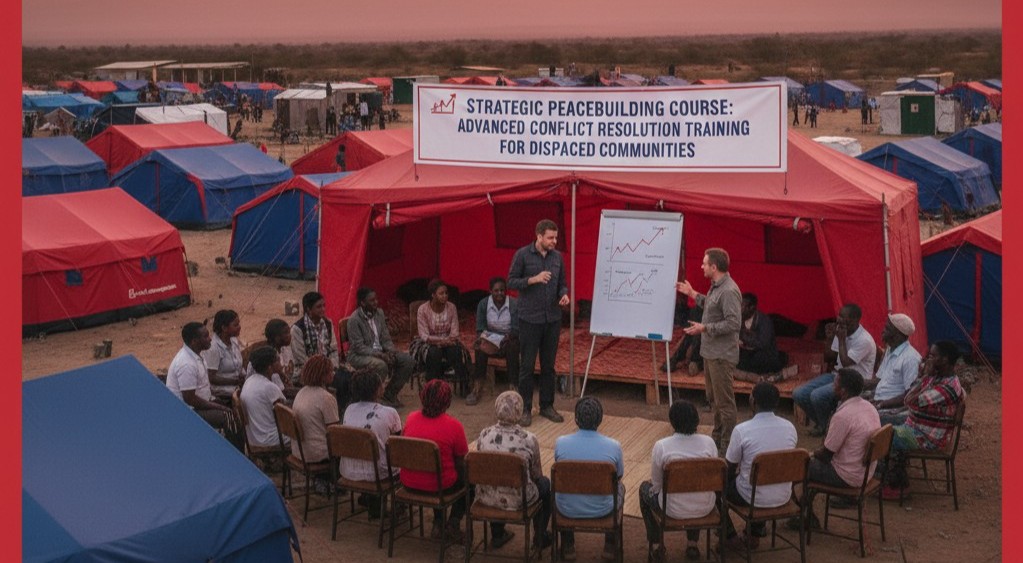
Course Overview
This specialized program provides an intensive conflict resolution training for displaced communities, designed to equip humanitarian workers, peacebuilders, and community leaders with the tools to manage social friction in high-pressure environments. Displacement—whether caused by war, climate change, or political unrest—creates unique socio-economic tensions between internally displaced persons (IDPs), refugees, and host communities. This conflict resolution training for displaced communities addresses these complexities by integrating psychosocial support with structural peacebuilding techniques to foster stability and social cohesion.
The conflict resolution training for displaced communities covers a vast array of technical and soft skills. Participants will explore the root causes of displacement-related friction, including resource competition, cultural misunderstandings, and trauma-induced aggression. By providing a comprehensive conflict resolution training for displaced communities, we move beyond simple mediation to explore restorative justice, inter-faith dialogue, and legal rights frameworks. This conflict resolution training for displaced communities ensures that peace is not just the absence of violence, but a sustainable foundation for community resilience.
Upon the successful completion of this Strategic Peacebuilding Course: Advanced Conflict Resolution Training for Displaced Communities, participants will be able to:
ü Apply integrated conflict resolution training for displaced communities’ principles to stabilize camp and host environments.
ü Conduct conflict sensitivity assessments in humanitarian contexts.
ü Facilitate multi-party mediation sessions between displaced persons and host populations.
ü Design trauma-informed peacebuilding initiatives.
ü Utilize restorative justice frameworks to resolve internal community disputes.
Training Methodology
The course is designed to be highly interactive, challenging and stimulating. It will be an instructor led training and will be delivered using a blended learning approach comprising of:
ü Experiential learning through role-plays and simulations.
ü Case study analysis of global displacement crises.
ü Peer-to-peer learning and thematic group discussions.
ü Visual aids and conflict mapping workshops.
ü Practical Session: Designing and facilitating a mock mediation between a host community leader and a displaced group representative.
Our facilitators are seasoned industry professionals with years of expertise in their chosen fields. All facilitation and course materials will be offered in English.
Who Should Attend?
This Strategic Peacebuilding Course: Advanced Conflict Resolution Training for Displaced Communities would be suitable for, but not limited to:
ü Humanitarian Aid Workers and NGO Field Staff
ü Community Leaders and Representatives of Displaced Groups
ü Refugee Camp Administrators and Social Workers
ü Local Government Officials in Host Regions
ü Peace and Security Officers
ü Human Rights Advocates and Legal Aid Providers
ü Psychologists and Trauma-Informed Care Specialists
Personal benefits
ü Acquire specialized skills in high-demand humanitarian peacebuilding.
ü Enhance your ability to manage high-stress interpersonal and group dynamics.
ü Develop a deep understanding of the legal and social rights of displaced populations.
ü Gain a globally recognized certificate in a niche area of conflict management.
Organizational benefits
ü Reduce security risks and operational disruptions in field locations.
ü Improve relationships between aid agencies and the communities they serve.
ü Ensure program sustainability through conflict-sensitive project implementation.
ü Strengthen the "Do No Harm" approach within organizational policies.
ü Course Duration: 10 Days
ü Training Fee:
o Physical Training: USD 3,000
o Online / Virtual Training: USD 2,500
Module 1: Dynamics of Conflict in Displacement Contexts
ü Definition and types of displacement (Refugees vs. IDPs)
ü Anatomy of a conflict: Needs, Interests, and Positions
ü Common triggers of violence in temporary settlements
ü The lifecycle of conflict in displacement zones
ü Practical Session: Creating a "Conflict Tree" for a specific displacement scenario
Module 2: The "Do No Harm" Principle and Conflict Sensitivity
ü Understanding the impact of aid on local conflict dynamics
ü Dividers and Connectors analysis
ü Identifying unintentional negative impacts of humanitarian intervention
ü Mainstreaming peacebuilding into emergency response
ü Practical Session: Reviewing an aid distribution plan for conflict risks
Module 3: Psychological Impacts of Displacement on Conflict Behaviour
ü Trauma, PTSD, and their role in social aggression
ü Loss of identity and the "victim" vs. "survivor" mentality
ü How displacement changes family and community power structures
ü Coping mechanisms and maladaptive behaviours
ü Practical Session: Role-play exercise on managing a trauma-induced outburst
Module 4: Stakeholder Mapping and Power Analysis
ü Identifying formal and informal community leaders
ü Mapping influence and interest groups in camps
ü The role of women and youth in the power hierarchy
ü Using the Venn Diagram of stakeholder relationships
ü Practical Session: Designing a comprehensive stakeholder map for a mock refugee camp
Module 5: Communication Skills: Active Listening and De-escalation
ü Non-violent communication (NVC) techniques
ü Cross-cultural communication barriers
ü Use of "I" statements in high-tension dialogue
ü Body language and non-verbal cues in conflict zones
ü Practical Session: Simulation of a de-escalation encounter with an angry community group
Module 6: Mediation Frameworks for Multi-Cultural Communities
ü The five stages of the mediation process
ü Remaining neutral in a high-bias environment
ü Creating safe spaces for dialogue
ü Documenting agreements and follow-up protocols
ü Practical Session: Full-length mediation simulation with feedback
Module 7: Resource-Based Conflict: Land, Water, and Aid Distribution
ü Negotiating resource access between IDPs and host communities
ü Conflict-sensitive aid distribution models
ü Managing perceptions of "favouritism" in aid
ü Collaborative resource management committees
ü Practical Session: Drafting a resource-sharing agreement template
Module 8: Gender-Based Violence (GBV) and Conflict Resolution
ü The link between displacement, conflict, and GBV
ü Safe reporting mechanisms for survivors
ü Male engagement in GBV prevention
ü Ethical considerations in mediating gender-related disputes
ü Practical Session: Developing a referral pathway for conflict-induced GBV cases
Module 9: Restorative Justice and Traditional Dispute Resolution
ü Principles of restorative vs. retributive justice
ü Integrating tribal or indigenous law with modern mediation
ü Circles of peace and community healing
ü Limitations of traditional systems in a human rights context
ü Practical Session: Simulation of a restorative justice circle
Module 10: Human Rights and Legal Frameworks for Displaced Persons
ü The 1951 Refugee Convention and regional laws
ü Housing, Land, and Property (HLP) rights for returnees
ü Legal status and its impact on conflict vulnerability
ü Access to local justice systems for displaced persons
ü Practical Session: Legal aid counselling simulation
Module 11: Inter-faith and Inter-ethnic Dialogue Techniques
ü Managing religious sensitivities in displacement
ü Common ground identifying exercises
ü Organizing inter-community cultural exchange events
ü Countering hate speech and rumours
ü Practical Session: Facilitating a mock inter-faith "peace table"
Module 12: Youth Engagement and Preventing Radicalization in Camps
ü Vulnerability of displaced youth to extremist recruitment
ü Creating constructive outlets: Sports, arts, and vocational peace
ü Youth as peace ambassadors in displaced communities
ü Mentorship programs for at-risk young adults
ü Practical Session: Designing a youth-led community service project
Module 13: Negotiation Tactics for Community Leaders
ü Interest-based negotiation (The Harvard Model)
ü BATNA (Best Alternative to a Negotiated Agreement)
ü Negotiating with authorities for better services
ü Managing internal dissent within a displaced group
ü Practical Session: Group negotiation simulation for camp facilities
Module 14: Integrating Peacebuilding into Livelihood Programs
ü Economic interdependence as a tool for peace
ü Joint markets for displaced and host communities
ü Skills training as a de-escalation tool
ü Micro-finance and social cohesion
ü Practical Session: Designing a "business for peace" project proposal
Module 15: Conflict Monitoring and Early Warning Systems
ü Identifying indicators of impending violence
ü Community-based reporting mechanisms
ü Information verification and rumour management
ü Mobile technology in conflict monitoring
ü Practical Session: Setting up a "Peace Monitoring Dashboard"
Module 16: Building Social Cohesion with Host Communities
ü Addressing host community grievances and "aid envy"
ü Shared infrastructure projects (Schools, Clinics)
ü Advocacy for inclusive local policies
ü Managing urban displacement vs. camp displacement
ü Practical Session: Drafting a social cohesion strategy document
Module 17: Trauma-Informed Conflict Resolution Strategies
ü Creating "brave spaces" for reconciliation
ü Psychological first aid during mediation
ü Self-care for the mediator (Secondary trauma prevention)
ü Art and play therapy in children's conflict resolution
ü Practical Session: Practicing grounding techniques for mediators
Module 18: Capstone: Developing a Community Peace Action Plan
ü Synthesizing all conflict resolution training for displaced communities
ü Identifying priority conflict zones in your current operational area
ü Building an implementation timeline
ü Presentation of final peace action plans
ü Practical Session: Peer review and finalization of the Action Plan
About Our Trainers
Our trainers are veteran peacebuilders with over 15 years of experience in the world’s most complex displacement zones. They have served with the UN, ICRC, and major international NGOs in conflict-affected regions. Each facilitator holds advanced degrees in Peace and Conflict Studies and is certified in trauma-informed care. Their approach to conflict resolution training for displaced communities is grounded in actual field success and restorative practices.
Quality Statement
Phoenix Center for Policy, Research and Training is committed to delivering world-class educational standards. Our conflict resolution training for displaced communities is updated annually to reflect the latest global humanitarian trends and the newest peacebuilding research. We guarantee a safe, inclusive, and highly practical learning environment.
Tailor-Made Courses
We understand that every organization has unique challenges and opportunities as well as unique training needs. Phoenix Training Center offers tailor-made courses designed to address specific requirements and challenges faced by your team or organization. Whether you need a customized curriculum, a specific duration, or on-site delivery, we can adapt our expertise to provide a training solution that perfectly aligns with your objectives. We can customize this conflict resolution training for displaced communities to focus on your specific geographical region, cultural context, or the specific nature of your project.
Admission Criteria
ü Participants should be reasonably proficient in English.
ü Applicants must live up to Phoenix Center for Policy, Research and Training admission criteria.
Terms and Conditions
ü Discounts: Organizations sponsoring Four Participants will have the 5th attend Free
ü What is catered for by the Course Fees: Fees cater for all requirements for the training – Learning materials, Lunches, Teas, Snacks and Certification. All participants will additionally cater for their travel and accommodation expenses, visa application, insurance, and other personal expenses.
ü Certificate Awarded: Participants are awarded Certificates of Participation at the end of the training.
ü Course Improvement: The program content shown here is for guidance purposes only. Our continuous course improvement process may lead to changes in topics and course structure.
ü Approval of Course: Our Programs are NITA Approved. Participating organizations can therefore claim reimbursement on fees paid in accordance with NITA Rules.
Booking for Training
Simply send an email to the Training Officer on training@phoenixtrainingcenter.com and we will send you a registration form. We advise you to book early to avoid missing a seat to this training. Or call us on +254720272325 / +254737296202
Payment Options
We provide 3 payment options, choose one for your convenience, and kindly make payments at least 5 days before the Training start date to reserve your seat:
ü Groups of 5 People and Above – Cheque Payments to: Phoenix Center for Policy, Research and Training Limited should be paid in advance, 5 days to the training.
ü Invoice: We can send a bill directly to you or your company.
ü Deposit directly into Bank Account (Account details provided upon request)
Cancellation Policy
ü Payment for all courses includes a registration fee, which is non-refundable, and equals 15% of the total sum of the course fee.
ü Participants may cancel attendance 14 days or more prior to the training commencement date.
ü No refunds will be made 14 days or less before the training commencement date. However, participants who are unable to attend may opt to attend a similar training course at a later date or send a substitute participant provided the participation criteria have been met.
Accommodation and Airport Transfer
For physical training attendees, we can assist with recommendations for accommodation near the training venue. Airport pick-up services can also be arranged upon request to ensure a smooth arrival. Please inform us of your travel details in advance if you require these services. For reservations contact the Training Officer on Email: training@phoenixtrainingcenter.com or on Tel: +254720272325 / +254737296202
| Course Dates | Venue | Fees | Enroll |
|---|

Phoenix Training Center
Typically replies in minutes