
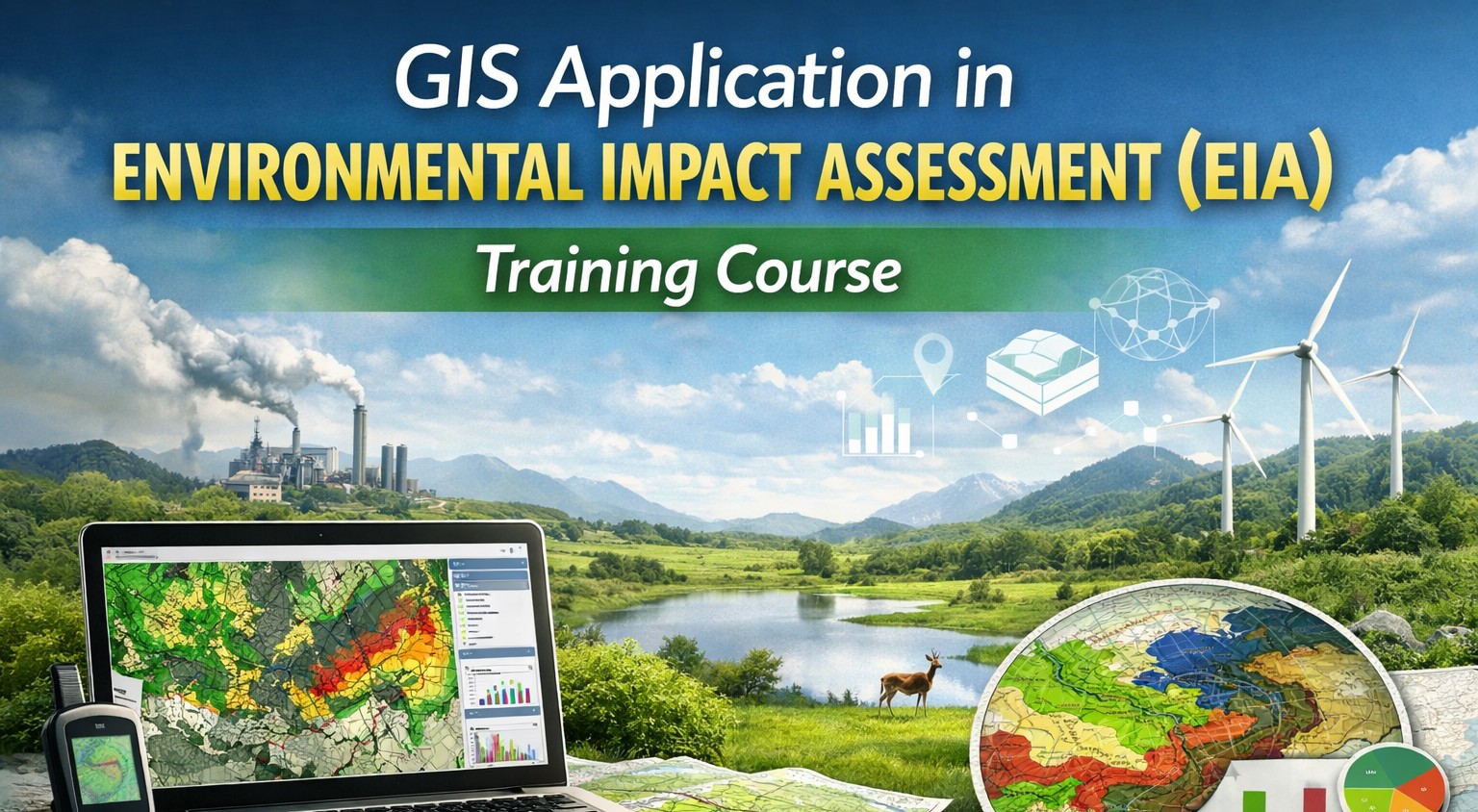
Geographic Information Systems (GIS) have become an indispensable tool in modern Environmental Impact Assessment (EIA) practice. As regulatory requirements become more stringent and projects increasingly complex, spatial analysis plays a critical role in identifying environmental sensitivities, assessing social impacts, and supporting evidence-based decision-making. This course equips participants with practical GIS skills tailored specifically to EIA processes, ensuring compliance with national regulations and international safeguard standards.
The training covers key themes including environmental and social safeguards, spatial risk assessment, governance and compliance mapping, cumulative impact analysis, stakeholder mapping, climate risk screening, and decision-support systems. Participants will learn how to integrate GIS into screening, scoping, baseline studies, impact prediction, mitigation planning, monitoring, and reporting in line with global frameworks.
Who Should Attend
This course is ideal for:
Objectives of the Training
By the end of the training, participants will be able to:
Personal Benefits
Participants will:
Organizational Benefits
Organizations will benefit through:
The course uses a blended and highly practical approach:
Course Duration & Fee
The training team consists of senior EIA Lead Experts, GIS Specialists, and Safeguards Consultants with over 15 years of regional and international experience. Trainers have worked on World Bank, IFC, AfDB, and UN-funded infrastructure, mining, energy, and water projects across Africa and Asia.
They bring hands-on experience in regulatory compliance, donor safeguards, spatial modelling, environmental governance, and institutional capacity building.
Quality Statement
We are committed to delivering high-quality, context-rich, and results-oriented training. The course blends international standards with local regulatory realities, ensuring participants gain practical and immediately applicable skills. Emphasis is placed on real-case simulations, adaptive management, and professional-level GIS outputs.
Tailor-Made Courses
Customized versions of this training are available for:
Modules can be adapted to sector-specific needs (mining, oil & gas, water, transport, renewable energy, urban planning).
Module 1: Foundations of GIS in EIA
Module 2: Screening & Scoping Using GIS
Module 3: Baseline Environmental Mapping
Module 4: Social Impact Spatial Analysis
Module 5: Impact Prediction & Modelling
Module 6: Environmental Risk Assessment
Module 7: Mitigation & Environmental Management Planning
Module 8: Governance, Compliance & Reporting
Module 9: Monitoring & Adaptive Management
Module 10: Emerging Trends in GIS for EIA
Requirements
Participants should be reasonably proficient in English.
Applicants must live up to Phoenix Training Center admission criteria.
Terms and Conditions
1. Discounts: Organizations sponsoring Four Participants will have the 5th attend Free
2. What is catered for by the Course Fees: Fees cater for all requirements for the training – Learning materials, Lunches, Teas, Snacks and Certification. All participants will additionally cater for their travel and accommodation expenses, visa application, insurance, and other personal expenses.
3. Certificate Awarded: Participants are awarded Certificates of Participation at the end of the training.
4. The program content shown here is for guidance purposes only. Our continuous course improvement process may lead to changes in topics and course structure.
5. Approval of Course: Our Programs are NITA Approved. Participating organizations can therefore claim reimbursement on fees paid in accordance with NITA Rules.
Booking for Training
Simply send an email to the Training Officer on training@phoenixtrainingcenter.com and we will send you a registration form. We advise you to book early to avoid missing a seat to this training.
Or call us on +254720272325 / +254725012095 / +254724452588
Payment Options
We provide 3 payment options, choose one for your convenience, and kindly make payments at least 5 days before the Training start date to reserve your seat:
1. Groups of 5 People and Above – Cheque Payments to: Armstrong Global Training & Development Center Limited should be paid in advance, 5 days to the training.
2. Invoice: We can send a bill directly to you or your company.
3. Deposit directly into Bank Account (Account details provided upon request)
Cancellation Policy
1. Payment for all courses includes a registration fee, which is non-refundable, and equals 15% of the total sum of the course fee.
2. Participants may cancel attendance 14 days or more prior to the training commencement date.
3. No refunds will be made 14 days or less before the training commencement date. However, participants who are unable to attend may opt to attend a similar training course at a later date or send a substitute participant provided the participation criteria have been met.
Tailor Made Courses
This training course can also be customized for your institution upon request for a minimum of 5 participants. You can have it conducted at our Training Centre or at a convenient location. For further inquiries, please contact us on Tel: +254720272325 / +254725012095 / +254724452588 or Email training@phoenixtrainingcenter.com
Accommodation and Airport Transfer
Accommodation and Airport Transfer is arranged upon request and at extra cost. For reservations contact the Training Officer on Email: training@phoenixtrainingcenter.com or on Tel: +254720272325 / +254725012095 / +254724452588
| Course Dates | Venue | Fees | Enroll |
|---|---|---|---|
| Jul 20 - Jul 24 2026 | Naivasha | $1,200 |
|

Phoenix Training Center
Typically replies in minutes