
Course Overview
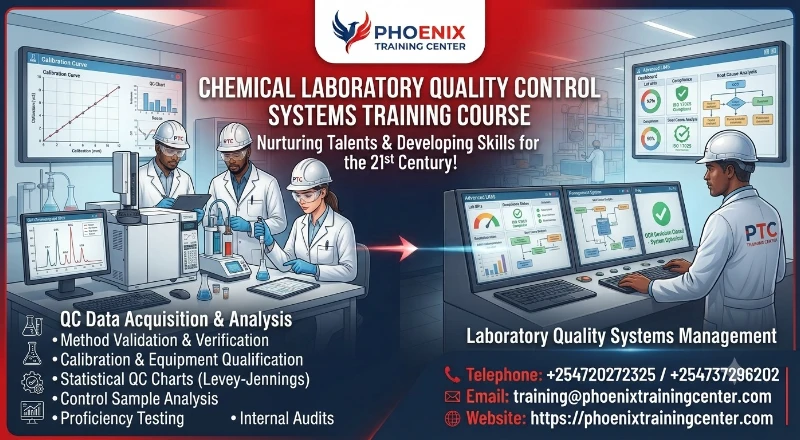
The Chemical Laboratory Quality Control Systems Training Course is an intensive technical program designed to empower laboratory managers, analytical chemists, and quality assurance officers with the skills needed to implement world-class quality systems. Operating a modern testing facility requires strict adherence to analytical precision, rigorous regulatory frameworks, and robust validation protocols. This course bridges fundamental chemical analysis techniques with international data integrity standards, ensuring your laboratory maintains accurate, legally defensible, and highly reproducible results under varying industrial conditions.
Throughout this five-day program, participants will review the essential components of a robust laboratory quality management system (LQMS). Key focus areas include the implementation of ISO/IEC 17025 compliance frameworks, standard operating procedure (SOP) design, analytical method validation, and chemical measurement uncertainty. Additionally, attendees will master advanced data analysis tools, including statistical process control (SPC) charts, proficiency testing evaluation, and systematic root-cause analysis for out-of-specification (OOS) results. This training provides the comprehensive operational toolkit necessary to eliminate laboratory errors, reduce retesting overheads, and streamline regulatory audits.
Upon the successful completion of this Chemical Laboratory Quality Control Systems Training Course, participants will be able to:
ü Interpret and integrate ISO/IEC 17025 quality standard requirements within everyday chemical laboratory operations.
ü Execute comprehensive analytical method validations and verifications for complex chemical instruments.
ü Calculate, evaluate, and report chemical measurement uncertainty in accordance with international metrological guidelines.
ü Design and implement statistical process control (SPC) charts to track real-time laboratory system consistency.
ü Conduct structured root-cause investigations for out-of-specification (OOS) results and implement sustainable corrective actions.
Training Methodology
The course is designed to be highly interactive, challenging and stimulating. It will be an instructor led training and will be delivered using a blended learning approach comprising of:
ü Interactive lectures supported by practical chemical laboratory operational case studies
ü Hands-on data calculation workshops utilizing real laboratory precision datasets
ü Group working sessions focused on writing compliant standard operating procedures (SOPs)
ü Immersive troubleshooting scenarios targeting out-of-specification (OOS) investigations
ü Template-driven auditing exercises to prepare for external compliance assessments
Our facilitators are seasoned industry professionals with years of expertise in their chosen fields. All facilitation and course materials will be offered in English.
Who Should Attend?
This Chemical Laboratory Quality Control Systems Training Course would be suitable for, but not limited to:
ü Laboratory Managers and Directors
ü Analytical Chemists and Biochemists
ü Laboratory Quality Assurance and Control Officers
ü Research and Development Scientists
ü Regulatory Compliance Inspectors
ü Laboratory Technical Supervisors
Personal Benefits
ü Acquire an elite, data-driven technical capability that elevates professional standing in scientific industries.
ü Master complex statistical computations required for precise scientific reporting and measurement verification.
ü Develop the executive capability to confidently manage external accreditation body inspections.
Organizational Benefits
ü Drastically decrease laboratory errors, sample contamination rates, and expensive re-testing cycles.
ü Secure international compliance and data recognition, facilitating smoother global market entry for company products.
ü Establish a self-correcting corporate laboratory framework that converts regulatory findings into long-term operational strengths.
ü Course Duration: 5 Days
ü Training Fee:
o Physical Training: USD 1,500
o Online / Virtual Training: USD 1,000
Module 1: Foundations of Laboratory Quality Management and ISO/IEC 17025
ü Structural overview of the ISO/IEC 17025 standard requirements
ü Core pillars of quality assurance (QA) vs. quality control (QC) in chemical testing
ü Establishing personnel competency matrices and training tracking frameworks
ü Ethical considerations, data integrity principles, and electronic record tracking
ü Document control systems and protection of intellectual test properties
ü Practical Session: Evaluating an unaccredited laboratory organizational layout and constructing a transitional gap-analysis roadmap.
Module 2: Structural Documentation and SOP Development
ü Structuring the hierarchy of corporate laboratory quality manuals
ü Writing unambiguous Standard Operating Procedures (SOPs) for high-accuracy analysis
ü Document version tracking, approval workflows, and archiving processes
ü Designing robust chemical tracking logs and sample chain-of-custody forms
ü Creating secure data sheet templates for manual raw weight entries
ü Practical Session: Drafting a comprehensive, audit-ready SOP for the storage and use of volatile reference standards.
Module 3: Metrology, Calibration, and Equipment Management Systems
ü Principles of metrological traceability in analytical chemistry
ü Developing preventive maintenance calendars for complex instrumentation (HPLC, GC-MS, ICP)
ü Executing intermediate checks on critical analytical balances and pipettes
ü Selecting, preparing, and verifying Certified Reference Materials (CRMs)
ü Establishing clear vendor criteria for third-party calibration services
ü Practical Session: Creating an equipment file and performance-verification plan for a newly acquired laboratory instrument.
Module 4: Analytical Method Validation Protocols
ü Distinguishing between method validation and method verification requirements
ü Evaluating fundamental validation parameters: Accuracy, Precision, and Linearity
ü Determining Method Detection Limits (MDL) and Limits of Quantitation (LOQ)
ü Assessing analytical specificity, selectivity, and system robustness under stress
ü Software systems for tracking validation testing regressions
ü Practical Session: Performing calculations to establish the linearity curve and detection limits for a spectrophotometric test.
Module 5: Quantifying Measurement Uncertainty in Chemical Analysis
ü Foundational concepts of type A and type B measurement uncertainties
ü Constructing cause-and-effect (Ishikawa) diagrams for chemical extraction errors
ü Identifying uncertainty components: glassware variances, purity certificates, and repeatability
ü Mathematical tools for calculating combined and expanded uncertainties
ü Reporting analytical testing outputs with confidence interval metrics
ü Practical Session: Developing an uncertainty budget for an acid-base volumetric titration assay.
Module 6: Statistical Quality Control and Control Charting (SPC)
ü Underlying statistical distributions relevant to analytical data evaluation
ü Constructing and interpreting Shewhart quality control charts ($X$-bar and $R$ charts)
ü Setting dynamic warning limits vs. strict action control limits on active charts
ü Applying Westgard Rules to detect early drift patterns in chemical instrumentation
ü Utilizing duplicate samples and matrix spikes to monitor analytical precision
ü Practical Session: Constructing an automated $X$-bar control chart using historical control sample data and analyzing out-of-control trends.
Module 7: Proficiency Testing and Inter-Laboratory Evaluations
ü The role of Proficiency Testing (PT) in external quality assurance verification
ü Selecting approved PT schemes and planning annual participation matrices
ü Interpreting PT performance metrics using $z$-score evaluation criteria
ü Investigating problematic $z$-scores ($|z| \ge 2$) and systematic bias indicators
ü Implementing alternative inter-laboratory comparisons when PT schemes are unavailable
ü Practical Session: Reviewing a mock proficiency testing performance report and formulating a corrective protocol for an elevated $z$-score.
Module 8: Investigating Out-of-Specification (OOS) Analytical Results
ü Establishing a defensible Phase I laboratory error assessment checklist
ü Interviewing technical operators, assessing instrument status, and checking raw calculations
ü Defining strict conditions for re-injection, re-testing, and re-sampling activities
ü Documenting comprehensive phase II corporate manufacturing failure investigations
ü Differentiating between out-of-specification (OOS) and out-of-trend (OOT) profiles
ü Practical Session: Roleplaying a complete Phase I investigation following a failed chemical assay on a production batch.
Module 9: Internal Laboratory Quality Audits and Risk Matrix Planning
ü Principles of scheduling, planning, and conducting internal laboratory quality audits
ü Developing focused, audit-ready vertical and horizontal testing checklists
ü Techniques for gathering objective audit evidence and conducting staff interviews
ü Categorizing audit findings into critical, major, and minor non-conformances
ü Integrating risk management principles into laboratory resource allocation plans
ü Practical Session: Conducting a simulated internal audit of sample receiving areas using ISO/IEC 17025 compliance criteria.
Module 10: Corrective and Preventive Actions (CAPA) and Continual Improvement
ü Transitioning from immediate corrections to robust corrective action planning
ü Utilizing the 5 Whys and Fishbone frameworks for technical laboratory failures
ü Defining and tracking the long-term effectiveness of implemented CAPAs
ü Formatting data inputs for formal corporate Laboratory Management Reviews
ü Cultivating a sustainable corporate culture focused on technical continual improvement
ü Practical Session: Building a comprehensive CAPA matrix to address an recurring instrumentation baseline stability error.
About Our Trainers
Our deployment experts are veteran laboratory directors, analytical chemists, and certified international laboratory lead auditors. Each trainer brings more than fifteen years of technical experience leading ISO/IEC 17025 accredited facilities within pharmaceutical manufacturing, environmental analysis, and independent commercial testing sectors. They possess deep analytical competencies in chromatographic systems, statistical quality controls, and metrological computations, and have directed multiple operations successfully through stringent accreditation audit pipelines.
Quality Statement
Phoenix Training Center is dedicated to setting the global benchmark for technical professional education. We maintain absolute excellence in structural instructional design, build programs using rigorously validated scientific methodologies, and provide immediately implementable operational toolkits. Our ongoing technical review loops ensure that all methodologies are updated to match evolving international standards, changing regulatory guidelines, and modern automated instrumentation trends.
Tailor-Made Courses
We understand that every organization has unique challenges and opportunities as well as unique training needs. Phoenix Training Center offers tailor-made courses designed to address specific requirements and challenges faced by your team or organization. Whether you need a customized curriculum, a specific duration, or on-site delivery, we can adapt our expertise to provide a training solution that perfectly aligns with your objectives. We can customize this Course to focus on your industry, specific risk profile, or internal stakeholder dynamics. Contact us to discuss how we can create a bespoke training program that maximizes value and impact for your team. For further inquiries, please contact us on Tel: +254720272325 / +254737296202 or Email training@phoenixtrainingcenter.com.
Admission Criteria
ü Participants should be reasonably proficient in English.
ü Applicants must live up to Phoenix Center for Policy, Research and Training admission criteria.
Terms and Conditions
ü Discounts: Organizations sponsoring Four Participants will have the 5th attend Free
ü What is catered for by the Course Fees: Fees cater for all requirements for the training – Learning materials, Lunches, Teas, Snacks and Certification. All participants will additionally cater for their travel and accommodation expenses, visa application, insurance, and other personal expenses.
ü Certificate Awarded: Participants are awarded Certificate of Completion at the end of the training.
ü Course Improvement: The program content shown here is for guidance purposes only. Our continuous course improvement process may lead to changes in topics and course structure.
ü Approval of Course: Our Programs are NITA Approved. Participating organizations can therefore claim reimbursement on fees paid in accordance with NITA Rules.
Booking for Training
Kindly send an email to the Training Officer on training@phoenixtrainingcenter.com and we will send you a registration form. We advise you to book early to avoid missing a seat to this training. Or call us on +254720272325 / +254737296202
Payment Options
We provide 3 payment options, choose one for your convenience, and kindly make payments a week before the training starts (at least 5 to 7 days before the Training start date) to reserve your seat:
ü Groups of 5 People and Above – Cheque Payments to: Phoenix Center for Policy, Research and Training Limited should be paid in advance, a week before the training starts.
ü Invoice: We can send a bill directly to you or your company.
ü Deposit directly into Bank Account (Account details provided upon request)
Cancellation Policy
ü Payment for all courses includes a registration fee, which is non-refundable, and equals 15% of the total sum of the course fee.
ü Participants may cancel attendance 14 days or more prior to the training commencement date.
ü No refunds will be made 14 days or less before the training commencement date. However, participants who are unable to attend may opt to attend a similar training course at a later date or send a substitute participant provided the participation criteria have been met.
Accommodation and Airport Pick-up
For physical training attendees, we can assist with recommendations for accommodation near the training venue. Airport pick-up services can also be arranged upon request to ensure a smooth arrival. Please inform us of your travel details in advance if you require these services. For reservations contact the Training Officer on Email: training@phoenixtrainingcenter.com or on Tel: +254720272325 / +254737296202.
| Course Dates | Venue | Fees | Enroll |
|---|---|---|---|
| Sep 21 - Sep 25 2026 | Nakuru | $1,500 |
|
| Sep 28 - Oct 02 2026 | Zoom | $1,000 |
|
| Oct 05 - Oct 09 2026 | Nairobi | $1,500 |
|
| Oct 12 - Oct 16 2026 | Nairobi | $1,500 |
|
| Oct 19 - Oct 23 2026 | Mombasa | $1,500 |
|
| Oct 26 - Oct 30 2026 | Naivasha | $1,500 |
|

Phoenix Training Center
Typically replies in minutes