
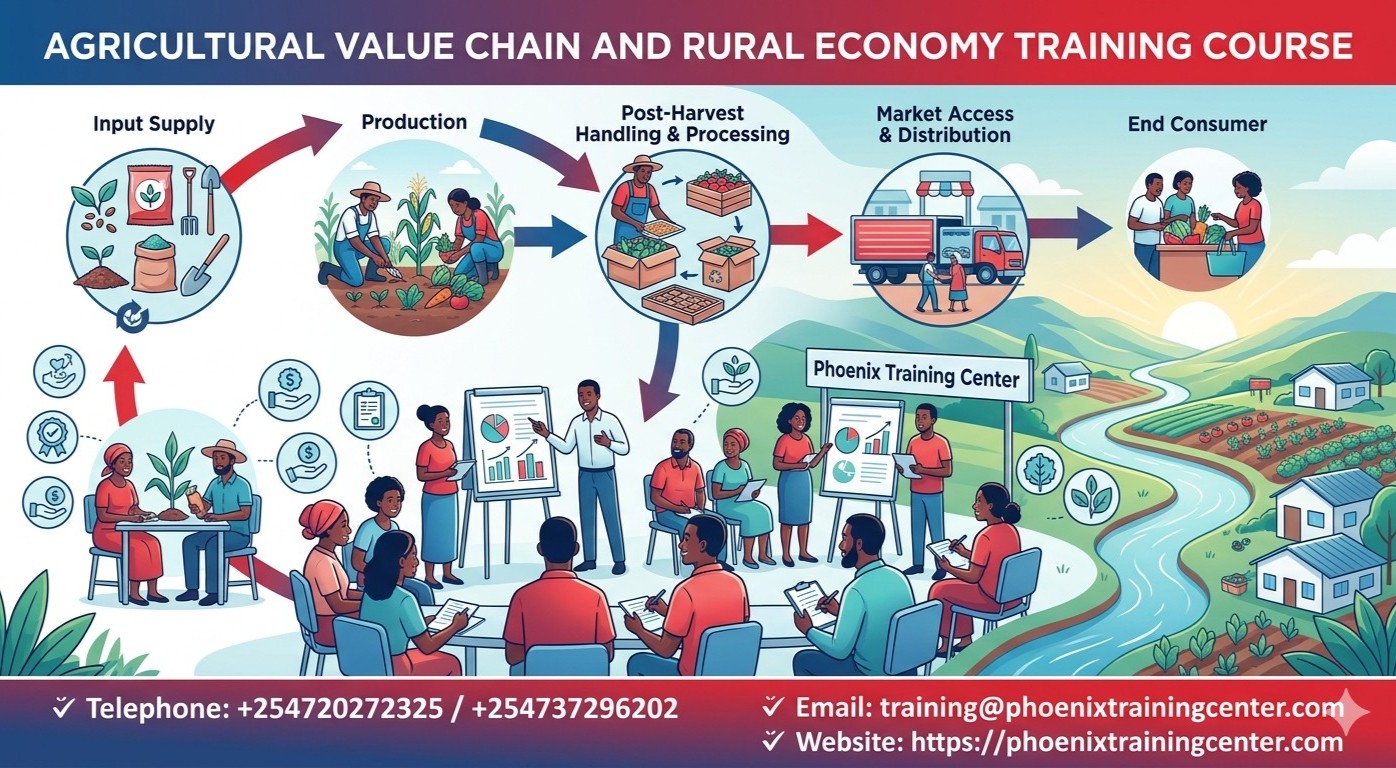
Course Overview
The Agricultural Value Chain and Rural Economy Training Course is designed to provide professionals with a deep understanding of the linkages between agricultural productivity and rural economic transformation. In today’s globalized market, isolated farming practices are no longer sustainable. This course focuses on integrating smallholder farmers and rural enterprises into high-value markets, ensuring that agricultural growth translates into tangible poverty reduction and economic stability within rural communities.
Throughout the program, participants will explore the multifaceted nature of agricultural extension and rural development courses, alongside rigorous modules on agricultural project management. We delve into value chain mapping, rural finance, and infrastructure development, providing a holistic view of the ecosystem. By the end of the sessions, learners will have the technical capacity to design and oversee initiatives that optimize the Agricultural Value Chain and Rural Economy Training Course objectives for long-term impact.
Upon the successful completion of this Agricultural Value Chain and Rural Economy Training Course participants will be able to:
ü Apply advanced agricultural project management tools to rural initiatives.
ü Analyze and map complex agricultural value chains to identify bottlenecks.
ü Design effective agricultural extension and rural development courses for community outreach.
ü Facilitate market access for rural producers through value-addition strategies.
ü Implement sustainable rural economy models that promote financial inclusion.
Training Methodology
The course is designed to be highly interactive, challenging and stimulating. It will be an instructor led training and will be delivered using a blended learning approach comprising of:
ü Interactive lectures and multimedia presentations
ü Case studies focusing on successful rural economy models
ü Group breakout sessions for value chain mapping exercises
ü Field-simulated data analysis and project planning
ü Practical Sessions involving the use of project management software and field assessment tools
Our facilitators are seasoned industry professionals with years of expertise in their chosen fields. All facilitation and course materials will be offered in English.
Who Should Attend?
This Agricultural Value Chain and Rural Economy Training Course would be suitable for, but not limited to:
ü Agricultural Project Managers
ü Rural Development Officers
ü Agricultural Extension Agents
ü Policy Makers in Agriculture and Rural Planning
ü NGO Program Managers in Food Security
ü Value Chain Analysts
ü Agribusiness Consultants
ü Cooperative Leaders and Rural Entrepreneurs
Personal Benefits
ü Mastery of project lifecycle management specifically tailored for the agricultural sector.
ü Enhanced ability to influence rural policy and community economic development.
ü Development of specialized skills in value chain analysis that are highly sought after by international development agencies.
ü Improved leadership and communication skills for managing diverse rural stakeholders.
Organizational Benefits
ü Improved success rates of rural interventions through professional agricultural project management.
ü Enhanced organizational reputation for delivering sustainable rural development outcomes.
ü Better alignment of agricultural projects with national and international development goals.
ü Increased efficiency in resource allocation within rural agricultural programs.
ü Course Duration: 5 Days
ü Training Fee
o Physical Training: USD 1,200
o Online / Virtual Training: USD 800
Module 1: Introduction to Agricultural Value Chains and Rural Dynamics
ü Concepts and principles of the Agricultural Value Chain and Rural Economy
ü The role of agriculture in rural structural transformation
ü Global trends affecting rural economies
ü Gender and youth integration in agricultural value chains
ü Practical Session: Comparative analysis of traditional vs. modern agricultural value chains
Module 2: Fundamentals of Agricultural Project Management
ü The agricultural project lifecycle: Identification to closure
ü Scope management and work breakdown structures for agri-projects
ü Scheduling and resource allocation in rural settings
ü Stakeholder engagement and communication planning
ü Practical Session: Developing a Logical Framework (LogFrame) for a rural agricultural project
Module 3: Rural Economy Analysis and Poverty Reduction Strategies
ü Understanding rural livelihoods and diversification
ü Identifying drivers of rural economic growth
ü Linkages between agriculture and non-farm rural sectors
ü Policies for inclusive rural development
ü Practical Session: Mapping rural economic assets and income streams
Module 4: Agricultural Extension and Rural Development Courses Design
ü Modern paradigms in agricultural extension services
ü ICT and digital tools for rural outreach
ü Participatory extension methodologies (Farmer Field Schools)
ü Curricula development for adult learners in rural areas
ü Practical Session: Designing a one-day training module for smallholder farmers
Module 5: Value Chain Mapping and Stakeholder Analysis
ü Selection criteria for high-potential value chains
ü Identifying value-added opportunities and "win-win" scenarios
ü Analyzing power dynamics within the chain
ü Cost and margin analysis across the value chain
ü Practical Session: Hands-on mapping of a local commodity value chain
Module 6: Rural Finance, Micro-insurance, and Investment
ü Barriers to financial inclusion in rural areas
ü Innovative lending models for smallholder farmers
ü Weather-indexed insurance and risk-sharing facilities
ü Attracting private sector investment to rural agribusiness
ü Practical Session: Developing a credit application and repayment schedule for a rural cooperative
Module 7: Post-Harvest Handling and Rural Infrastructure
ü Managing post-harvest losses and quality control
ü Rural storage solutions and warehouse receipt systems
ü The impact of feeder roads and energy on rural markets
ü Value addition and primary processing at the village level
ü Practical Session: Site selection exercise for a rural collection center
Module 8: Market Access, Trade, and Competitive Strategy
ü Analyzing market requirements and consumer trends
ü Certification standards (Organic, Fairtrade, GlobalGAP)
ü Facilitating collective marketing and producer organizations
ü Negotiating with off-takers and wholesalers
ü Practical Session: Simulating a negotiation between a farmer group and a large-scale processor
Module 9: Risk Management and Resilience in Rural Economies
ü Identifying climate-related and market risks
ü Strategies for climate-smart agriculture
ü Diversification as a risk mitigation tool
ü Community-based disaster risk management
ü Practical Session: Creating a risk mitigation matrix for a specific rural intervention
Module 10: Monitoring, Evaluation, and Impact Assessment
ü Selecting indicators for the Agricultural Value Chain and Rural Economy
ü Tools for data collection in remote rural areas
ü Measuring social and economic impact on rural households
ü Reporting and learning for project improvement
ü Practical Session: Designing a baseline survey for a new agricultural intervention
About Our Trainers
Our trainers are leading experts in the fields of agricultural economics, rural development, and project management. With over 20 years of combined experience working with international organizations such as the FAO, IFAD, and various national ministries of agriculture, they bring a wealth of practical field knowledge and academic rigor to the classroom.
Quality Statement
Phoenix Center for Policy, Research and Training is dedicated to providing high-quality, evidence-based training solutions. We ensure our content is updated annually to reflect the latest shifts in global agricultural policy and technological advancements, guaranteeing that our participants stay ahead of the industry curve.
Tailor-Made Courses
We understand that every organization has unique challenges and opportunities as well as unique training needs. Phoenix Training Center offers tailor-made courses designed to address specific requirements and challenges faced by your team or organization. Whether you need a customized curriculum, a specific duration, or on-site delivery, we can adapt our expertise to provide a training solution that perfectly aligns with your objectives. We can customize this Course to focus on your industry, specific risk profile, or internal stakeholder dynamics. Contact us to discuss how we can create a bespoke training program that maximizes value and impact for your team. For further inquiries, please contact us on Tel: +254720272325 / +254737296202 or Email training@phoenixtrainingcenter.com
ü Participants should be reasonably proficient in English.
ü Applicants must live up to Phoenix Center for Policy, Research and Training admission criteria.
Terms and Conditions
ü Discounts: Organizations sponsoring Four Participants will have the 5th attend Free
ü What is catered for by the Course Fees: Fees cater for all requirements for the training – Learning materials, Lunches, Teas, Snacks and Certification. All participants will additionally cater for their travel and accommodation expenses, visa application, insurance, and other personal expenses.
ü Certificate Awarded: Participants are awarded Certificates of Participation at the end of the training.
ü The program content shown here is for guidance purposes only. Our continuous course improvement process may lead to changes in topics and course structure.
ü Approval of Course: Our Programs are NITA Approved. Participating organizations can therefore claim reimbursement on fees paid in accordance with NITA Rules.
Booking for Training
Simply send an email to the Training Officer on training@phoenixtrainingcenter.com and we will send you a registration form. We advise you to book early to avoid missing a seat to this training. Or call us on +254720272325 / +254737296202
Payment Options
We provide 3 payment options, choose one for your convenience, and kindly make payments at least 5 days before the Training start date to reserve your seat:
ü Groups of 5 People and Above – Cheque Payments to: Phoenix Center for Policy, Research and Training Limited should be paid in advance, 5 days to the training.
ü Invoice: We can send a bill directly to you or your company.
ü Deposit directly into Bank Account (Account details provided upon request)
Cancellation Policy
ü Payment for all courses includes a registration fee, which is non-refundable, and equals 15% of the total sum of the course fee.
ü Participants may cancel attendance 14 days or more prior to the training commencement date.
ü No refunds will be made 14 days or less before the training commencement date. However, participants who are unable to attend may opt to attend a similar training course at a later date or send a substitute participant provided the participation criteria have been met.
Accommodation and Airport Transfer
For physical training attendees, we can assist with recommendations for accommodation near the training venue. Airport pick-up services can also be arranged upon request to ensure a smooth arrival. Please inform us of your travel details in advance if you require these services. For reservations contact the Training Officer on Email: training@phoenixtrainingcenter.com or on Tel: +254720272325 / +254737296202
| Course Dates | Venue | Fees | Enroll |
|---|---|---|---|
| Jul 20 - Jul 24 2026 | Mombasa | $1,200 |
|
| Jul 27 - Jul 31 2026 | Kisumu | $1,200 |
|
| Aug 03 - Aug 07 2026 | Nairobi | $1,200 |
|

Phoenix Training Center
Typically replies in minutes