
Course Overview
This intensive NGO financial management course is designed to equip finance and non-finance professionals working in the non-profit sector with the specialized knowledge and practical skills required to ensure financial accountability, sustainability, and rigorous donor compliance. This comprehensive NGO finance course provides a deep dive into the unique aspects of non-profit accounting, budgeting, and financial reporting, emphasizing best practices in transparency and good governance.
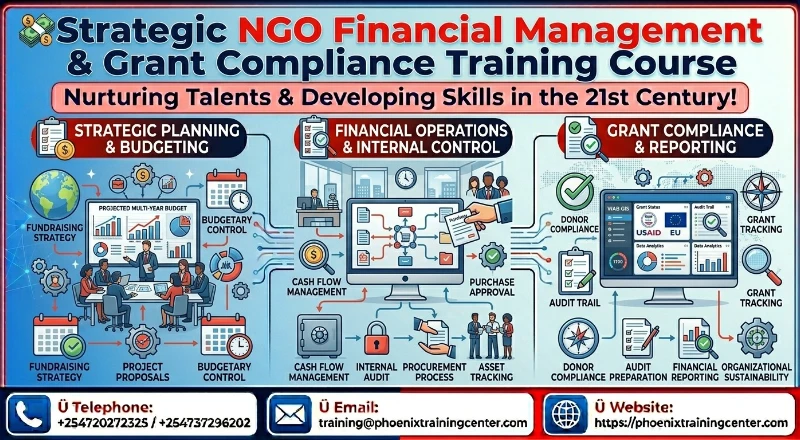
The curriculum provides a brief overview of the topics essential for effective NGO finance management. This includes understanding non-profit accounting principles, mastering activity-based budgeting and forecasting, implementing robust internal controls and fraud prevention measures, navigating complex donor regulations (e.g., USG, EU), optimizing cash and treasury management, and preparing compliant and transparent financial reports for stakeholders. This specialized NGO finance training is critical for organizations seeking to maintain donor trust and achieve long-term financial health.
Upon the successful completion of this 💰 Strategic NGO Financial Management & Grant Compliance Training Course participants will be able to:
ü Apply fundamental NGO financial management principles, including fund accounting and non-profit specific standards.
ü Develop realistic and comprehensive project and organizational budgets for financial planning and control.
ü Implement robust internal control systems to safeguard assets and prevent fraud.
ü Navigate and ensure strict compliance with common international donor financial requirements and regulations.
ü Prepare transparent, informative, and audience-specific financial statements and reports.
ü Manage organizational cash flow effectively and assess the financial health and sustainability of the NGO.
Training Methodology
The course is designed to be highly interactive, challenging and stimulating. It will be an instructor led training and will be delivered using a blended learning approach comprising of:
ü Interactive Lectures and Case Study Discussions
ü Group Exercises and Practical Problem Solving
ü Real-World Examples from Donor-Funded Projects
ü Practical Session: Budget Formulation and Variance Analysis Simulation
ü Regulatory Compliance Checklists and Workshops
Our facilitators are seasoned industry professionals with years of expertise in their chosen fields. All facilitation and course materials will be offered in English.
Who Should Attend?
This 💰 Strategic NGO Financial Management & Grant Compliance Training Course
would be suitable for, but not limited to:
ü NGO Finance Managers and Accountants
ü Program Managers responsible for budget oversight
ü Executive Directors and Senior Management
ü Internal and External Auditors of Non-Profits
ü Grant Managers and Compliance Officers
ü Board Members and Finance Committee Members
Personal Benefits
ü Gain specialized expertise in NGO finance management, highly valued by international non-profits.
ü Enhance career mobility into senior financial and leadership roles.
ü Develop competence in grant management and donor reporting, a core skill for the sector.
ü Acquire practical skills to improve efficiency and reduce financial risk in their organization.
ü Achieve professional recognition by completing a specialized NGO finance course.
Organizational Benefits
ü Strengthened financial accountability, transparency, and donor confidence.
ü Reduced risk of financial irregularities, fraud, and non-compliance penalties.
ü Improved accuracy in budgeting, forecasting, and resource allocation.
ü Enhanced capacity to secure and effectively manage complex donor grants.
ü Greater long-term sustainability through robust NGO financial management practices.
ü Course Duration: 5 Days
ü Training Fee:
o Physical Training: USD 1,400
o Online / Virtual Training: USD 1,000
Module 1: Fundamentals of NGO Financial Management and Accounting
ü Introduction to NGO Financial Management principles
ü Fund Accounting vs. Commercial Accounting
ü The chart of accounts for non-profits
ü Financial policies and procedures manual development
ü Understanding revenue recognition in the non-profit context
ü Practical Session: Reviewing an NGO's Chart of Accounts and Fund Structures
Module 2: Project and Organizational Budgeting & Forecasting
ü Developing activity-based budgets for projects
ü Integrating budgets into the organizational master budget
ü Techniques for accurate financial forecasting
ü Budget monitoring and control mechanisms
ü Analyzing budget variances and taking corrective action
ü Practical Session: Developing a Project Budget and Performing a Monthly Variance Analysis
Module 3: Internal Controls, Fraud Prevention, and Risk Management
ü Establishing a strong control environment
ü Segregation of duties and authorization matrix
ü Identifying and mitigating common NGO financial risks
ü Implementing anti-fraud policies and whistle-blower mechanisms
ü Financial documentation and record-keeping requirements
ü Practical Session: Assessing Internal Controls and Developing a Financial Risk Register
Module 4: Donor Financial Compliance and Grant Management
ü Key financial requirements of major donors (e.g., USAID, EC, UN)
ü Understanding allowable and unallowable costs
ü Cost allocation methods (direct vs. indirect costs)
ü Sub-grantee management and monitoring
ü Preparing and submitting donor financial reports for the NGO finance course
ü Practical Session: Preparing a Sample Donor Financial Expenditure Report and Certification
Module 5: Financial Reporting and Statement Preparation
ü Preparing the Statement of Financial Position (Balance Sheet)
ü Preparing the Statement of Activities (Income Statement)
ü Notes to the financial statements and transparency
ü Tailoring reports for different audiences (Board, Donors, Management)
ü IFRS/IPSAS and non-profit reporting standards
ü Practical Session: Interpreting Key Financial Ratios from an NGO's Financial Statements
Module 6: Fixed Assets and Inventory Management in NGOs
ü Establishing a fixed asset policy and register
ü Capitalization thresholds and depreciation methods
ü Inventory valuation and control procedures (e.g., relief items)
ü Donor requirements for asset tagging and disposal
ü Reconciling physical assets with financial records
ü Practical Session: Developing an Asset Register Schedule and Calculating Depreciation
Module 7: Cash Flow, Treasury, and Liquidity Management
ü Preparing a cash flow forecast and monitoring actuals
ü Strategies for maximizing interest income and minimizing bank charges
ü Managing foreign currency risks and transactions
ü Petty cash management and reconciliation
ü Maintaining adequate liquidity for operational needs
ü Practical Session: Developing a 3-Month Cash Flow Forecast
Module 8: Payroll, Personnel Costs, and Statutory Compliance
ü Proper accounting for salaries, wages, and benefits
ü Donor rules on staff costs and time sheets
ü Compliance with local labor laws and tax regulations
ü Managing staff advances and reimbursements
ü Segregation of duties in the payroll function
ü Practical Session: Reviewing Timesheets and Calculating Personnel Cost Allocation
Module 9: NGO Audits and External Scrutiny
ü Preparing for an external audit (statutory and grant-specific)
ü Understanding the auditor's role and focus areas
ü Responding to management letters and audit findings
ü Internal audit function and its role in NGO finance management
ü Key areas of audit risk in non-profit operations
ü Practical Session: Analyzing and Responding to Mock Audit Findings
Module 10: Financial Sustainability and Strategic Planning
ü Assessing the organization's financial health (reserves, ratios)
ü Developing a financial sustainability plan
ü Linking financial strategy to programmatic goals
ü Diversifying funding sources and income generation
ü Financial governance roles of the Board and Executive team
ü Practical Session: Evaluating an NGO's Financial Sustainability and Reserve Policy
About Our Trainers
Our trainers are certified accountants (CPAs/ACCA) and financial management professionals with a minimum of 8 years of dedicated experience in NGO financial management and compliance, often having served as Finance Directors or Chief Financial Officers for major international NGOs. They possess in-depth knowledge of major donor requirements and have practical experience implementing effective financial systems across various international contexts. Their expertise ensures that this NGO finance course provides best-practice solutions directly applicable to the non-profit sector.
Quality Statement
Phoenix Training Center is committed to delivering a premier NGO finance training experience. We ensure our materials are continuously updated to reflect the latest changes in international financial reporting standards (e.g., IFRS/IPSAS) and major donor compliance regulations. Our instruction is characterized by a practical, case-study-driven approach, guaranteeing that participants leave with immediately actionable skills to enhance their organization's NGO financial management capabilities.
Tailor-Made Courses
We offer specialized, tailor-made solutions for this NGO finance course, focusing on your organization's unique needs. This can include customizing the content to specific donor requirements (e.g., heavily focused on US Government or EU funding rules), specific country contexts, or organizational structure. Whether you require an accelerated program for non-finance managers or an in-depth session on advanced budgeting techniques, we can design a private, customized NGO finance course delivered either physically or virtually. For further inquiries, please contact us on Tel: +254720272325 / +254737296202 or Email training@phoenixtrainingcenter.com
ü Participants should be reasonably proficient in English.
ü Applicants must live up to Phoenix Center for Policy, Research and Training admission criteria.
Terms and Conditions
ü Discounts: Organizations sponsoring Four Participants will have the 5th attend Free
ü What is catered for by the Course Fees: Fees cater for all requirements for the training – Learning materials, Lunches, Teas, Snacks and Certification. All participants will additionally cater for their travel and accommodation expenses, visa application, insurance, and other personal expenses.
ü Certificate Awarded: Participants are awarded Certificates of Participation at the end of the training.
ü The program content shown here is for guidance purposes only. Our continuous course improvement process may lead to changes in topics and course structure.
ü Approval of Course: Our Programs are NITA Approved. Participating organizations can therefore claim reimbursement on fees paid in accordance with NITA Rules.
Booking for Training
Simply send an email to the Training Officer on training@phoenixtrainingcenter.com and we will send you a registration form. We advise you to book early to avoid missing a seat to this training. Or call us on +254720272325 / +254737296202
Payment Options
We provide 3 payment options, choose one for your convenience, and kindly make payments at least 5 days before the Training start date to reserve your seat:
ü Groups of 5 People and Above – Cheque Payments to: Phoenix Center for Policy, Research and Training Limited should be paid in advance, 5 days to the training.
ü Invoice: We can send a bill directly to you or your company.
ü Deposit directly into Bank Account (Account details provided upon request)
Cancellation Policy
ü Payment for all courses includes a registration fee, which is non-refundable, and equals 15% of the total sum of the course fee.
ü Participants may cancel attendance 14 days or more prior to the training commencement date.
ü No refunds will be made 14 days or less before the training commencement date. However, participants who are unable to attend may opt to attend a similar training course at a later date or send a substitute participant provided the participation criteria have been met.
Accommodation and Airport Transfer
For physical training attendees, we can assist with recommendations for accommodation near the training venue. Airport pick-up services can also be arranged upon request to ensure a smooth arrival. Please inform us of your travel details in advance if you require these services. For reservations contact the Training Officer on Email: training@phoenixtrainingcenter.com or on Tel: +254720272325 / +254737296202
| Course Dates | Venue | Fees | Enroll |
|---|

Phoenix Training Center
Typically replies in minutes