
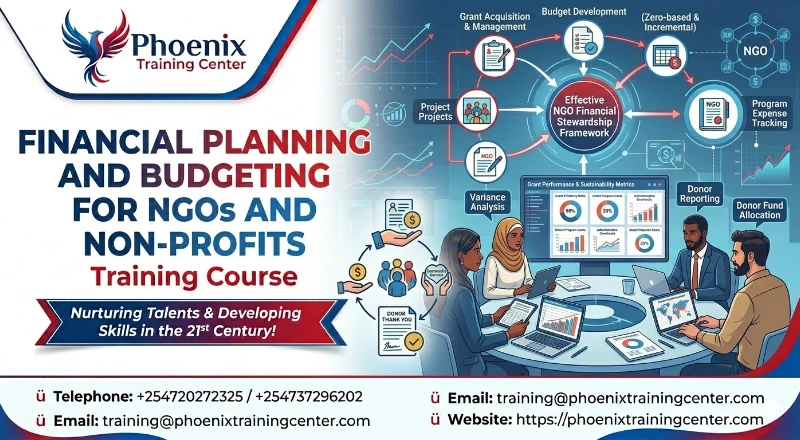
Course Overview
This specialized Financial Planning and Budgeting Training Course is crucial for Finance Managers, Program Directors, Executive Directors, and Grants Managers within Non-Governmental Organizations (NGOs) and Non-Profits. The program is designed to move beyond basic bookkeeping, focusing on strategic financial planning, effective budget development, and accurate financial management tailored to the unique regulatory and funding environments of the non-profit sector. Participants will gain the specialized expertise needed to ensure financial sustainability, maximize donor confidence, and adhere to strict compliance requirements across multiple funding streams.
The curriculum provides a practical, deep dive into strategic non-profit finance. Key topics include mastering Activity-Based Costing (ABC) for proposal development, developing flexible and restrictive Grant Budgeting models, creating comprehensive Organizational Sustainability Plans, implementing internal controls and managing risk, and mastering advanced Financial Forecasting and Reporting techniques to meet diverse donor and board needs. The course emphasizes transparency, accountability, and the strategic use of financial data for decision-making.
Upon the successful completion of this 💰 Financial Planning and Budgeting for NGOs and Non-Profits Training Course participants will be able to:
ü Develop a comprehensive annual operating budget and multi-year financial forecast aligned with the organization's strategic goals.
ü Master the principles of Activity-Based Costing (ABC) and zero-based budgeting for accurate proposal development and resource allocation.
ü Navigate the complexities of restricted vs. unrestricted funding, including cost allocation methodologies and indirect cost recovery.
ü Design robust internal control systems and risk management frameworks to ensure financial compliance and integrity.
ü Prepare clear, accurate, and audience-specific financial reports for donors, boards, and internal stakeholders.
ü Develop actionable financial sustainability plans that incorporate diverse funding streams and long-term viability.
Training Methodology
The course is designed to be highly interactive, challenging and stimulating. It will be an instructor led training and will be delivered using a blended learning approach comprising of:
ü Instructor-led case studies of common NGO financial management challenges
ü Hands-on workshops developing Activity-Based Costing (ABC) models
ü Group exercises constructing multi-donor, multi-year project budgets
ü Review and critique of actual financial reports and audit findings
ü Utilization of financial modeling and spreadsheet tools for forecasting
ü Practical session implementation and facilitated peer review of a sustainability plan
Our facilitators are seasoned industry professionals with years of expertise in their chosen fields. All facilitation and course materials will be offered in English.
Who Should Attend?
This 💰 Financial Planning and Budgeting for NGOs and Non-Profits Training Course would be suitable for, but not limited to:
ü NGO and Non-Profit Finance Managers and Officers
ü Program Directors and Senior Managers overseeing budgets
ü Grants and Contracts Managers
ü Executive Directors and Chief Operating Officers (COOs)
ü Monitoring, Evaluation, and Learning (MEAL) Specialists
ü Internal Auditors and Compliance Officers
Personal Benefits
ü Achieve expert competence in strategic non-profit financial management and budgeting.
ü Gain confidence in navigating complex donor requirements and audit processes.
ü Acquisition of practical tools for accurate cost allocation and indirect cost recovery.
ü Enhanced ability to communicate financial health and strategic needs to executive leadership and boards.
ü Increased career opportunities in high-level finance and leadership roles within the non-profit sector.
Organizational Benefits
ü Improved accuracy and transparency in financial reporting and management, increasing donor trust.
ü Maximized recovery of eligible indirect costs through effective cost allocation plans.
ü Reduced risk of fraud, mismanagement, and non-compliance with donor regulations.
ü Enhanced organizational efficiency through disciplined activity-based costing and budgeting.
ü Strengthened long-term financial stability and sustainability through proactive planning.
ü Course Duration: 5 Days
ü Training Fee
o Physical Training: USD 1,400
o Online / Virtual Training: USD 1,000
Module 1: Non-Profit Financial Stewardship and Regulatory Environment
ü Principles of Non-Profit Accountability and Financial Ethics
ü Key Accounting Standards for NGOs (e.g., IFRS/GAAP)
ü Governance Roles of the Finance Committee and Board
ü Legal and Tax Compliance for Non-Profits (e.g., registration status)
ü Practical Session: Analyzing a Non-Profit's Financial Governance Structure
Module 2: Strategic Financial Planning and Annual Operating Budget Development
ü Linking Financial Planning to Organizational Strategy and Theory of Change
ü Developing the Annual Operating Budget (Expense and Revenue)
ü Techniques for Budget Monitoring and Mid-Year Reviews
ü Variance Analysis and Budget Revisions Procedures
ü Practical Session: Developing the High-Level Structure of an Annual Operating Budget
Module 3: Activity-Based Costing (ABC) and Zero-Based Budgeting for Proposals
ü Principles of Activity-Based Costing (ABC) in Project Budgets
ü Utilizing Zero-Based Budgeting for Efficiency and Justification
ü Differentiating between Direct, Indirect, and Shared Costs
ü Cost Effectiveness Analysis in Program Design
ü Practical Session: Creating an ABC Model for a Programmatic Activity
Module 4: Grant Budgeting, Restricted Funds, and Cost Allocation
ü Managing the Difference between Restricted and Unrestricted Funds
ü Structuring Multi-Donor and Multi-Currency Grant Budgets
ü Developing a Simple and Fair Cost Allocation Methodology
ü Allocating Personnel Time and Shared Resources
ü Practical Session: Structuring a Complex Grant Budget with Multiple Donors
Module 5: Indirect Cost Recovery and Negotiating with Donors
ü Understanding the Indirect Cost Rate and Cost Recovery Rationale
ü Negotiating F&A (Facilities and Administration) Rates with Key Donors
ü Strategies for Maximizing Indirect Cost Recovery on Proposals
ü Documenting and Justifying Indirect Costs for Audit
ü Practical Session: Developing a Strategy for Indirect Cost Rate Negotiation
Module 6: Internal Controls, Segregation of Duties, and Fraud Risk Management
ü Designing and Implementing Robust Internal Controls Systems
ü Principles of Segregation of Duties (SOD) in Financial Processes
ü Identifying and Mitigating Common Fraud and Corruption Risks
ü Whistleblower Policies and Internal Reporting Mechanisms
ü Practical Session: Designing Segregation of Duties for a Field Office Procurement Process
Module 7: Advanced Financial Reporting and Variance Analysis
ü Preparing the Statement of Financial Position (Balance Sheet) and Activities (P&L)
ü Donor-Specific Financial Reporting Requirements and Formats
ü Conducting In-Depth Variance Analysis and Explanations
ü Presenting Financial Data Clearly to Non-Finance Audiences (Dashboards)
ü Practical Session: Analyzing and Explaining Significant Budget Variances
Module 8: Cash Flow Management and Treasury Functions
ü Developing Accurate Cash Flow Forecasts
ü Managing Foreign Exchange (FX) Risk and Currency Fluctuations
ü Optimizing Working Capital and Liquidity
ü Banking Relations and Best Practices in Treasury Management
ü Practical Session: Developing a 12-Month Cash Flow Forecast
Module 9: Financial Forecasting, Scenario Planning, and Audit Readiness
ü Developing Multi-Year Financial Forecasts (3-5 Years)
ü Scenario Planning for Revenue Shortfalls or Program Expansion
ü Preparing Documentation and Staff for External Audits
ü Responding to Audit Findings and Implementing Remedial Actions
ü Practical Session: Developing a 'Worst-Case' Financial Scenario Plan
Module 10: Long-Term Financial Sustainability and Funding Diversification
ü Assessing the Organization’s Current Financial Sustainability Profile
ü Strategies for Funding Diversification (Earned Income, Reserves, Endowment)
ü Developing a Reserves Policy and Investment Strategy
ü Financial Metrics for Long-Term Viability and Health
ü Practical Session: Drafting Key Components of a Financial Sustainability Plan
About Our Trainers
Our trainers are Certified Public Accountants (CPAs) or Chartered Global Management Accountants (CGMAs) who have served as CFOs or Senior Finance Directors for large international NGOs. They possess over 15 years of direct experience managing multi-million-dollar donor portfolios (e.g., USAID, FCDO, UN), implementing complex Activity-Based Costing (ABC) systems, and successfully navigating rigorous external audits, ensuring the training is financially rigorous and sector-specific.
Quality Statement
Phoenix Training Center is committed to delivering a premier Financial Planning and Budgeting for NGOs and Non-Profits Training Course. Our curriculum is aligned with global accounting standards and best practices for non-profit financial governance. We guarantee a strategic, practical, and compliance-focused learning experience essential for the financial health and accountability of aid organizations.
Tailor-Made Courses
This Financial Planning and Budgeting Training Course can be fully customized to focus on specific donor financial compliance requirements (e.g., 2 CFR 200/Uniform Guidance, specific foundation rules), specialized software systems your organization uses (e.g., QuickBooks, NetSuite), or deep dives into specific programmatic cost structures. We offer bespoke in-house training programs designed after a detailed needs assessment. For further inquiries, please contact us on Tel: +254720272325 / +254737296202 or Email training@phoenixtrainingcenter.com
ü Participants should be reasonably proficient in English.
ü Applicants must live up to Phoenix Center for Policy, Research and Training admission criteria.
Terms and Conditions
ü Discounts: Organizations sponsoring Four Participants will have the 5th attend Free
ü What is catered for by the Course Fees: Fees cater for all requirements for the training – Learning materials, Lunches, Teas, Snacks and Certification. All participants will additionally cater for their travel and accommodation expenses, visa application, insurance, and other personal expenses.
ü Certificate Awarded: Participants are awarded Certificates of Participation at the end of the training.
ü The program content shown here is for guidance purposes only. Our continuous course improvement process may lead to changes in topics and course structure.
ü Approval of Course: Our Programs are NITA Approved. Participating organizations can therefore claim reimbursement on fees paid in accordance with NITA Rules.
Booking for Training
Simply send an email to the Training Officer on training@phoenixtrainingcenter.com and we will send you a registration form. We advise you to book early to avoid missing a seat to this training. Or call us on +254720272325 / +254737296202
Payment Options
We provide 3 payment options, choose one for your convenience, and kindly make payments at least 5 days before the Training start date to reserve your seat:
ü Groups of 5 People and Above – Cheque Payments to: Phoenix Center for Policy, Research and Training Limited should be paid in advance, 5 days to the training.
ü Invoice: We can send a bill directly to you or your company.
ü Deposit directly into Bank Account (Account details provided upon request)
Cancellation Policy
ü Payment for all courses includes a registration fee, which is non-refundable, and equals 15% of the total sum of the course fee.
ü Participants may cancel attendance 14 days or more prior to the training commencement date.
ü No refunds will be made 14 days or less before the training commencement date. However, participants who are unable to attend may opt to attend a similar training course at a later date or send a substitute participant provided the participation criteria have been met.
Accommodation and Airport Transfer
For physical training attendees, we can assist with recommendations for accommodation near the training venue. Airport pick-up services can also be arranged upon request to ensure a smooth arrival. Please inform us of your travel details in advance if you require these services. For reservations contact the Training Officer on Email: training@phoenixtrainingcenter.com or on Tel: +254720272325 / +254737296202
| Course Dates | Venue | Fees | Enroll |
|---|

Phoenix Training Center
Typically replies in minutes